
Menu
Get Expert Legal Support Today

TL;DR:
- Civil dispute resolution includes court procedures and alternative methods like mediation and arbitration. Mediation offers confidentiality and speed, while litigation provides binding, enforceable decisions when necessary. Early preparation and understanding your options can significantly improve your chances of a favorable outcome.
Civil dispute resolution is the use of legal and alternative procedures to settle personal or commercial disagreements without necessarily going to trial. In England and Wales, the Civil Procedure Rules 1998 (CPR) govern formal court proceedings, while alternative dispute resolution (ADR) frameworks offer faster, less costly routes. The two systems are not rivals. They work alongside each other, and understanding both gives you real choices when a dispute arises. Whether you face a contract disagreement, a property conflict, or a personal injury claim, knowing which route fits your situation is the first decision that shapes everything else.
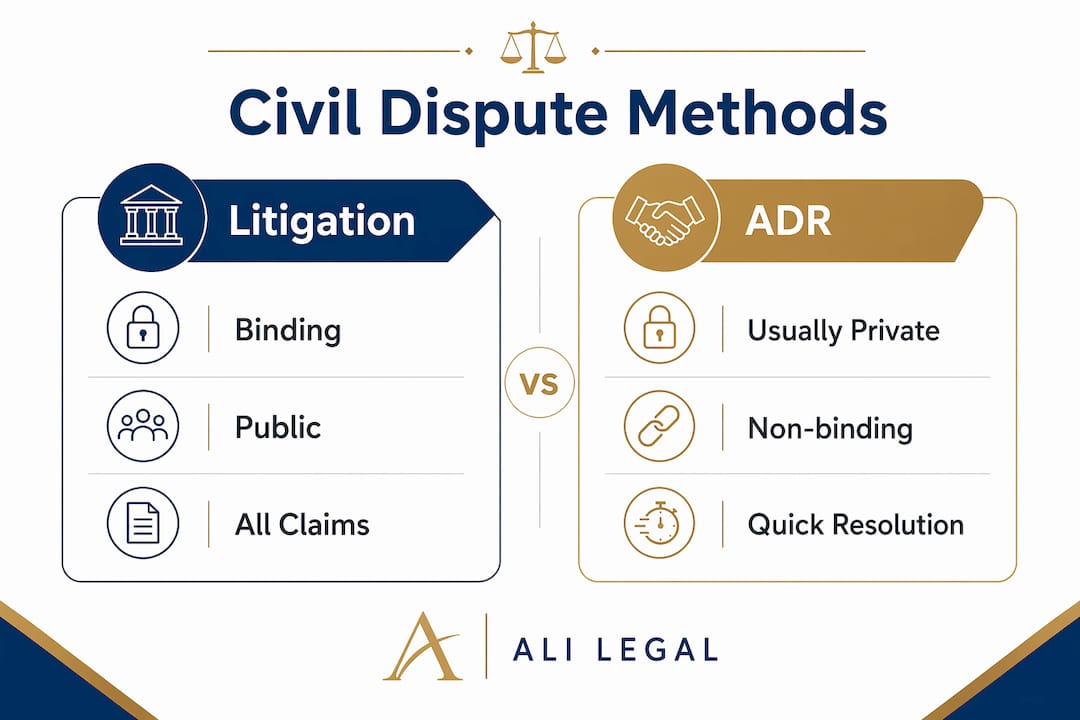
Dispute resolution methods fall into two broad categories: litigation through the courts, and ADR outside them. Each serves a different purpose, and neither is universally superior.
Litigation is the formal court process governed by the CPR. You issue a claim, serve the defendant, exchange statements of case, and proceed through disclosure, evidence, and trial. Courts can impose binding decisions on unwilling parties. That is their defining advantage over ADR.
Alternative dispute resolution covers several distinct processes:
The Digital Markets, Competition and Consumers Act 2024 formally defines ADR as any non-court method including mediation, arbitration, expert determination, adjudication, ombudsman schemes, and early neutral evaluation. That legislative clarity matters because it shapes which processes qualify for government-backed ADR schemes.
| Method | Binding on parties? | Private? | Typical use |
|---|---|---|---|
| Litigation | Yes | No | All civil claims |
| Mediation | Only if settled | Yes | Most civil disputes |
| Arbitration | Yes | Yes | Commercial, construction |
| Expert determination | Yes | Yes | Technical valuations |
| Ombudsman | On business only | Partly | Consumer complaints |
Pro Tip: If you want confidentiality and speed, mediation is usually the first route to consider. If you need a binding decision and the other party refuses to cooperate, litigation or arbitration are your realistic options.
The CPR sets out every procedural step from the moment a claim is issued to the delivery of a judgment. Civil proceedings in England and Wales follow these rules without exception. Understanding the stages removes much of the uncertainty that makes litigation feel daunting.
The three main tracks are the small claims track (claims up to £10,000), the fast track (£10,000 to £25,000), and the multi-track (above £25,000 or complex cases). The Supreme Court sits as the final court of appeal for the most significant legal questions.
| Track | Claim value | Typical timeline | Cost recovery |
|---|---|---|---|
| Small claims | Up to £10,000 | Months | Limited |
| Fast track | £10,000–£25,000 | 6–12 months | Standard |
| Multi-track | Above £25,000 | 12–36 months | Full (discretionary) |

Pre-action protocols require both parties to exchange information and attempt resolution before issuing proceedings. Courts take compliance seriously. Ignoring a protocol can result in cost penalties even if you win your case.
ADR is not simply a cheaper version of litigation. It is a fundamentally different approach to resolving conflict, with its own strengths and limits.
Advantages of ADR:
Limitations of ADR:
The UK government promotes integrated ADR as a faster, cost-effective alternative to litigation, particularly for consumer and business disputes. The legal system increasingly encourages ADR before and during proceedings. Refusing ADR without good reason can attract cost sanctions from the court.
Pro Tip: Even if you intend to litigate, attending a mediation session costs relatively little and can produce a settlement that saves months of proceedings. Courts expect you to have tried it.
The outcome of a civil dispute is often shaped long before any hearing takes place. Early preparation is the single most important factor in your bargaining position.
Preserve all relevant documents immediately. Emails, contracts, invoices, photographs, and text messages all constitute evidence. Pre-action document preservation directly affects your negotiating leverage and the reliability of your evidence at trial. Do not delete anything, even if it appears unhelpful.
Review any pre-action protocol that applies to your dispute. Protocols exist for personal injury, professional negligence, construction, and many other claim types. Following the correct protocol demonstrates good faith and avoids cost penalties.
Communicate clearly and in writing with the other party. A well-drafted letter before action sets out your claim, the evidence you rely on, and a reasonable deadline for response. Courts expect this step. It also creates a paper trail that supports your position.
Choose the right resolution method for your specific situation. A boundary dispute with a neighbour calls for a different approach than a £200,000 contract claim against a supplier. Consider the value of the claim, the relationship with the other party, the need for confidentiality, and whether you need a binding decision. Guidance on how to resolve contract disputes can help you match the method to the facts.
Obtain specialist legal advice early. A solicitor can assess the strength of your claim, advise on the most appropriate resolution route, and identify risks you may not have considered. Early advice is almost always cheaper than late advice.
Understand the costs and time frames before committing. Litigation is expensive. Even a successful claimant rarely recovers all their legal costs. Factor in the realistic cost of proceedings against the value of what you are claiming. For cross-border disputes, international legal consultancy adds another layer of complexity that specialist advice can help manage.
Consider expert evidence where the dispute involves technical matters. Valuations, medical causation, and construction defects all benefit from independent expert opinion. Courts give significant weight to properly instructed experts who comply with CPR requirements.
After working with clients across a wide range of civil disputes, the pattern I see most often is this: people wait too long before taking the situation seriously. They hope the other side will back down, or they assume the strength of their position speaks for itself. It rarely does.
The disputes that resolve most efficiently share one characteristic. Both parties have a clear-eyed understanding of their own weaknesses, not just their strengths. Mediation works best when each side has already stress-tested its case with a solicitor. Walking into a mediation session without that preparation is like negotiating a contract without reading it first.
I also think the legal system’s push towards ADR is genuinely good for most individuals. Litigation is slow, expensive, and emotionally draining. A mediated settlement that gives you 80% of what you wanted in three months is almost always better than a court judgment for 100% in three years. The exception is when you need a public ruling or the other party is acting in bad faith. In those cases, the court is the right place to be, and you should commit to it fully.
The most common mistake I see is treating ADR and litigation as mutually exclusive. They are not. You can attempt mediation, fail to settle, and then proceed to court with your position strengthened by the process. The civil litigation steps do not disappear because you tried mediation first. They simply begin from a more informed starting point.
— Panagiotis
Facing a civil dispute without specialist support puts you at a real disadvantage. Alilegal’s team handles the full range of civil litigation and dispute resolution matters, from early pre-action advice through to trial, covering contract disputes, property conflicts, personal injury claims, and more.

Alilegal offers fixed fees and straightforward advice so you know exactly where you stand from the first conversation. Whether you need help choosing between mediation and litigation, preparing your evidence, or representing you in court, the team brings the same clarity and commitment to every case. You can learn more about Alilegal’s civil litigation services or contact the team directly for a case evaluation tailored to your situation.
Civil dispute resolution is the process of settling legal disagreements between individuals or organisations using court proceedings or alternative methods such as mediation and arbitration. In England and Wales, the Civil Procedure Rules 1998 govern formal litigation, while ADR frameworks operate alongside the court system.
Mediation itself is not binding, but any settlement agreement reached through mediation is enforceable as a contract. If one party later refuses to honour the agreement, the other can apply to court to enforce it.
Choose litigation when the other party refuses to engage in ADR, when you need a public judgment, or when the dispute involves a legal point that requires a definitive court ruling. Courts remain the only forum for binding decisions without the other party’s consent.
The small claims track handles civil claims up to £10,000. It is designed to be accessible without legal representation, with limited cost recovery and a simplified procedure compared to the fast track or multi-track.
Preserving documents and evidence before formal proceedings begin directly strengthens your negotiating position and the reliability of your case at trial. Courts also expect compliance with pre-action protocols, and failure to follow them can result in cost penalties regardless of the outcome.


