
Menu
Get Expert Legal Support Today

TL;DR:
- Legal aid services provide free or low-cost legal assistance mainly for civil disputes, including housing, family law, and benefits. Eligibility depends on income, assets, case type, and geographic location, with many applicants facing capacity limits. Since many people are left unserved, exploring multiple providers, legal clinics, and pro bono networks increases chances of receiving help.
Legal aid services are defined as free or low-cost legal assistance provided to individuals who cannot afford private legal representation in civil matters. The term covers a broad network of non-profit organisations, government-funded programmes, and pro bono solicitors working to close the gap between legal need and legal access. In the United Kingdom and the United States, bodies such as the Legal Aid Agency and the Legal Services Corporation coordinate much of this provision. Understanding what legal aid services are, who qualifies, and how to access them is the first step to protecting your rights without facing prohibitive legal costs.
Legal aid services are a structured system of free or subsidised legal support for civil disputes, not a single organisation or programme. The distinction matters. Criminal legal aid is a constitutional right in the United States, with public defenders assigned automatically. Civil legal aid carries no such guarantee. It is delivered through a patchwork of providers, each with its own funding, mandate, and geographic reach.

The scope of legal aid provision varies by provider, but most programmes address civil matters where the consequences of losing are severe. Housing, family law, welfare benefits, debt, and immigration are the most common categories. Criminal defence, personal injury claims on a contingency basis, and most commercial disputes fall outside the typical legal aid mandate.
Understanding this boundary prevents wasted time. If you face a civil legal problem and cannot afford a solicitor, legal aid services are your primary route to representation or advice.
Legal aid services cover a defined range of civil legal problems. The following categories represent the most commonly accepted case types:
Legal aid organisations often have narrow mandates and limit cases by geography, case type, and funding restrictions. That means a provider in one city may accept housing cases but not immigration cases, while a provider in the next town operates the reverse. Checking the specific mandate of your local provider before applying saves significant time.
Personal injury claims are largely excluded because solicitors can take these on a no-win, no-fee basis. Commercial disputes between businesses are almost always outside scope. Knowing what legal aid does not cover is as useful as knowing what it does.
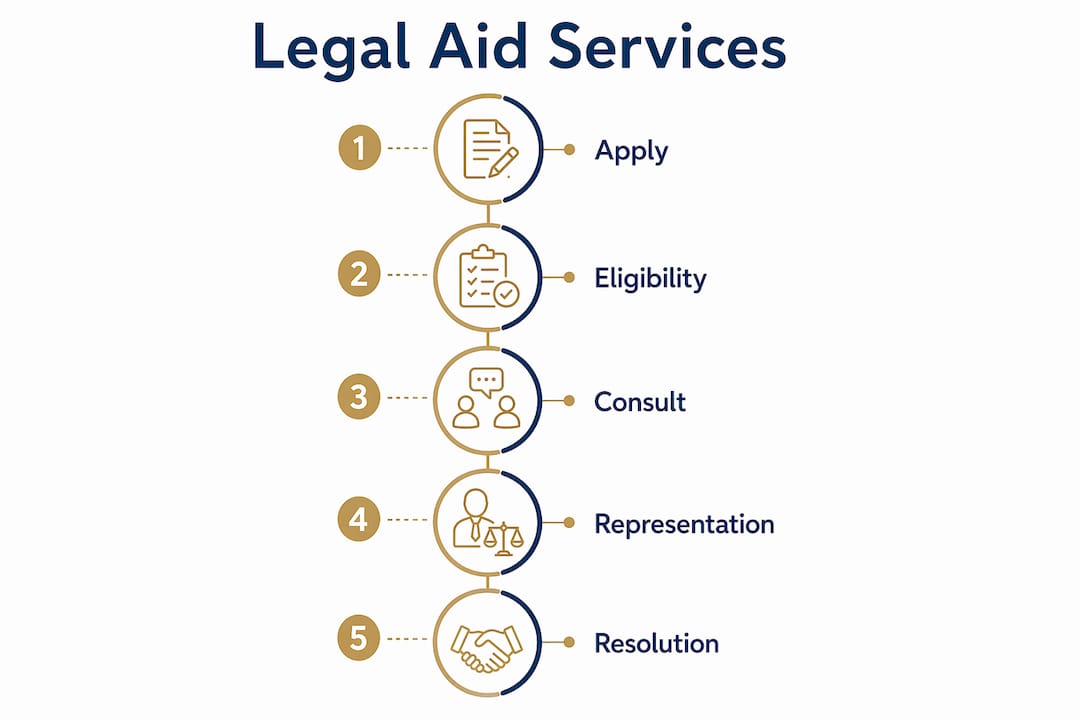
Eligibility for legal aid rests on two tests: a means test and a merits test. Both must be satisfied before a provider will accept your case.
Each organisation has strict case eligibility and geographic service boundaries. This is not a reflection of your situation’s severity. It is a funding constraint. Over 50% of eligible applicants may be turned away due to capacity limits alone.
Pro Tip: Prepare a one-paragraph summary of your legal problem before you call. Include the type of dispute, any court dates, and the outcome you need. Providers make faster decisions when the issue is clear from the first contact.
Legal aid services do not all work the same way. The level of support you receive depends on the provider’s capacity and the complexity of your case. The table below outlines the main service models.
| Service model | What it includes | Best suited for |
|---|---|---|
| Legal advice and information | One-off consultation, explanation of rights | Early-stage disputes, benefit appeals |
| Brief services | Document review, letter drafting, court form help | Straightforward housing or debt matters |
| Limited-scope representation | Solicitor handles specific tasks; client manages the rest | Cases where full representation is unavailable |
| Full representation | Solicitor manages the entire case from start to finish | Serious family law or housing possession cases |
| Legal clinic | Drop-in or appointment-based group advice sessions | First-time enquiries, general guidance |
Limited-scope representation involves legal aid providers handling specific tasks while the client manages the remainder of the case. This model is common because it allows providers to assist more people within tight budgets. You might receive help drafting a defence but attend the hearing yourself.
Pro bono networks such as LawWorks in England and Wales connect volunteer solicitors with individuals who do not qualify for funded legal aid but still cannot afford private fees. These networks fill a critical gap, particularly for those whose income sits just above the eligibility threshold.
An estimated 92% of low-income Americans’ civil legal needs remain unmet annually. That figure reflects the scale of the gap between demand and capacity. It also explains why providers triage cases by urgency and severity rather than first-come, first-served.
Pro Tip: If you are offered limited-scope representation, accept it. Partial legal help is far better than none, and a solicitor drafting your key documents significantly improves your position in court.
Applying for legal aid requires preparation. Providers make decisions quickly, and a well-prepared applicant stands a better chance of acceptance.
Rejection from one provider does not mean rejection from all. Providers have different mandates, and a case outside one organisation’s scope may fall squarely within another’s.
The biggest misconception I encounter is that legal aid is simply charity. It is not. Legal aid is a pillar of the rule of law, and its funding shortfalls force providers to triage cases by severity rather than by need alone. That reality is uncomfortable, but understanding it changes how you approach the application.
People often arrive at intake expecting the same service they would receive from a private solicitor. The reality is frequently a brief consultation or limited document help. That is not a failure of the system. It is the system working within its constraints. Adjusting your expectations before you apply means you use what is offered more effectively.
The distinction between criminal and civil legal representation is the other area where people consistently go wrong. If you are facing criminal charges, a public defender is your right. If you are facing eviction, a custody dispute, or a benefits appeal, you are in civil territory, and the right to free representation does not automatically follow. Knowing which side of that line you stand on shapes every decision you make next.
My strongest advice is persistence. Apply to multiple providers. Attend legal clinics. Contact pro bono networks. The gap between legal need and legal provision is real, but it is not absolute. Preparation and clear communication remain the two factors most within your control.
— Panagiotis
Legal aid services cover a vital range of civil matters, but capacity limits mean many people are left without representation at critical moments. For disputes involving significant financial stakes, complex litigation, or commercial dimensions, professional legal support becomes necessary.

Alilegal provides civil litigation services for individuals and businesses facing disputes where the outcome genuinely matters. The firm operates on fixed fees with clear communication at every stage, so you know exactly what you are paying for and why. For those navigating complex family matters, Alilegal’s family and divorce practice offers direct, experienced support. If legal aid has been declined or is insufficient for your situation, speaking with a solicitor at Alilegal is a practical next step.
Most legal aid programmes set eligibility at 125% of the Federal Poverty Guidelines, approximately $19,950 per year for a single individual in 2026. Some programmes extend this threshold to 200% for specific case types such as domestic violence matters.
Legal aid is free at the point of use for those who qualify financially. Providers funded by government programmes such as the Legal Services Corporation or the Legal Aid Agency charge no fees to eligible clients.
Criminal defence is handled separately through public defenders, who are assigned as a constitutional right in the United States. Civil legal aid, which covers housing, family law, and benefits disputes, is not guaranteed and depends on provider capacity and eligibility.
Legal aid intake involves a screening interview covering income, assets, and case details, with decisions typically taking days to weeks depending on caseload. Cases with imminent court dates are often prioritised.
Rejection from one provider does not close all options. Ask for a referral to another local organisation, attend a legal clinic, or contact a pro bono network such as LawWorks. You can also explore community legal aid resources for accident victims and other specific circumstances.


