
Menu
Get Expert Legal Support Today

TL;DR:
- Many companies underestimate their litigation exposure despite rising dispute risks worldwide.
- Strategic management of corporate litigation involves understanding processes, choosing appropriate mechanisms, and integrating legal risk into business planning.
Most business leaders think of litigation as something that happens to other companies. The numbers suggest otherwise. Nearly a quarter of organisations faced class action litigation in the prior twelve months alone, and more than half of corporate counsel expect litigation volumes to increase further due to geopolitical instability, regulatory pressure, and economic uncertainty. Understanding what is corporate litigation, how it works, and what it means for your business is no longer a matter of legal curiosity. It is a strategic necessity.
Corporate litigation refers to formal legal disputes that involve a company as either a claimant or a defendant. Those disputes may arise internally, between shareholders, directors, or officers, or externally, with counterparties, regulators, employees, or third parties. What unifies them is that the corporation itself is a party to the proceedings.
A common source of confusion is the difference between corporate litigation and commercial litigation. Commercial litigation typically describes disputes arising from contracts and business transactions between parties, such as a supplier suing a customer for unpaid invoices or a contractor disputing the terms of a service agreement. Corporate litigation, by contrast, tends to concern the governance, structure, or operation of the company itself.
Examples that fall squarely within corporate litigation include:
Both categories sit under the broader umbrella of civil litigation, which encompasses all non-criminal dispute proceedings. Understanding where corporate legal issues fit within that wider framework helps business leaders make better decisions when disputes arise.
The types of corporate litigation your business encounters will depend on your sector, size, and exposure to evolving regulatory regimes. That said, certain categories appear with striking consistency across industries.
| Type of dispute | Common triggers | Business impact |
|---|---|---|
| Employment and labour | Wrongful dismissal, discrimination, whistleblowing | Reputational damage, operational disruption |
| Cybersecurity and data privacy | Data breaches, GDPR non-compliance | Regulatory fines, class actions |
| Banking and finance | Loan disputes, mis-selling, covenant breaches | Liquidity risk, credit relationships |
| Antitrust and competition | Price-fixing allegations, market abuse | Criminal and civil exposure |
| ESG-related claims | Greenwashing, supply chain failures | Investor and regulatory scrutiny |
Banking and finance disputes doubled in 2024, with one in five respondents reporting proceedings in that area. Employment and cybersecurity claims remain the most prevalent categories year on year, driven by technology integration, remote working, and the expanding reach of data protection law.
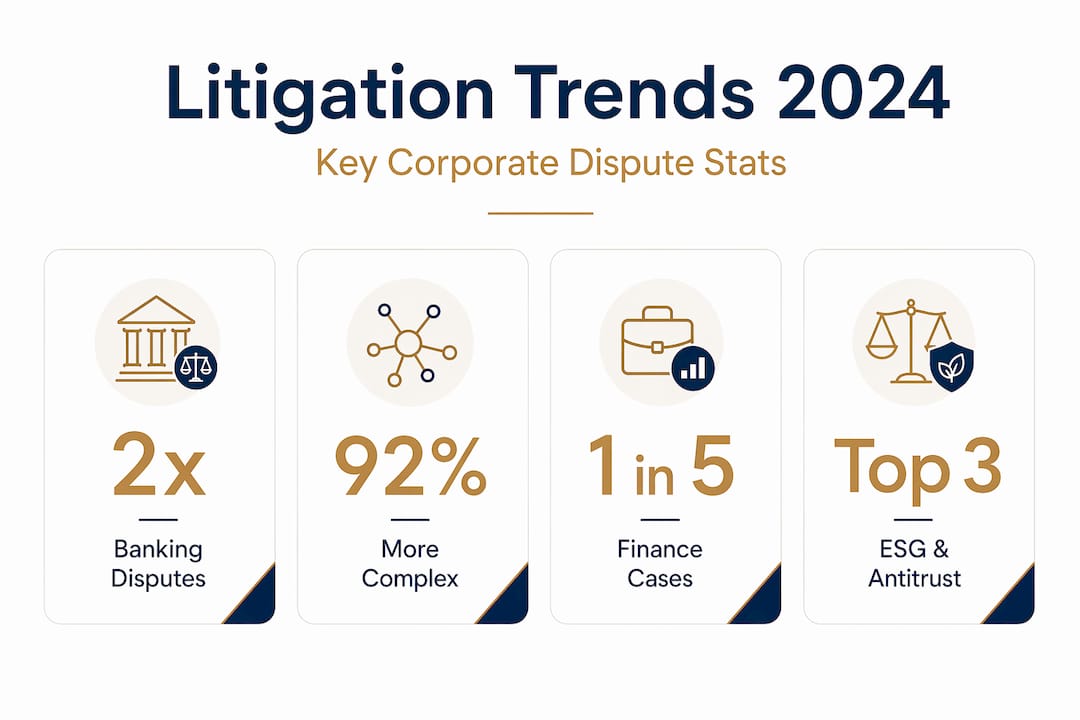
ESG and antitrust claims are now firmly among the top litigation concerns for sectors including healthcare, financial services, and manufacturing. Regulatory expectations in these areas continue to shift, and companies that have not stress-tested their compliance frameworks are at meaningful risk.

The broader picture is not encouraging for those hoping disputes will become easier to resolve. 92% of companies say that settling before court is important, yet 82% report it is becoming harder, citing higher settlement demands, rising legal costs, and more aggressive plaintiff behaviour.
Pro Tip: Keep a litigation register that tracks not just active claims but near-miss incidents, regulatory enquiries, and employee grievances. Identifying patterns early gives your legal team time to act before a dispute crystallises.
Understanding how corporate litigation works removes much of the uncertainty that makes disputes so disruptive. The process has recognisable stages, even if the specifics vary by jurisdiction, contract terms, and the nature of the claim.
Clarity in dispute resolution clauses is one of the most frequently underestimated factors in managing this process. English courts have repeatedly found that ambiguous clauses lead to expensive satellite litigation about jurisdiction and procedure before the substantive dispute is even heard. A poorly drafted clause can cost more to untangle than the original dispute.
Pro Tip: Review dispute resolution clauses in all material contracts at least annually. Check that they specify the governing law, the chosen forum, the number of arbitrators or judges, and any mandatory pre-action steps. Vagueness here is a liability.
The most sophisticated companies no longer treat corporate dispute resolution as a binary choice between going to court or settling. They use an integrated system of mechanisms, selecting the right tool for each dispute and often combining several within a single strategy.
Courts, arbitration, and mediation increasingly function as a coordinated ecosystem rather than competing alternatives. The risks of treating them in isolation are real: parallel proceedings, conflicting interim orders, and enforcement gaps can all arise when companies allow disputes to drift between forums without a clear strategy.
The key mechanisms available to you are:
The integration of these mechanisms into a coherent dispute strategy is what separates reactive companies from those that manage legal risk as a business function.
Corporate legal issues do not stay in the legal department. They affect cash flow, leadership bandwidth, investor confidence, and operational focus. Treating litigation as a problem to hand off to outside counsel and ignore until trial is a strategy that consistently produces poor outcomes.
The most important shift in thinking is this: litigation is increasingly a financial and strategic asset, not merely a cost. A well-founded claim against a counterparty that has caused you significant loss has genuine economic value. So does a robust defence strategy that discourages speculative claims. Approaching disputes with this mindset changes the decisions you make from the outset.
Practical steps that directly reduce your exposure include:
Pro Tip: When engaging outside counsel, agree on regular litigation budget reviews and ask them to distinguish between costs that are legally necessary and costs that are tactical. You will often find that the most expensive steps are not always the most strategically valuable.
I have seen a clear shift in how the most effective business leaders think about litigation. Ten years ago, the instinct was to contain it: keep it away from the board, settle quickly, move on. That instinct is understandable, but it has become expensive.
The companies I see managing litigation well in 2026 treat it as they would any other significant business risk. They quantify it, they resource it appropriately, and they make deliberate decisions about how to deploy their legal assets. They use legal finance not because they cannot afford litigation, but because it makes capital sense. They draft dispute resolution clauses with the same care they give to payment terms.
What strikes me most is how many disputes escalate unnecessarily because nobody reviewed the resolution clause in the original contract. A clause that specifies the wrong forum, or that fails to address what happens when related contracts have conflicting terms, can generate years of satellite litigation. The fix costs almost nothing at contract stage.
My honest view is that the legal department cannot solve this alone. Litigation strategy needs to sit at the intersection of legal, finance, and operations. The businesses that will manage disputes most effectively are those that build that conversation now, before the next claim arrives.
— Panagiotis
Corporate disputes rarely arrive with advance notice, and the decisions made in the first days frequently determine the outcome months later. Ali Legal works with business clients to provide strategy-led legal support from the earliest signs of a dispute through to resolution, whether that means negotiation, arbitration, or full court proceedings.

Our commercial litigation services are built for high-stakes disputes where getting the strategy right from the start matters. We advise on dispute resolution clause drafting, jurisdictional choices, arbitration proceedings, and the use of legal finance to protect your liquidity while pursuing or defending claims. If you are dealing with a dispute now, or want to review your exposure before one arises, speak with a solicitor at Ali Legal. Transparent advice, clear fees, and direct access to experienced practitioners are what we offer from the first conversation. Contact us to arrange a consultation.
Corporate litigation refers to formal legal proceedings in which a company is a party, either as claimant or defendant. It covers disputes involving shareholders, directors, mergers, regulatory enforcement, and other matters relating to the governance or operation of a business.
Employment and labour disputes, cybersecurity and data privacy claims, banking and finance disagreements, and antitrust matters are among the most frequent. Banking and finance disputes doubled in 2024, and ESG-related claims are a growing category.
Timelines vary significantly depending on the complexity of the dispute, the forum chosen, and whether parties settle early. Expedited arbitration under the 2026 ICC rules aims to deliver a final award within six months for eligible disputes, making it one of the faster options available.
Legal finance involves a third party funding the costs of litigation or arbitration in exchange for a share of any recovery. It allows companies to pursue or defend claims without using operating capital, and is now used by large companies as a tool for capital optimisation rather than a last resort.
Conduct regular legal risk audits, draft clear and specific dispute resolution clauses in all material contracts, and integrate litigation risk into board reporting. Ambiguous dispute resolution clauses are among the most common and avoidable causes of escalating litigation costs.


