
Menu
Get Expert Legal Support Today

TL;DR:
- Proper vessel registration is vital for legal operation, ownership verification, and insurance validity on public waterways.
- Understanding the appropriate registration regime—state, federal, or flag state—is essential before applying to avoid costly errors.
Many boat owners treat registration as a simple box-ticking exercise, something to sort once and forget. That assumption can be costly. Registration is not just paperwork; it determines your vessel’s legal identity, your right to operate on public waterways, and your standing when things go wrong. Get it wrong, and you risk fines, impounded vessels, or an insurance company refusing a claim at the worst possible moment. This guide cuts through the confusion, explains what vessel registration actually means, and sets out exactly what you need to do to stay on the right side of the law.
| Point | Details |
|---|---|
| Registration defines legality | Official vessel registration is essential for lawful operation and identification. |
| Different regimes exist | State, national, and flag State registrations each have specific rules and legal impacts. |
| Compliance avoids risks | Accurate registration and proper display of proof prevent penalties and protect ownership. |
| Documentation renews regularly | Most vessel registrations require timely renewal to stay valid and avoid fines. |
| Professional help simplifies process | Legal experts can guide you through complex registration and compliance challenges efficiently. |
At its core, vessel registration is the act of officially recording a vessel with an authority so it can be legally operated and identified. Think of it as the equivalent of registering a car with the DVLA. Without it, your vessel has no recognised legal identity on public water.
Most powered vessels and larger boats must be registered. The exact threshold varies by jurisdiction, but in most countries any motorised boat operating on public waterways needs to be on record with the relevant authority. Registration results in the issuance of a unique identification number and, in many cases, decals or markings that must be displayed on the hull.
“Vessel registration is the act of officially recording a vessel with an authority so it can be legally operated and identified.”
Registration serves several practical and legal functions at once. It enables law enforcement and coastguard services to identify any vessel quickly. It also confirms ownership, which matters enormously if your boat is stolen, involved in a collision, or becomes the subject of a legal dispute. Understanding navigating maritime law from the outset helps owners appreciate why registration is foundational, not optional.
Key reasons why registration matters:
Neglecting or misunderstanding registration is not a minor oversight. It exposes you to enforcement action, civil liability, and the very real possibility that your insurer will walk away from a claim. You can learn more about vessel documentation basics to build a solid foundation before you start the process.
One of the most common sources of confusion for boat owners is that there is not one single registration system. Different regimes apply depending on vessel type, size, and how and where the boat is used. Understanding which regime governs your situation is the first and most critical step.
State or local registration covers most leisure boats and smaller craft operating on inland or coastal waters. In the United States, for example, state-level authorities register vessels used primarily on state waters. In the UK, the relevant framework for inland waterways is overseen by the Canal & River Trust, while coastal and offshore vessels sit under different provisions. Most recreational day-boats and small motorised vessels fall into this category.
Federal or national documentation applies to larger or commercially operated vessels. In the US, the NVDC uses specific terms for registration and documentation actions based on vessel type and intended use. A vessel with a net tonnage of five or more, for instance, may qualify for or require US Coast Guard documentation rather than, or in addition to, state registration. Federally documented vessels receive a Certificate of Documentation, which carries a higher degree of legal recognition and is often preferred by lenders for marine mortgages.

Flag State registration operates at an entirely different level. For merchant ships and ocean-going craft, Flag State registration and a Certificate of Registry tie the vessel to a country’s legal authority under international maritime law. The flag the vessel flies determines which country’s laws govern it on the high seas, who has enforcement jurisdiction, and what international conventions apply. This is the regime relevant to commercial shipping operators and owners of larger yachts operating across international waters. You can read a useful registration steps comparison to see how these distinctions translate into practical steps.
| Registration type | Typical vessel | Governing authority | Key document issued |
|---|---|---|---|
| State/local | Small recreational boats | State or local authority | Registration certificate and number |
| Federal/national | Vessels 5+ net tons, commercial use | National body (e.g. NVDC, MCA) | Certificate of Documentation |
| Flag State | Merchant/ocean-going vessels | Flag State government | Certificate of Registry |
To identify which regime applies to you:
Pro Tip: If your vessel qualifies under both state and federal regimes, you may be required to hold both forms of documentation. Do not assume one automatically replaces the other. Consulting a specialist in maritime law and vessel status will prevent costly errors.
Knowing which regime governs your vessel is essential before starting the registration process. Next, let’s see what the process looks like and what documents you’ll need.
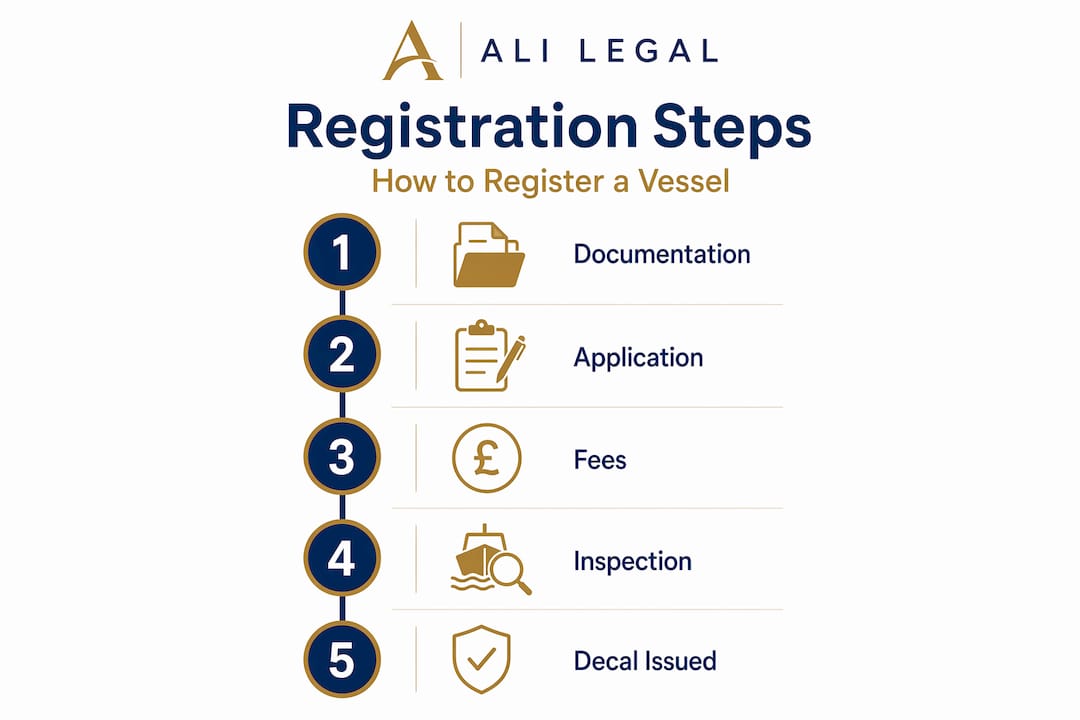
Registration is not a one-step process. It involves several distinct actions, and missing any one of them can leave you technically non-compliant even if you think you have done everything correctly. Registration involves applying, paying fees, providing ownership proof, and following display rules such as displaying decals, carrying certificates on board, and keeping registrations up to date.
Here is a typical sequence for most vessel owners:
For commercial and international vessels, the Netherlands ILT requires property registration (teboekstelling) and a Certificate of Registry for merchant ships, illustrating just how specific and layered these requirements can become.
| Requirement | Recreational vessel | Commercial vessel | Ocean-going/merchant vessel |
|---|---|---|---|
| Application form | Standard state/local form | National body form | Flag State application |
| Proof of ownership | Bill of sale/builder’s cert | Full ownership documentation | Chain of title documents |
| Fees | Modest annual/biennial fee | Higher national fees | Varies by flag state |
| Identification display | Hull number and decals | Certificate of Documentation number | IMO number and flag |
| Certificate on board | Required | Required | Required (Certificate of Registry) |
| Renewal period | 1 to 3 years | Varies | Annual survey linked |
Proper attention to marine insurance considerations alongside registration ensures that your coverage is watertight from the start. Many insurers check registration status before accepting or renewing a policy.
Pro Tip: Take dated photographs of your hull numbers and decals each time you renew. If you are ever challenged about compliance, photographic evidence can resolve the matter far faster than hunting through paperwork.
For a clearer overview of safety and compliance obligations, boating safety compliance resources provide practical checklists that complement the legal documentation process.
Even owners who believe they are fully compliant regularly fall foul of vessel registration rules. The consequences range from embarrassing to financially devastating, and most are entirely avoidable.
The most common mistakes include:
The consequences of non-compliance are serious. Fines can range from modest fixed penalties to substantial sums for repeat offences or commercial violations. Your insurer may void your policy if the vessel is unregistered or improperly registered at the time of an incident. In extreme cases, authorities have the power to impound the vessel until registration is regularised.
Pro Tip: Set a calendar reminder at least 90 days before your registration renewal date. This gives you time to gather documents, pay fees, and resolve any complications without rushing into the renewal window.
For a broader picture of your obligations, boating certification requirements cover the wider range of compliance topics that sit alongside registration. Understanding maritime law for ship owners in greater depth is particularly valuable if you operate commercially or across multiple jurisdictions.
Many owners and operators come to us treating registration as a regulatory inconvenience, something to be dealt with quickly and filed away. After working with vessel owners across recreational, commercial, and international contexts, we hold a different view entirely.
Registration is an asset protection tool. The moment your vessel is correctly registered, you have created a documented legal identity for it. That identity becomes the foundation for everything that follows: insurance claims, financing applications, ownership disputes, and resale transactions. Without it, you are operating in a legal grey area that exposes you to risks you may not even know exist until it is too late.
There is also a tendency among owners to treat registration as a one-time event rather than an ongoing process. Vessels change. Ownership changes. Operations change. Each change can have registration implications, and failing to keep pace with those changes can unravel protections you thought you had in place.
The owners we see navigating disputes most successfully are those who treat their vessel’s documentation as a living record, not a dusty file in a drawer. They update promptly, renew early, and seek advice when they are uncertain which regime applies. Deeper maritime law insights can help you understand not just what the rules require, but why they exist and how to use them to your advantage.
Vessel registration is not just about avoiding penalties. It is about building a legal foundation strong enough to protect your investment, support your claims, and give you confidence on the water.
Vessel registration affects far more than whether you can legally leave the marina. It shapes your ownership rights, determines how disputes are resolved, and underpins the validity of your marine insurance. Getting it right from the outset is significantly easier than correcting problems after the fact.

At Ali Legal, our solicitors work with boat owners, operators, and commercial vessel clients on the full range of maritime legal matters. Whether you need guidance on which registration regime applies to your vessel, help resolving a dispute that has arisen from a documentation gap, or support with a complex international registration matter, we bring clarity and practical advice to every situation. Our maritime legal services are designed to protect your interests with straightforward advice and transparent fixed fees. Contact us today to speak with a solicitor who understands maritime law from the hull up.
Anyone operating on public waterways with a powered or sizeable boat is typically required to register their vessel with the relevant authority. Unpowered craft below certain size thresholds may be exempt, but this varies by jurisdiction.
You will need proof of ownership, an application form, and payment of applicable fees. Some authorities also require a builder’s certificate for new vessels or evidence of any previous registration.
State registration covers most recreational and small boats at a local level, while federal documentation applies to vessels that qualify by size or use for national registration, often preferred for commercial operations and marine financing.
Most registrations are valid for one to three years and must be renewed before expiry. For example, Iowa renewals are required every three years, though other jurisdictions may impose shorter renewal cycles.
Failure to display required numbers and carry your certificate on board can result in fines, your insurer refusing a claim, or enforcement authorities impounding your vessel until compliance is established.


