
Menu
Get Expert Legal Support Today

Mergers and acquisitions can reshape the future of any British company, but even seasoned corporate finance managers face uncertainty when the rules seem ever more technical and demanding. With the Competition and Markets Authority strictly enforcing competition law and the Companies Act 2006 guiding transaction structure, managing regulatory compliance is crucial. This article highlights the key legal frameworks, potential pitfalls, and practical steps every British finance manager should know before pursuing an ambitious merger or acquisition.
Mergers and acquisitions (M&A) represent complex legal transactions where companies combine or transfer ownership, fundamentally reshaping business structures and competitive landscapes. In the United Kingdom, these strategic manoeuvres are carefully regulated to protect market competition and consumer interests.
The legal framework for mergers and acquisitions in the UK is primarily governed by several key regulatory bodies and legislative mechanisms:
Under UK law, a merger occurs when two separate entities combine to create a single new organisation, while an acquisition involves one company purchasing another, typically absorbing its operations and assets. The CMA investigates potential market impacts to ensure these transactions do not substantially reduce market competition.
Specifically, the CMA evaluates M&A transactions based on several critical criteria:
Businesses contemplating mergers or acquisitions must navigate a complex regulatory environment that prioritises maintaining fair market conditions. The legal scrutiny ensures that corporate restructuring does not compromise consumer welfare or create monopolistic market conditions.
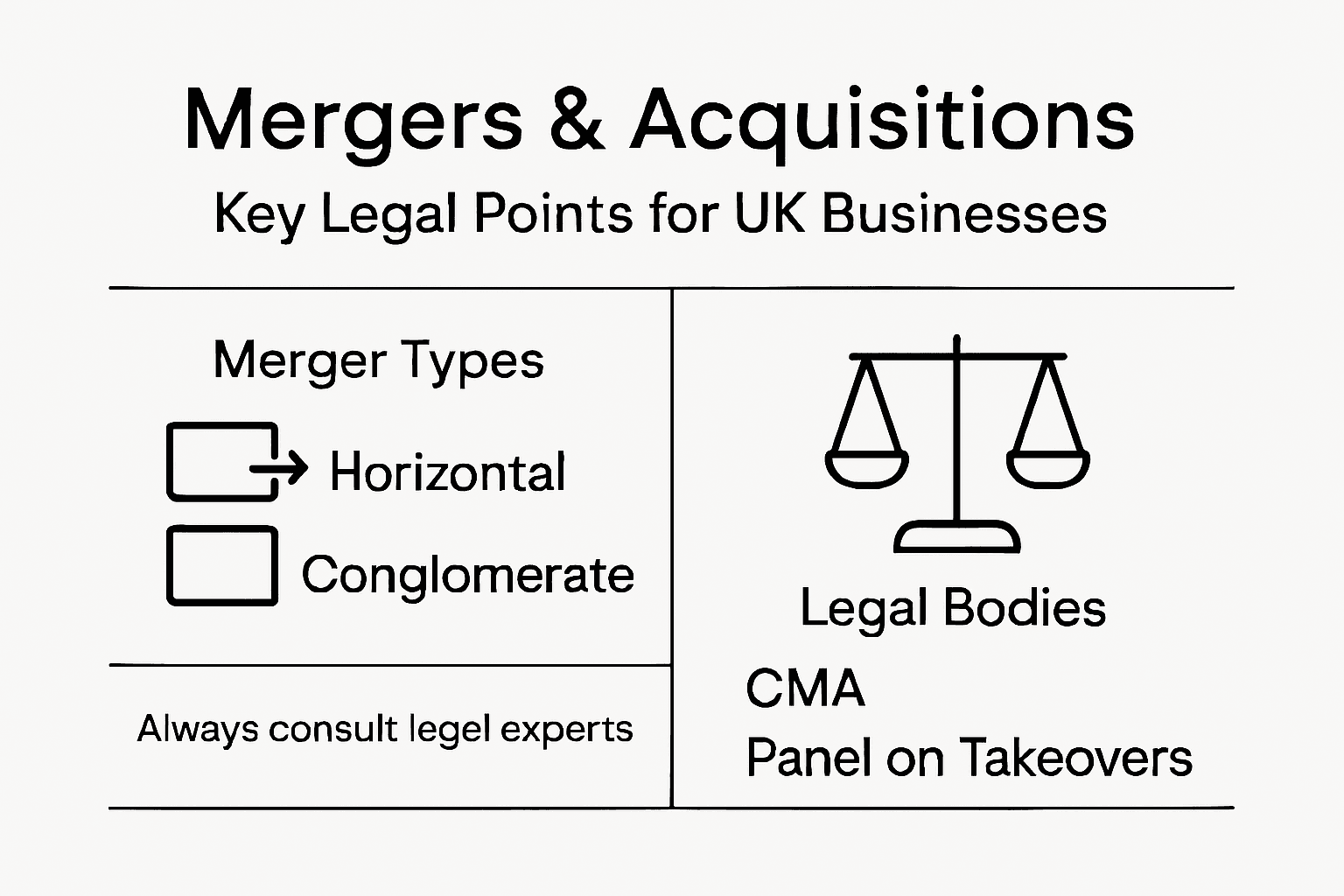
Pro tip: Always engage legal counsel specialising in corporate transactions before initiating any merger or acquisition to ensure comprehensive regulatory compliance and strategic alignment.
Mergers and acquisitions in the United Kingdom represent sophisticated legal strategies for corporate transformation, encompassing multiple complex transaction types designed to achieve strategic business objectives. UK legal frameworks recognise several distinctive M&A approaches that businesses can strategically employ.
The primary categories of mergers and acquisitions include:
Each merger type carries unique legal and strategic implications. Horizontal mergers typically aim to consolidate market share, reduce competition, and achieve economies of scale. Vertical mergers focus on streamlining supply chain efficiencies and reducing operational costs by integrating different production stages.

Conglomerate mergers represent more complex transactions where businesses from entirely different sectors combine, often seeking portfolio diversification and risk mitigation. These transactions require meticulous legal scrutiny to ensure compliance with competition regulations.
The following table compares the main types of mergers and acquisitions and their strategic objectives:
| Merger Type | Typical Parties Involved | Primary Objective | Key Legal Consideration |
|---|---|---|---|
| Horizontal | Direct competitors | Increase market share | Competition law compliance |
| Vertical | Supply chain partners | Streamline operations | Regulatory approval of integration |
| Conglomerate | Unrelated industries | Diversify business | Detailed risk assessment required |
| Friendly Acquisition | Willing buyer and seller | Mutual business growth | Clear communication to shareholders |
| Hostile Takeover | Unwilling target company | Gain control quickly | Defence strategies by target |
In the United Kingdom, merger transactions must navigate intricate regulatory landscapes to protect market competition and shareholder interests.
The legal mechanisms for these transactions vary, with specific processes like schemes of arrangement providing court-sanctioned methods for corporate restructuring. Companies must carefully evaluate their strategic objectives, potential synergies, and regulatory constraints when considering any merger or acquisition strategy.
Pro tip: Consult specialised corporate legal experts who understand the nuanced differences between merger types to develop a comprehensive and legally robust transaction strategy.
The United Kingdom maintains a sophisticated legal infrastructure governing mergers and acquisitions, designed to protect market integrity, shareholder interests, and economic competition. UK merger control mechanisms represent a comprehensive system of regulatory oversight that ensures transparent and fair corporate transactions.
Key regulatory bodies responsible for overseeing M&A activities include:
Statutory legislation plays a crucial role in defining the legal landscape for corporate transactions. The Enterprise Act 2002 and Companies Act 2006 provide the foundational legal frameworks that govern merger and acquisition processes, establishing clear guidelines for corporate restructuring and shareholder protections.
The Competition and Markets Authority holds particular significance in M&A transactions. This regulatory body has the power to investigate and potentially block mergers that might substantially reduce market competition or harm consumer interests. Their assessment criteria include market concentration, potential price increases, and impacts on consumer choice.
Regulatory oversight ensures that corporate transactions balance commercial interests with broader economic and consumer welfare considerations.
Additional regulatory mechanisms include the City Code on Takeovers and Mergers, which provides detailed rules for public company acquisitions. This code ensures transparency, fairness, and equal treatment of shareholders during complex corporate transactions.
Below is a summary of key UK regulatory bodies and their principal functions in M&A processes:
| Regulator | Role in M&A | Business Impact |
|---|---|---|
| Competition and Markets Authority | Monopoly prevention | May block anti-competitive deals |
| Financial Conduct Authority | Ensures market fairness | Sets standards for financial disclosures |
| Panel on Takeovers and Mergers | Administers takeover code | Protects shareholder equality |
| Financial Reporting Council | Monitors governance standards | Ensures accurate financial reporting |
Pro tip: Engage specialised legal counsel with expertise in UK corporate law to navigate the intricate regulatory landscape and ensure full compliance with statutory requirements.
The merger and acquisition process in the United Kingdom involves a structured, multi-stage approach designed to ensure transparency, regulatory compliance, and strategic alignment. CMA’s transaction investigation process provides a comprehensive framework for navigating complex corporate transactions.
The typical M&A transaction process encompasses the following critical stages:
The preliminary assessment involves extensive financial and strategic evaluation. Companies must carefully analyse potential targets, examining financial performance, market positioning, and alignment with overall business strategy. This stage requires meticulous research and strategic thinking to identify opportunities that genuinely enhance corporate value.
Successful M&A transactions balance strategic vision with rigorous financial and legal scrutiny.
Regulatory investigations represent a crucial phase in the transaction process. The Competition and Markets Authority conducts detailed assessments to ensure that proposed mergers do not substantially reduce market competition or harm consumer interests. These investigations can involve multiple stages, with companies required to provide comprehensive evidence and potentially negotiate remedies.
Pro tip: Engage specialised legal and financial advisors early in the M&A process to anticipate potential regulatory challenges and develop proactive mitigation strategies.
Mergers and acquisitions represent complex transactions fraught with potential financial and legal risks that can significantly impact corporate strategies. Insurance due diligence reveals critical hidden exposures that companies must carefully evaluate before finalising any transaction.
Key potential risks in M&A transactions include:
Financial Risks
Undisclosed historical debts
Unexpected retrospective premium adjustments
Undervalued asset assessments
Unresolved legal claims
Regulatory Risks
Potential competition authority penalties
Non-compliance with national security regulations
Unexpected integration compliance costs
Post-completion regulatory investigations
The comprehensive risk assessment requires meticulous examination of multiple corporate dimensions. Companies must conduct thorough financial, legal, and operational investigations to uncover potential liabilities that might not be immediately apparent during initial negotiations.
Successful M&A transactions demand rigorous due diligence to mitigate potential financial and legal vulnerabilities.
Legal due diligence plays a crucial role in identifying and allocating potential risks. This process involves detailed investigations into historic insurance limits, ongoing claim reserves, and potential regulatory penalties. Sophisticated organisations develop sophisticated risk transfer strategies and comprehensive business continuity plans to manage potential exposure.
Pro tip: Engage specialised forensic accountants and legal experts to conduct exhaustive risk assessments before finalising any merger or acquisition transaction.
Mergers and acquisitions demand sophisticated legal strategies to mitigate potential risks and ensure successful corporate transactions. Legal safeguards protect businesses during complex negotiations by establishing comprehensive protective mechanisms throughout the transaction process.
Key legal safeguards and potential pitfalls include:
Fundamental Legal Safeguards:
Common Potential Pitfalls:
The contractual framework represents a critical element in managing potential legal vulnerabilities. Companies must develop meticulous documentation that clearly defines expectations, allocates risks, and establishes precise mechanisms for addressing potential disputes or unexpected challenges.
Successful M&A transactions require proactive legal strategies that anticipate and mitigate potential risks before they materialise.
Regulatory compliance demands exceptional attention, particularly regarding competition laws and shareholder disclosure requirements. Organisations must navigate complex legal landscapes, ensuring transparent communication and adherence to statutory requirements throughout the transaction process.
Pro tip: Engage specialised legal counsel with extensive M&A experience to conduct comprehensive risk assessments and develop robust contractual protections.
Navigating mergers and acquisitions in the United Kingdom demands expert legal guidance to manage complex regulatory frameworks and mitigate financial and operational risks. With challenges such as compliance with Competition and Markets Authority regulations, thorough due diligence, and crafting robust contractual safeguards, the process can quickly become overwhelming. If you are seeking clarity on key legal insights and want to ensure your corporate transactions proceed smoothly, Ali Legal offers strategic, transparent, and client-focused solutions tailored for your unique situation.

Take control of your M&A journey now by consulting with our experienced legal team. We prioritise clear communication, fixed fees, and long-term relationships to help you achieve your business goals without costly surprises. Ready to safeguard your merger or acquisition with professional advice? Contact us today at Ali Legal to start securing your transaction with confidence.
A merger occurs when two companies combine to form a new entity, while an acquisition involves one company purchasing another, integrating its operations and assets into its own.
The main regulatory bodies include the Competition and Markets Authority (CMA), Financial Conduct Authority (FCA), Panel on Takeovers and Mergers, and the Financial Reporting Council.
The M&A process typically includes strategic planning, due diligence, and regulatory assessment, ensuring thorough evaluation and compliance at each stage.
Common risks include undisclosed debts, regulatory penalties, integration compliance costs, and valuation errors, all of which can significantly impact the success of a transaction.


