
Menu
Get Expert Legal Support Today

Running a small business in the UK means facing unexpected situations that could lead to costly claims and legal headaches. Understanding business liability is crucial because it determines whether your company or even you personally are held responsible when things go wrong. From workplace injuries to faulty products, these risks shape your daily operations and long-term survival. This guide explains the key liability types, how UK law protects or exposes your assets, and practical steps to keep your business compliant and financially secure.
Business liability refers to the legal responsibility your company bears when it causes harm to someone else. This harm can take many forms: a customer slips in your shop and breaks their leg, a faulty product injures a user, an employee gets hurt at work, or your professional advice leads to financial loss for a client. In each scenario, the injured party can claim compensation from your business, and that’s where liability becomes a real financial and operational concern.
For UK firms, understanding liability is not optional. The law distinguishes between different types of liability based on how the harm occurred and who was affected. Liability insurance in the UK covers business owners against compensation claims due to negligence, protecting against costs for personal injury, property damage, and legal obligations. Employers’ liability insurance is legally mandatory if you have staff, covering injury or illness claims from employees. Public liability covers claims from customers or members of the public, product liability protects against defective goods, professional indemnity shields professional service providers, and directors’ liability covers claims against company directors personally.
One critical distinction in UK law is the concept of limited liability. When you operate as a limited company structure, your personal assets remain separate from the business. This means shareholders and directors are only responsible for company debts up to the value of their shares. A limited company is a separate legal entity responsible for its own finances, assets, and liabilities, which provides substantial financial protection. By contrast, sole traders and partnerships face unlimited liability, meaning creditors can pursue personal assets if the business cannot pay its debts. This structural difference fundamentally changes your exposure to risk and how contractual liability arrangements should be managed.
Business liability also extends to negligence claims, which occur when your business fails to exercise reasonable care and causes loss or injury as a result. This might involve poor maintenance of premises, inadequate staff training, or failure to follow industry standards. The courts assess whether a reasonable business in your position would have taken the same actions, making negligence claims both common and costly. Understanding these definitions helps you identify which types of liability pose the greatest risk to your specific business, and therefore which insurance coverage and contractual protections you genuinely need.
Professional tip Document all safety procedures, maintenance records, and staff training from day one, as these demonstrate you took reasonable care and significantly strengthen your position if a liability claim arises.
Business liability is not a single concept but rather a collection of different legal exposures, each arising from distinct situations and each requiring different protections. Understanding these separate categories helps you identify which risks matter most to your operation and where insurance gaps might exist. The main types reflect the different ways your business can cause harm: through injuries to people, damage to property, faulty products, or inadequate professional services.
Employers’ Liability stands out because it is mandatory for most UK businesses. This covers compensation claims from your employees if they suffer injury or illness at work. Employers’ liability insurance is compulsory for virtually all UK employers and must cover permanent, contract, casual employees, and certain temporary workers. It protects your business if an employee claims you failed to provide safe working conditions, inadequate training, or defective equipment. Without it, you face both legal penalties and the prospect of personally funding compensation awards that could reach hundreds of thousands of pounds. A broken arm from a slippery floor, repetitive strain injury, or occupational illness all fall under this category.
Public Liability covers the opposite situation: claims from customers, visitors, or members of the public who are injured or suffer property damage because of your business activities. A customer slips in your shop, a delivery driver damages someone’s fence, or a window from your building falls onto a parked car. These claims happen regularly, and the costs can be substantial. Product liability is related but distinct, protecting your business if someone is injured by a faulty product your company supplies or manufactures. If you sell clothing that catches fire easily, food that causes allergic reactions, or tools that fail and injure the user, product liability covers the resulting claims.
Professional Indemnity applies if your business provides advice or services to clients. Accountants, surveyors, solicitors, consultants, and similar professionals face claims if their professional advice causes financial loss to clients. A surveyor misses structural problems in a property survey, an accountant’s poor tax advice leads to unexpected bills, or a consultant’s recommendations damage a business’s operations. This type of liability differs fundamentally because it stems not from physical injury or property damage but from professional failure. Directors’ and Officers’ Liability is another important category, protecting company directors personally from claims arising from alleged wrongful acts in their management duties. This covers claims that directors breached their duties, made negligent decisions, or acted dishonestly in running the company. Unlike other liabilities that fall on the company itself, this protects the individuals in charge.
Your specific business type determines which of these matters most. A manufacturing company needs strong product liability cover. A professional services firm cannot operate without professional indemnity. A retail shop requires public liability as much as employers’ liability. The cost of each type varies considerably based on your industry, number of employees, turnover, and claims history. Getting this mix right protects your business from financial catastrophe, but getting it wrong can leave serious gaps in coverage. Understanding negligence claims helps clarify which situations fall under which liability type and therefore which insurance you need.
The following table clarifies the main types of business liability in the UK and their typical claim examples:
| Liability Type | Who Brings Claims | Common Triggers | Typical Example |
|---|---|---|---|
| Employers’ Liability | Employees | Workplace accidents/illnesses | Slip causing broken arm |
| Public Liability | Customers/public | Injuries on premises, property damage | Customer injured by falling object |
| Product Liability | Product users/customers | Faulty/unsafe goods | Food allergy from product |
| Professional Indemnity | Clients | Negligent advice/services | Incorrect tax advice |
| Directors’ & Officers’ | Company/shareholders/creditors | Breach of director duties | Negligent company decision |
Professional tip Contact your insurance broker with details of your exact business operations, not just your job title, as this helps them recommend cover that actually matches your real exposures rather than generic industry defaults.
UK business liability does not exist in isolation. It sits within a comprehensive legal and regulatory framework that dictates what your business must do, how you must operate, and what happens if you fail to comply. These obligations come from multiple sources: Acts of Parliament, regulatory bodies, common law, and contractual agreements. Understanding this framework helps you grasp not just what liability is, but where it comes from and why it matters to your specific operation.
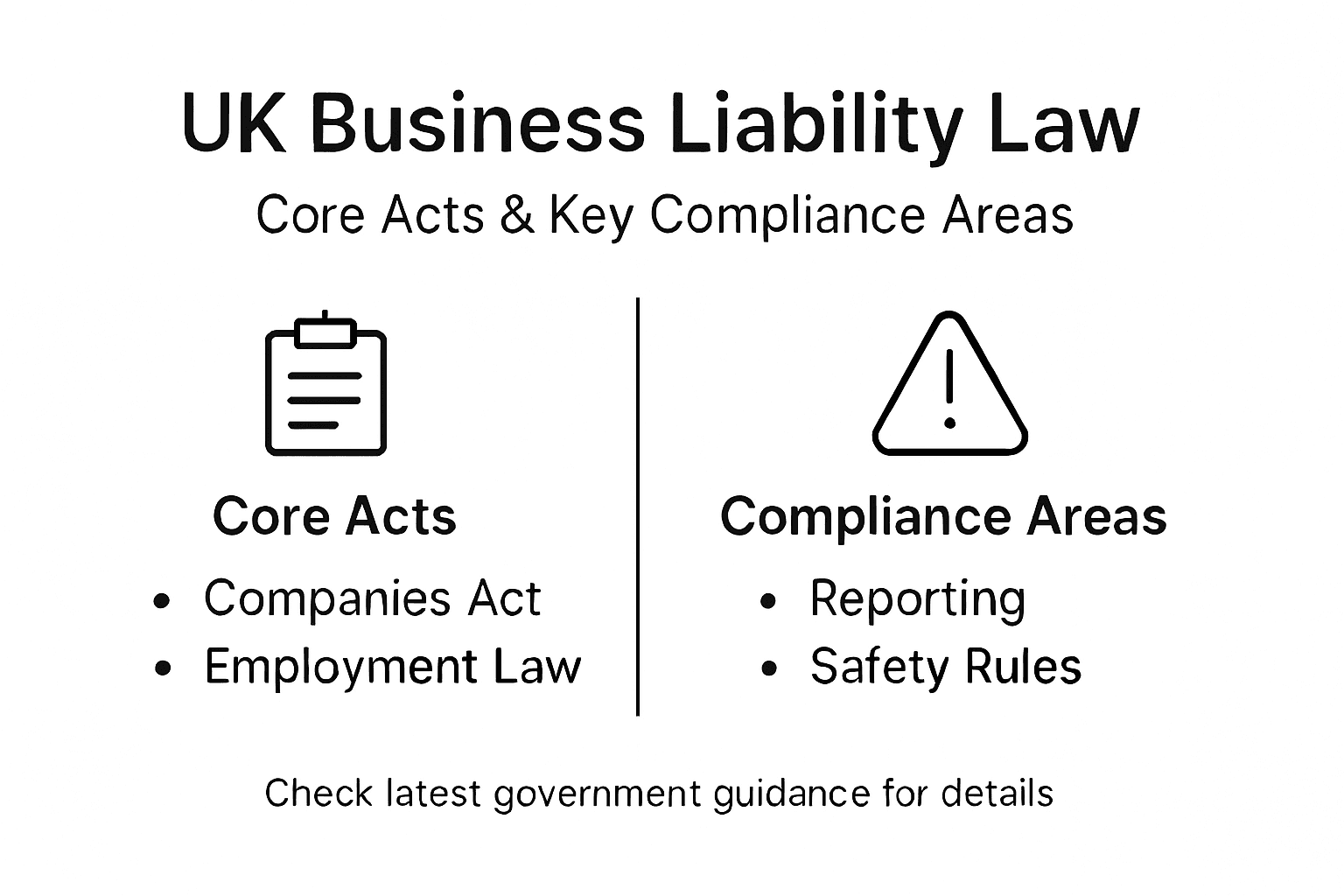
At the core sits the Companies Act 2006, which establishes the legal foundation for UK companies. This legislation defines company formation, registration requirements, and most importantly, the duties of directors. Directors must act within company powers, promote the company’s success, and avoid conflicts of interest. These are not suggestions but legal obligations with real consequences. If a director breaches these duties, they can face personal liability claims from the company itself, from shareholders, or from creditors if the company becomes insolvent. This creates a direct link between governance and liability. Poor decision making, failure to keep proper records, or negligent management can expose directors to claims that pierce the company’s limited liability protection. The Companies Act essentially codifies that running a company responsibly is not optional.
Compliance with filing requirements creates another layer of liability exposure that many business owners underestimate. UK companies must file annual accounts and reports with Companies House within prescribed deadlines, and failure to file on time results in automatic penalties that escalate with the length of delay. A company filing accounts three months late faces a fine of £750 for private companies, but filing six months late increases that to £1,500. Directors are personally responsible for timely filing, which means the burden falls on you. These are not negotiable obligations. Regulators view late filing seriously because financial transparency is fundamental to the UK’s corporate system. Beyond the financial penalties, late filing can damage your business reputation, alert creditors to potential problems, and create evidence that you are not managing the company properly. This matters for liability because regulatory compliance itself becomes a measure of whether you exercised reasonable care in managing the business.
Different industries face additional regulatory requirements that directly shape liability exposure. Employment law imposes strict obligations on employers regarding health and safety, working time, discrimination, and data protection. Consumer protection law creates liability if your business sells products or services that harm customers. Data protection law under the UK General Data Protection Regulation creates liability if you mishandle customer information. Environmental regulations create liability if your business pollutes. Financial services regulations create liability if you provide financial advice. The specific industry you operate in determines which regulatory frameworks apply to you and therefore which additional liability risks you face. A small hairdressing salon has different regulatory obligations than a software company providing services to corporate clients.
The relationship between regulation and liability is not coincidental. Regulations establish standards of conduct. When you breach those standards, you create evidence of negligence or breach of duty, which strengthens any liability claim against you. Courts use regulatory breaches as evidence that you failed to exercise reasonable care. If employment law requires you to conduct risk assessments for health and safety but you do not, and an employee is then injured, that failure to comply strengthens their claim against you. Regulation provides the baseline for what constitutes responsible business conduct.
Professional tip Create a compliance calendar marking key deadlines for your industry, assign responsibility to specific individuals, and set internal reminders one month before filing deadlines to avoid automatic penalties that cost money and damage your liability profile.
Business liability risks are not theoretical abstractions. They materialise as real claims, real costs, and real damage to your business. Understanding which risks pose the greatest threat to your operation helps you prioritise both insurance coverage and internal risk management. The consequences of poor liability management extend far beyond the immediate financial hit. A single claim can damage your reputation, distract management from running the business, trigger regulatory investigations, and make it harder to secure future contracts or borrowing.
Workplace injuries and illnesses represent the most frequent source of liability claims. An employee slips on a wet floor and fractures their wrist. A warehouse worker develops repetitive strain injury from poor ergonomic practices. A cleaner inhales fumes from inadequate ventilation. Employers’ liability claims address work-related injuries seeking compensation for pain, treatment costs, lost earnings, and related expenses. The financial impact varies enormously based on injury severity. A minor sprain might cost £5,000 in compensation and medical fees. A permanent disability claim could reach £500,000 or more. Beyond compensation payments, you face legal costs, management time spent on the claim, potential regulatory investigation from the Health and Safety Executive, and reputational damage if word spreads that your workplace is unsafe. Failure to manage workplace risks properly exposes your business to significant legal and financial consequences that extend well beyond the compensation payment itself.

Public liability claims arise when customers, visitors, or members of the public are injured or suffer property damage during your business operations. A customer slips in your shop and breaks their leg. A delivery lorry from your company damages a parked car. A window falls from your building onto a pedestrian. These incidents happen regularly across UK businesses. The costs depend entirely on the injury severity and property damage value. A minor injury might settle for £1,000 to £5,000. A serious injury requiring surgery and ongoing care could reach £50,000 to £200,000. Property damage claims vary but can be substantial if a vehicle or building is damaged. What makes these claims particularly damaging is their visibility. Customers talk about accidents. Word spreads through social media. Your business gets a reputation for being unsafe or poorly maintained, which affects customer confidence and revenue.
Product liability claims emerge when someone is injured by a product your business supplied or manufactured. A food product causes allergic reactions. Clothing material catches fire more easily than advertised. A tool fails and causes injury. The financial consequences can be severe because product liability claims often involve multiple claimants. If your product causes harm to hundreds of customers, you face hundreds of claims simultaneously. Common risks businesses face include selling defective or harmful products, which can lead to expensive claims, large compensation payments, legal fees, and reputational damage that can critically affect a business’s financial health. A product recall can cost millions. Compensation claims can reach millions more. The reputational damage can destroy a brand entirely.
Professional indemnity claims affect businesses that provide advice or services. An accountant’s tax advice proves incorrect, leaving the client with unexpected tax bills. A surveyor misses structural problems, and the buyer later discovers defects. A solicitor fails to register a charge, and the client loses security over a property. These claims typically involve significant financial loss to the client, which translates into substantial compensation demands. A professional making a mistake on a property transaction worth £500,000 might face a claim for £100,000 or more if their negligence caused the client loss.
The cumulative financial impact extends beyond direct compensation. Legal costs to defend claims can equal or exceed the compensation amount itself. Regulatory sanctions might follow, particularly if your breach involved breach of safety law or financial services regulation. Insurance excess payments fall on you. Increased insurance premiums in future years follow claims. Business interruption during investigation and legal proceedings costs money. Loss of client confidence costs revenue. The reputational damage is often the most costly consequence, particularly for service businesses reliant on trust and recommendation.
Here is a side-by-side view of common liability risks and their potential financial impact on UK businesses:
| Risk Type | Potential Costs | Broader Consequences |
|---|---|---|
| Workplace Injury | £5,000–£500,000+ | Legal fees, regulatory action |
| Public Liability Claim | £1,000–£200,000 | Reputation damage, lost customers |
| Product Liability Claim | Tens of thousands to millions | Product recalls, brand destruction |
| Professional Negligence | £10,000–£100,000+ | Loss of client trust, higher premiums |
Professional tip Maintain detailed records of all safety procedures, maintenance, staff training, and incident reports, as these documents demonstrate reasonable care and significantly reduce both claim likelihood and settlement amounts if a claim does arise.
Minimising legal exposure requires a strategic, layered approach that combines proper documentation, contractual protections, insurance coverage, and ongoing operational discipline. You cannot eliminate liability entirely because it is built into operating a business, but you can substantially reduce both the likelihood of claims arising and the financial impact if they do. This section outlines practical steps that have proven effective for UK businesses across different sectors and sizes.
Start with your contracts. Every significant business relationship should be governed by a properly drafted written agreement that clearly allocates risk and responsibility between parties. Indemnity clauses, exclusion clauses, and limitation of liability caps in contracts protect your business by shifting certain risks to the other party or capping your financial exposure at a defined amount. An indemnity clause requires one party to cover losses incurred by the other party for specified events. An exclusion clause removes liability for certain types of loss. A limitation clause caps liability at a specific amount, such as the contract value or an annual turnover figure. These protections only work if they are properly drafted and clearly communicated to the other party. A vague or buried exclusion clause will likely be disregarded by courts. A limitation clause must be reasonable relative to the contract value and the nature of the relationship. Working with a solicitor to draft these clauses correctly costs money upfront but prevents far more costly disputes later.
Second, obtain the right insurance coverage in appropriate amounts. UK businesses are advised to obtain appropriate types and levels of liability insurance including employers’ liability, public liability, product liability, and professional indemnity insurance where relevant. Insurance does not prevent claims from arising, but it shields your business from financial catastrophe when they do. A £1 million public liability claim can destroy a small business without insurance. With insurance, the insurer handles the claim and pays compensation within the policy limit. The key is matching your insurance to your actual risks. A hairdressing salon does not need product liability insurance but does need public liability. A software consultant needs professional indemnity but not product liability. An online retailer selling physical products needs both product liability and public liability. Underinsuring is a common mistake that creates a false sense of security until a major claim arrives.
Third, implement proactive operational practices that reduce claim likelihood in the first place. Regular risk assessments identify hazards before they cause injury or damage. Health and safety compliance means following regulations, not just understanding them theoretically. Staff training ensures employees understand procedures and can spot hazards. A manufacturing business might conduct annual risk assessments, invest in equipment maintenance, and train workers on safe procedures. A professional services firm might conduct file reviews to ensure compliance with regulatory requirements, train staff on client communication, and maintain professional development standards. The investment in these practices is far lower than the cost of defending a single claim.
Fourth, document everything. Poor documentation makes it impossible to demonstrate that you exercised reasonable care. Good documentation proves you did. A workplace injury claim becomes far easier to defend if you have records showing that you conducted risk assessments, identified the hazard, and implemented controls. A professional negligence claim becomes easier to defend if you have contemporaneous file notes showing you provided appropriate advice. A product liability claim becomes easier to defend if you have quality control records and testing documentation. Courts assess negligence partly by looking at whether you followed standard industry practices and kept appropriate records. The documents do not need to be elaborate, but they must be contemporaneous and sufficiently detailed to demonstrate reasonable care.
Fifth, maintain appropriate governance structures. Directors should ensure they understand their duties, keep proper board minutes, follow company procedures, and make decisions transparently. Poorly documented board decisions or ignored procedures create evidence of negligent management. Regular director training on their legal duties helps prevent breaches. Proper segregation of duties and internal controls reduce the risk of fraud or error that could create liability.
Professional tip Conduct an annual liability risk review with your insurance broker and solicitor to ensure your insurance coverage reflects your current business activities, that your contracts appropriately allocate risk, and that your operational practices remain compliant with current regulations.
Understanding business liability in the UK means recognising your exposure to risks such as employers’ liability, public liability, product liability and professional indemnity. If you want to avoid costly claims triggered by workplace injury or negligence, you need more than just insurance. You need legal guidance that helps you navigate complex responsibilities, regulatory frameworks and contractual protections with confidence. At Ali Legal, we specialise in offering straightforward advice and fixed fee services tailored to your unique business situation.

Explore insights and solutions in our Uncategorized | Ali Legal section or reach out directly to ensure your business complies with legal obligations while minimising financial exposure. Time-sensitive compliance issues like timely Companies House filings and contract risk allocation demand swift action. Contact us today at https://alilegal.co.uk/contact-us to secure expert legal backing. Protect your company, your directors and your peace of mind with Ali Legal’s strategic and transparent legal support.
Business liability refers to the legal responsibilities a company has when it causes harm to another party, such as through personal injury, property damage, or financial loss due to professional negligence.
UK firms should consider several types of liability insurance, including employers’ liability insurance, public liability insurance, product liability insurance, and professional indemnity insurance, each covering specific risks associated with their operations.
Limited liability protects the personal assets of shareholders and directors, meaning they are only responsible for business debts up to the value of their shares. In contrast, unlimited liability means sole traders and partners can be pursued for business debts using their personal assets.
Workplace injury claims can vary significantly in cost, ranging from a few thousand pounds for minor injuries to hundreds of thousands for severe injuries, including legal fees and potential regulatory investigations.


