
Menu
Get Expert Legal Support Today

Exporting products from the UK to markets like Australia or Japan can feel daunting once you realise how many rules shape each shipment. Understanding trade law is more than just knowing about tariffs—it covers everything from customs paperwork and product standards to contracts and dispute procedures. Post-Brexit changes mean every UK business now faces a unique set of requirements and risks. This guide breaks down those challenges, clears up common trade law misconceptions, and outlines practical ways to spot compliance gaps before they turn into costly problems.
Trade law is fundamentally the set of legal rules that governs how goods, services, and intellectual property move across national borders. For UK businesses, this matters because these rules determine whether you can sell abroad, what paperwork you need, what taxes you’ll pay, and whether your supply chain stays compliant. Trade law covers everything from tariffs and customs procedures to product standards and trade agreements between countries. It sounds abstract, but it directly affects your bottom line. A single missed compliance requirement can halt a shipment, cost you thousands in penalties, or damage relationships with international partners.
The landscape shifted dramatically for UK businesses after 31 December 2020. The UK transitioned from operating within European Union frameworks to becoming an independent trading nation with its own trade policy. This meant establishing new legal structures entirely. The UK now operates under the UK’s Trade and Cooperation Agreement with the European Union, maintains membership in the World Trade Organization (WTO), and has negotiated its own free trade agreements with countries worldwide. Understanding independent trade arrangements is now essential for any UK business engaged in cross-border commerce.
Misconceptions about trade law often cause expensive mistakes. Many business owners believe trade law is purely about tariffs and import duties. The reality is far broader. Trade law encompasses customs clearance procedures, product compliance standards, rules of origin documentation, export controls, sanctions compliance, intellectual property protection, and dispute resolution mechanisms. Another common misconception is that if you use a freight forwarder or customs broker, you’re no longer responsible for compliance. Wrong. You remain legally accountable for the accuracy of customs declarations and adherence to trade regulations, regardless of who handles the paperwork. Some businesses also assume that because they sell through an online platform, they’re exempt from trade law requirements. Platforms like Amazon or eBay don’t shield you from regulatory obligations when shipping internationally. Additionally, many assume Brexit solved all complexity by creating a simple binary relationship with the EU. In fact, the current framework creates nuanced distinctions between EU and non-EU trade, requiring careful attention to origin rules and regulatory alignment requirements.
Pro tip: Review your current supply chain documentation and identify which countries you export to, then cross-reference those destinations against UK trade agreements and tariff schedules to spot compliance gaps before they become costly problems.
Trade law in the UK operates across multiple legal frameworks, each serving a distinct purpose in regulating cross-border commerce. Understanding these different types helps you identify which rules apply to your business and where compliance gaps might exist. The UK’s trade law architecture consists of international agreements, domestic legislation, and regulatory regimes that work together to control what enters and leaves the country, how it’s taxed, and whether it meets safety and quality standards.
At the highest level, the UK operates within the World Trade Organization (WTO) framework, which establishes baseline rules that apply to trade with most nations globally. On top of this, the UK has negotiated bilateral and multilateral trade agreements tailored to specific partners. The UK’s Trade and Cooperation Agreement with the European Union sets the terms for trade with the UK’s largest trading partner, covering goods, services, and regulatory cooperation. Beyond this, the UK has established what the government calls “continuity agreements,” which essentially rolled over existing EU trade deals into standalone UK agreements with countries like Japan, South Korea, and Canada. Additionally, the UK has negotiated entirely new free trade agreements (FTAs) with partners such as Australia and is pursuing further agreements with other nations. Each agreement contains different rules about tariffs, rules of origin, product standards, and dispute resolution procedures.
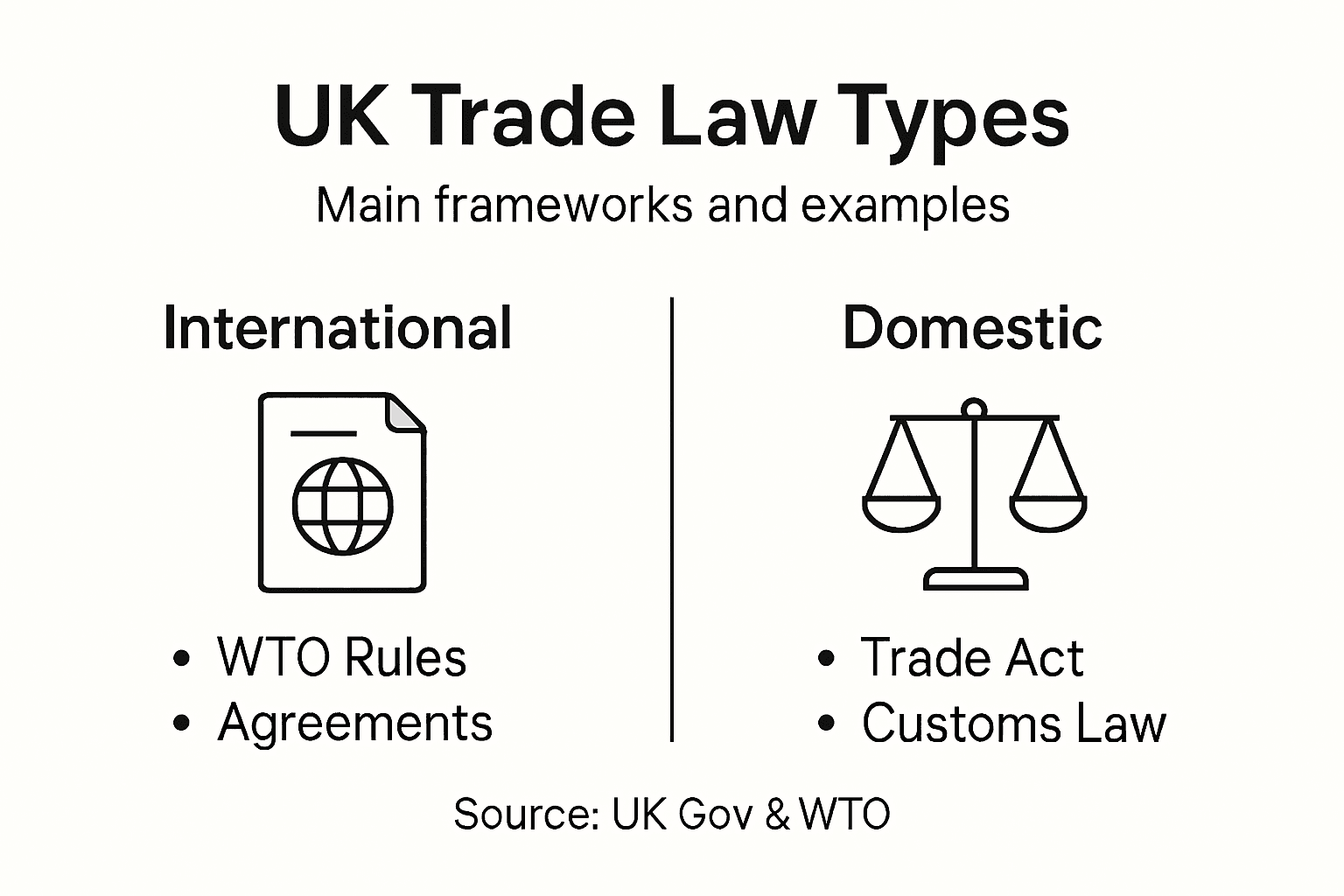
Domestically, UK trade law includes several key legislative instruments. The Trade Act 2022 provides the legal framework for the UK to negotiate and implement trade agreements independently. The Taxation (Cross-border Trade) Act 2018 establishes the customs regime, setting out how import duties are calculated, collected, and enforced. This legislation also covers VAT and excise duty arrangements for imported goods. Beyond tariffs, the UK operates anti-dumping and countervailing duty regimes that protect domestic industries from unfair foreign competition. These regimes allow the UK to impose additional duties on goods sold below fair value or subsidised by foreign governments. Product-specific regulations also fall under trade law. For example, if you import food, chemicals, electrical equipment, or textiles, you must comply with UK product standards that mirror or exceed those previously applied under EU law. International law frameworks increasingly influence how these domestic regimes operate, particularly regarding intellectual property protection and dispute settlement mechanisms.
The practical reality is that these different types of trade law interact constantly. When you export a product, you need to confirm it meets the rules of origin requirements in the relevant trade agreement, calculate the correct tariff classification under UK law, ensure it complies with product standards, and navigate any customs procedures or documentation requirements. A breach in any one of these areas can halt your shipment or result in penalties. What makes this complex is that each trade agreement has slightly different rules, and those rules change as new agreements come into force or existing ones are renegotiated.
Here is a summary of the primary UK trade law frameworks and their unique roles:
| Framework Type | Main Role in Trade | Example Regulations |
|---|---|---|
| International | Sets baseline rules | WTO rules, bilateral agreements |
| Domestic Legislation | Governs UK procedures | Trade Act 2022, Taxation Act 2018 |
| Regulatory Regimes | Enforces compliance | Product standards, customs policies |
Pro tip: Map out which trade agreements apply to your top five export destinations, then request a customs broker or trade consultant to provide a one-page summary of the specific tariff codes, rules of origin, and compliance requirements for your products under each agreement.
The UK’s trade law operates within a carefully structured legal framework built on multilateral agreements, domestic legislation, and established governing principles that shape how businesses conduct cross-border commerce. This framework did not emerge randomly. It reflects decades of international negotiation, WTO commitments, and post-Brexit political choices about how the UK positions itself in global trade. For your business, understanding this framework means knowing which rules are fixed, which have flexibility, and which are likely to change. The foundation rests on three pillars: international obligations, domestic law, and regulatory bodies that enforce both.
At the international level, the UK remains bound by its membership in the World Trade Organization (WTO), which established multilateral trading rules that apply to most nations globally. The core WTO principle is non-discrimination, meaning the UK cannot treat one trading partner better than another unless a specific trade agreement justifies the difference. This principle underpins tariff scheduling, where the UK committed to maximum tariff rates on imports from WTO members. Alongside WTO membership, the UK operates under bilateral and multilateral trade agreements, most prominently the UK-EU Trade and Cooperation Agreement, which sets preferential terms for trade with European partners. Each agreement contains its own legal framework, establishing rules of origin (which determine product nationality), tariff classifications, and dispute resolution mechanisms. Domestically, the Trade Act 2022 and the Taxation (Cross-border Trade) Act 2018 form the legislative backbone, granting the UK government power to negotiate trade agreements, set customs procedures, and enforce trade remedies.
The governing principles that shape UK trade law reflect a commitment to what the government describes as “free and fair trade.” Free trade means minimising barriers to commerce and avoiding protectionism wherever possible. Fair trade means the UK can respond when other nations act unfairly, such as dumping goods at below-cost prices or subsidising exports excessively. To manage this balance, the UK established the Trade Remedies Authority (TRA), an independent body that investigates alleged unfair trading practices and recommends whether anti-dumping duties, countervailing duties, or safeguard measures should be applied. Another governing principle is legal transparency. The UK publishes its tariff schedules, rules of origin requirements, and trade agreement terms publicly, so businesses can understand their obligations without requiring specialist knowledge. Regulatory continuity forms another principle. Where possible, the UK maintained alignment with product standards and technical regulations that existed under EU law, reducing compliance burdens for businesses. However, the UK reserved the right to diverge from those standards where it serves British interests, creating opportunities and risks for importers and exporters alike.
What ties these elements together is rules-based governance. Unlike some trading systems built on ad-hoc negotiations or political favour, the UK’s approach emphasises predetermined rules applied consistently. When you import goods, the tariff applied depends on technical classification criteria, not negotiation with a customs official. When you export, your eligibility for preferential tariffs under a trade agreement depends on objective rules of origin criteria. When unfair trading occurs, the TRA follows a defined investigative process. This approach reduces corruption and creates predictability, though it also means your business must invest in understanding and complying with those rules. International dispute mechanisms increasingly shape how these principles are applied, particularly when disagreements arise between the UK and trading partners over whether obligations have been met.
Pro tip: Request a summary from your customs broker detailing which specific WTO tariff commitments and trade agreement rules apply to your primary product categories, then cross-reference those against your current pricing and supply chain to identify whether you are currently optimising tariff classifications or missing preferential rate opportunities.
Trade contracts and international agreements form the backbone of cross-border commerce. These are not abstract legal documents filed away in government offices. They directly determine what you can sell, where you can sell it, how much duty you will pay, and what happens if disputes arise. For a UK business, understanding these contracts means knowing which agreements apply to your specific trading partners and what competitive advantages or obligations they create.
International trade agreements operate at two levels. At the macro level, they establish the rules that govern trade between nations. These are binding legal instruments negotiated between governments, often taking years to finalise. The UK currently maintains 40 trade agreements with 74 countries and territories, covering everything from goods to services to intellectual property protection. These agreements fall into two categories. Continuity agreements are those the UK rolled over directly from existing EU arrangements with countries like Japan, South Korea, and Canada. New bespoke agreements are those negotiated by the UK independently post-Brexit, such as the agreements with Australia and New Zealand. Each agreement has different tariff schedules, rules of origin requirements, and dispute resolution procedures. At the micro level, you enter into trade contracts with your business partners. These are commercial agreements between your company and foreign suppliers, distributors, or customers. These contracts reference and operate within the framework of international agreements. For instance, you might offer your Australian distributor a price calculated on the assumption that goods entering Australia qualify for preferential tariff treatment under the UK-Australia Free Trade Agreement.
What makes international agreements particularly important is the concept of rules of origin. This phrase refers to the legal criteria used to determine the nationality of a product. Many trade agreements offer reduced tariffs only if the goods originate from one of the partner countries. The problem is that modern products often contain components from multiple nations. A garment assembled in Vietnam might use British fabric and Chinese buttons. Under most UK trade agreements, the garment qualifies as Vietnamese origin if Vietnam adds sufficient value or processes it enough. This determination affects the tariff dramatically. Without qualifying origin, your product enters the destination market at standard WTO tariff rates. With qualifying origin, it enters at preferential rates, sometimes duty-free. Your commercial contracts need to account for this. If you sell goods to a partner and promise them preferential tariff treatment that they later cannot claim, you create a liability.
Another critical aspect of trade contracts involves dispute resolution clauses. When something goes wrong in international trade, you need a clear process for resolution. Unlike domestic disputes, which rely on UK courts, international trade disputes often require arbitration or negotiation under the terms of relevant trade agreements. Some agreements establish specialised dispute panels. For example, the UK-EU Trade and Cooperation Agreement includes a dispute settlement mechanism where disagreements can be escalated to a Trade Partnership Committee and, if unresolved, to an arbitration panel. Your commercial contracts should specify which legal jurisdiction applies, which law governs interpretation, and what arbitration process you will use. Many UK businesses overlook this detail, only to discover mid-dispute that they lack clarity on where and how to resolve the matter. When negotiating with international partners, clarifying these contractual elements upfront prevents expensive confusion later. International business agreements require careful attention to legal terms that protect your rights across different legal systems.
Implementation of international agreements also matters operationally. Once the UK and a trading partner sign an agreement, both parties must translate it into domestic law and practical procedures. This involves customs procedures, product standard alignment, and regulatory recognition. For instance, when the UK-Japan agreement came into force, UK businesses selling electrical equipment to Japan had to verify that their products met Japanese product standards, not just UK standards. Similarly, Japanese businesses selling to the UK needed to ensure compliance with UK product standards. These implementation details determine whether your international agreements actually translate into business opportunities or create unforeseen barriers.
Pro tip: Before entering a significant trade contract with an international partner, confirm which trade agreement applies to that destination, obtain a copy of the relevant tariff schedule and rules of origin requirements from the UK Trade Tariff, and have your legal advisor draft contract clauses that explicitly address tariff classification, origin qualification, and dispute resolution procedures.
Compliance with trade law is not optional for UK businesses engaged in cross-border commerce. You are legally bound to follow specific obligations, and failure to do so creates genuine financial and reputational consequences. The challenge is that trade law obligations span multiple areas, from customs procedures to product standards to sanctions compliance. Missing just one can derail your entire operation. Understanding your obligations, recognising the risks associated with non-compliance, and building systems to ensure ongoing compliance forms the foundation of sustainable international business.

Your primary obligations depend on whether you are importing or exporting. If you import goods, you must ensure accurate customs declarations, pay the correct duties and taxes, and comply with all import controls and product standards. You are responsible for tariff classification, even if you use a customs broker or freight forwarder to handle the paperwork. If that classification is wrong, you remain liable for underpaid duties plus penalties. Product compliance obligations are equally critical. Food products must meet UK food safety standards. Electrical equipment must carry CE marking and meet electromagnetic compatibility requirements. Textiles must comply with labelling regulations. Many businesses underestimate these product obligations, believing that if a product is legal in the country of origin, it is automatically legal in the UK. Wrong. The UK sets its own product standards, and you cannot import goods that fail to meet them. If you export, you must comply with export controls for certain items, maintain proper documentation proving rules of origin compliance, and ensure your goods meet the destination country’s standards. Additionally, trade obligations include sanctions compliance and contractual liability, which means you cannot trade with restricted parties or breach terms that could expose you to legal claims.
The risks of non-compliance are substantial and multifaceted. At the operational level, customs authorities can seize your shipments, leaving you without goods and without payment. At the financial level, you face duty arrears, penalties for misclassification, and potential interest charges that compound over time. A single undervalued shipment could result in back duties on all similar shipments made within a specified period, running into thousands of pounds. At the legal level, if you breach product standards or export controls, you can face criminal prosecution, not just civil penalties. Directors can be held personally liable for serious breaches. At the reputational level, compliance failures damage customer relationships and can result in loss of preferred supplier status. A major retailer will drop a supplier whose shipments are repeatedly delayed by customs issues. At the contractual level, if you promise a customer preferential tariff treatment that your goods cannot actually claim due to rules of origin failure, you breach your commercial contract and face liability for the customer’s losses.
Building effective compliance requires three elements. First, you need clear systems for documenting your products, their components, their origin, and their compliance status. Second, you need trained personnel who understand which obligations apply to which products and destinations. Third, you need regular audits to catch gaps before authorities do. Many small to medium sized businesses assume they cannot afford compliance infrastructure, but the cost of a single serious breach far exceeds the cost of preventative systems. Practically speaking, this means maintaining product specification sheets, tariff classification decisions documented with supporting evidence, rules of origin calculations with supplier declarations, customs declarations with supporting invoices, and proof of compliance testing for regulated products. You should also conduct periodic internal audits, perhaps quarterly, reviewing a sample of recent shipments to verify that documentation is complete and classifications are current. Trade law changes regularly, particularly as new trade agreements come into force or regulations evolve. What was compliant last year might not be compliant this year. Annual training for your team ensures they stay current with these changes.
Below is a comparison of major compliance risks UK firms face and their business consequences:
| Compliance Risk | Typical Cause | Business Consequence |
|---|---|---|
| Incorrect tariff code | Misclassifying goods | Financial penalties, delays |
| Missing origin proof | No supplier documentation | Lost preferential tariffs |
| Outdated regulations | Not tracking legal changes | Shipments blocked, liability |
| Poor contract drafting | Unclear legal jurisdiction | Costly disputes, litigation |
| Incomplete product docs | Ignoring UK product standards | Goods seized, criminal risk |
Pro tip: Create a compliance checklist specific to your products and top five destination countries, including tariff codes, rules of origin requirements, product standard certifications, and documentation deadlines, then assign one team member responsibility for reviewing this checklist quarterly and updating it as trade agreements or regulations change.
UK businesses operating internationally stumble over the same pitfalls repeatedly. These are not exotic legal problems reserved for multinational corporations. Small and medium-sized enterprises encounter these issues constantly, often learning about them only after costly mistakes occur. Understanding these pitfalls in advance allows you to avoid them. The most dangerous pitfall is assuming that trade law compliance is someone else’s responsibility. Your customs broker handles customs matters. Your freight forwarder handles shipping. Your partner in the destination country handles local rules. This assumption is catastrophic. You remain legally responsible for every aspect of your trade transactions, regardless of who executes each step. When customs authorities discover a misclassified shipment, they pursue you, not your broker. When product standards are breached, regulatory agencies hold your company accountable, not your foreign partner. Delegating tasks is sensible. Delegating responsibility is not.
A second major pitfall involves misunderstanding rules of origin and tariff classification. Many businesses assume that if they can produce goods cheaply in one location, they automatically qualify for preferential tariff treatment under the relevant trade agreement. This is incorrect. Rules of origin are technical, often requiring specific levels of local value-added or processing performed in the correct countries. A garment assembled in Bangladesh from Chinese fabric does not qualify as Bangladeshi origin under most trade agreements. Similarly, many firms classify products based on what they think a product is, rather than what the tariff code legally defines it as. A product you consider a “component” might be classified as a “finished good” under the UK Trade Tariff, resulting in completely different duty rates. These misclassifications often go undetected for months until customs audits reveal discrepancies across multiple shipments. Another related pitfall is failing to update tariff classifications when trade agreements change. When a new free trade agreement comes into force, preferential tariff rates change. What attracted zero duty yesterday now attracts 5 per cent duty tomorrow. Businesses that do not update their systems continue claiming the old rate, accumulating back duties and penalties.
A third pitfall arises from inadequate contract drafting. Unclear or ambiguous contract terms concerning governing law and dispute resolution create costly confusion when disagreements arise. Many UK businesses sign international trade contracts without specifying which country’s law applies, which courts have jurisdiction, or how disputes will be resolved. When a payment dispute emerges with a supplier in Vietnam, you discover your contract is silent on these issues. You face a choice between expensive litigation in a foreign court or accepting a loss. Equally problematic is failing to specify tariff allocation in contracts. If you promise a customer preferential tariff treatment but your goods fail to qualify due to rules of origin issues, you create contractual liability. You owe the customer compensation for the duty they unexpectedly had to pay. Many firms also overlook regulatory compliance clauses. Your contract should specify that goods comply with all destination country product standards, with clear responsibility for testing and certification. Without this clarity, disputes about product compliance become disputes about who bears the cost of remediation.
A fourth pitfall involves underestimating regulatory changes and compliance drift. Trade law evolves constantly. New product safety standards are introduced. Trade agreements are amended. Tariff rates change. Import prohibitions emerge (particularly around sanctions regimes targeting specific countries or entities). Firms that do not actively monitor these changes gradually fall out of compliance. A product legal to import today becomes restricted next year when new safety standards take effect. A sanctioned entity you were not trading with becomes relevant when the UK extends sanctions to additional parties. The most successful trading firms establish compliance calendars, assign responsibility for monitoring regulatory changes, and conduct quarterly reviews of their tariff classifications and rules of origin procedures. Less organised firms simply hope nothing changes.
A fifth pitfall concerns insufficient documentation. Customs authorities, tax authorities, and product safety regulators all rely on documentation to verify compliance. If you cannot produce documentation proving that goods meet product standards, you face penalties regardless of whether they actually do. If you cannot produce supplier declarations proving rules of origin compliance, you lose eligibility for preferential tariff treatment. Many businesses treat documentation as bureaucratic burden rather than evidence of compliance. They file it away haphazardly or discard it after a year. This creates vulnerability. Keep documentation systematically and retain it for at least six years, the standard period for customs audits in the UK.
Pro tip: Conduct an internal audit of your last 20 trade transactions, checking whether each has documented tariff classification, rules of origin proof, product compliance evidence, and a clear governing law clause in the underlying commercial contract, then identify gaps and resolve them before authorities identify them for you.
Navigating UK trade law complexities can feel overwhelming, especially with evolving rules on tariffs, rules of origin, and compliance obligations affecting your exports and imports. Avoid costly mistakes like misclassification, missing documentation, or unclear contract terms by partnering with a legal team experienced in international trade regulations and dispute resolution. Ali Legal offers tailored support focused on transparency, speed, and clear communication to keep your business compliant and prepared for changes.

Take control of your international trade compliance today by consulting with a solicitor who understands the intricate legal framework governing UK trade. Whether you need help drafting robust commercial contracts or ensuring customs compliance in line with the UK’s trade agreements, Ali Legal is here to help you minimise risks and safeguard your business. Reach out now through our contact page to get straightforward advice and fixed-fee solutions designed for your needs.
Learn more about how we can support your compliance and international transactions by visiting Ali Legal Contact Us and securing your path to sustainable trade success.
Trade law is the set of legal rules governing how goods, services, and intellectual property are exchanged across borders. It is crucial for UK businesses as it determines export eligibility, necessary paperwork, tax obligations, and compliance within supply chains, directly impacting profitability.
UK trade law operates through multiple frameworks, including international agreements set by the World Trade Organization (WTO), bilateral and multilateral agreements with specific partners, and domestic legislation like the Trade Act 2022 and the Taxation (Cross-border Trade) Act 2018.
Rules of origin are legal criteria that determine a product’s nationality for tariff purposes. If products do not meet the specified criteria of a trade agreement, they may not qualify for preferential tariffs and could be subject to higher standard rates, significantly affecting costs.
Non-compliance can lead to severe consequences, including shipment seizures, financial penalties for misclassification, legal liabilities, and reputational damage. Ensuring compliance with customs declarations, product standards, and contractual obligations is essential to mitigate these risks.


