
Menu
Get Expert Legal Support Today

Nearly half of British small business owners underestimate how complex negligence laws can be, leaving their companies exposed to costly mistakes. Legal misunderstandings often lead to unnecessary civil claims and stressful litigation. Knowing what truly counts as negligence, and how courts approach business risks, empowers owners to make smarter decisions and put the right protections in place.
Negligence represents a complex legal concept within tort law that extends far beyond casual misconceptions. At its core, negligence involves a failure to exercise reasonable care, potentially resulting in harm or financial loss. Historical legal developments demonstrate how the understanding of negligence has evolved significantly over decades, establishing critical principles for determining legal responsibility.
To legally establish negligence, four fundamental elements must be proven: duty of care, breach of that duty, causation, and actual damage. This means business owners are not automatically liable for every incident, but must have failed to meet a reasonable standard of care that directly contributed to someone’s harm. The landmark case of Donoghue v Stevenson established the modern interpretation, highlighting that organisations have a responsibility to prevent foreseeable risks.
Common myths about negligence often misrepresent legal standards. Many business owners incorrectly believe that any accident automatically constitutes negligence or that they can be held responsible for completely unforeseeable circumstances. In reality, courts examine specific contextual details, assessing whether a reasonable person in similar circumstances would have taken different precautions. The legal standard is not perfection, but a demonstrable commitment to managing reasonable risks.
Pro tip: Maintain comprehensive documentation of risk assessments, safety protocols, and employee training to demonstrate proactive management of potential negligence risks.
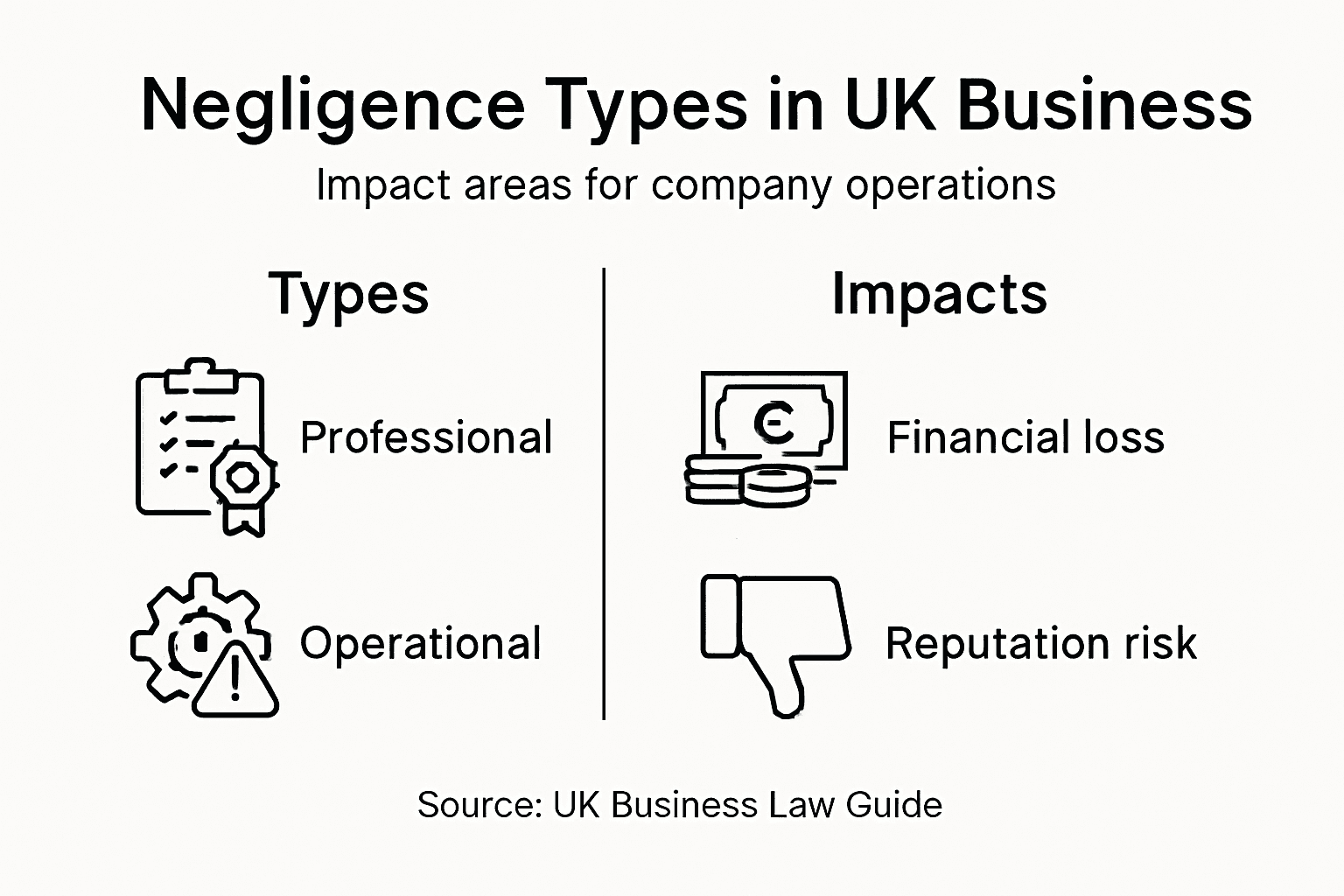
Negligence in law encompasses several distinct categories that business owners must understand to protect their interests. Professional negligence occurs when a professional fails to meet the standard of care expected in their specific field, such as a solicitor providing incorrect legal advice or an accountant making significant financial errors. Personal injury litigation frequently involves these professional negligence claims, highlighting the potential financial and reputational risks for businesses.
Another critical type is medical negligence, which involves healthcare professionals providing substandard care that causes patient harm. This can range from surgical mistakes to misdiagnosis or improper treatment. In the business context, companies in healthcare, insurance, and related sectors must be particularly vigilant about maintaining rigorous professional standards and comprehensive documentation to mitigate potential negligence risks.
Operational negligence represents a broader category affecting businesses across multiple sectors. This includes scenarios where a company fails to implement reasonable safety protocols, maintain equipment, or train staff adequately. For instance, a manufacturing company not providing proper safety equipment, a retail business with inadequate slip prevention measures, or a construction firm neglecting site safety regulations could all face significant legal consequences if their actions directly contribute to workplace injuries or property damage.
Pro tip: Conduct regular risk assessments, maintain comprehensive staff training records, and develop robust safety protocols to demonstrate proactive management and reduce potential negligence exposure.
This table summarises the major types of negligence relevant to UK businesses and highlights their typical business impacts.
| Type of Negligence | Description | Common Business Impact |
|---|---|---|
| Professional | Failure to meet sector standards | Financial loss and loss of reputation |
| Medical | Substandard care by health professionals | Regulatory investigation, patient harm |
| Operational | Poor safety protocols or training | Increased injury claims, legal penalties |
The legal framework for negligence hinges on four critical elements that must be systematically proven. Detailed legal tests reveal the intricate process of establishing negligence, with each component playing a crucial role in determining legal liability. Duty of care represents the first fundamental element, requiring businesses to demonstrate a reasonable obligation to prevent foreseeable harm to others, whether employees, customers, or the general public.

The breach of duty test examines whether a reasonable person in similar circumstances would have acted differently. Courts assess the standard of care expected, considering factors like professional expertise, industry standards, and potential risks. This evaluation is not about perfect prevention but about demonstrating a responsible approach to risk management. For instance, a construction company must provide appropriate safety equipment and training, while a medical practice must follow established professional protocols.
The final two elements - causation and damage - are equally critical. Causation requires proving that the breach directly resulted in the harm, using the ‘but for’ test to establish a clear link between negligent action and consequential damage. Businesses must show that the harm would not have occurred without their specific negligent behaviour. Damage must be real and quantifiable, ranging from physical injury to financial loss, ensuring that the legal claim represents a genuine and substantive impact.
Pro tip: Implement comprehensive documentation systems that record risk assessments, safety protocols, and training records to provide robust evidence of proactive risk management in potential negligence scenarios.
UK businesses operate within a complex legal landscape that demands comprehensive understanding of their duty of care obligations. Legal negligence principles demonstrate that organisations must proactively protect stakeholders from foreseeable harm. This duty extends beyond simple risk avoidance, requiring businesses to anticipate potential dangers and implement robust preventative measures across all operational domains.
The scope of business liability encompasses multiple stakeholder groups, including employees, customers, suppliers, and the broader public. Different sectors face unique risk profiles that demand tailored approaches to managing potential negligence. A retail business might focus on physical safety and premises maintenance, while a professional services firm must prioritise accuracy of advice and confidentiality. Critical considerations include workplace safety protocols, equipment maintenance, staff training, professional standards, and comprehensive insurance coverage that protects against potential legal claims.
Financial risks associated with negligence can be substantial, potentially threatening a business’s entire operational sustainability. Legal claims may result in direct compensation payments, legal fees, regulatory penalties, and significant reputational damage. Small and medium enterprises are particularly vulnerable, as they often lack the financial reserves to absorb extensive legal costs. Successful risk management involves systematic documentation, regular risk assessments, ongoing staff training, and maintaining transparent communication channels that demonstrate a genuine commitment to stakeholder protection.
Pro tip: Develop a comprehensive risk management strategy that includes regular legal audits, staff training programmes, and transparent incident reporting mechanisms to proactively mitigate potential negligence risks.
Defending against potential negligence claims requires a strategic and proactive approach to legal risk management. Business litigation strategies play a critical role in minimising potential legal vulnerabilities. UK businesses must develop comprehensive documentation practices that demonstrate reasonable care and systematic risk mitigation, creating a robust defence against potential negligence allegations.
The primary defence strategies involve thorough record-keeping, implementing rigorous safety protocols, and maintaining clear evidence of due diligence. This includes detailed training records, risk assessment documentation, maintenance logs, and standard operating procedures that showcase the organisation’s commitment to preventing foreseeable harm. Professional indemnity insurance provides an additional layer of protection, offering financial support and legal representation in the event of a negligence claim.
Successful negligence defence relies on presenting compelling evidence that challenges the four fundamental elements of a negligence claim: duty of care, breach of duty, causation, and damage. Businesses must be prepared to demonstrate that they exercised reasonable care, that any alleged breach was not directly responsible for the claimed harm, or that the damage was not a foreseeable or direct consequence of their actions. This requires meticulous documentation, expert testimony, and a comprehensive understanding of legal standards specific to their industry.
Pro tip: Develop a comprehensive incident reporting system that captures immediate details of any potential risk events, ensuring immediate documentation and creating a robust evidence trail for potential future legal challenges.
The following table compares key strategies for defending against negligence claims, helping businesses proactively reduce legal risk.
| Defence Strategy | Main Focus | Typical Benefit |
|---|---|---|
| Record-keeping | Document actions and policies | Provides clear evidence |
| Safety protocols | Prevent workplace accidents | Reduces incident likelihood |
| Staff training | Improve employee awareness | Minimises careless acts |
| Professional indemnity | Financial cover for claims | Lowers business exposure |
Understanding the complexities of negligence law is vital for UK business owners seeking to safeguard their operations and reputation. This article highlights key challenges such as proving duty of care, breach, causation, and actual damage — important elements that can have serious financial and legal consequences if mishandled. Businesses face ongoing risks from professional, medical, and operational negligence, making it essential to adopt proactive risk management strategies and rigorous documentation.
At Ali Legal, we specialise in helping businesses navigate these demanding legal landscapes with clear, straightforward advice tailored to your unique needs. Our client-centric approach ensures you receive transparent support focused on reducing liability and defending against negligence claims effectively. Whether you need guidance on staff training compliance or robust safety protocols, our expertise in civil litigation and corporate law helps you act fast and decisively.

Don’t leave your business vulnerable to costly negligence claims. Contact us today for a personalised consultation and discover how our fixed-fee, transparent legal services can protect your interests and build long-term resilience. Take the first step now by reaching out via Ali Legal Contact. Learn more about how to approach personal injury litigation or discuss tailored solutions with our experienced solicitors. Your business deserves the best defence—get in touch with Ali Legal immediately.
Negligence in law refers to a failure to exercise reasonable care that results in harm or financial loss to another party. It is a key principle in tort law and requires the establishment of four elements: duty of care, breach of that duty, causation, and actual damage.
UK business owners can defend against negligence claims by maintaining thorough records, implementing rigorous safety protocols, conducting regular staff training, and obtaining professional indemnity insurance to provide financial support in case of a claim.
The main types of negligence affecting businesses include professional negligence, which occurs when professionals fail to meet industry standards; medical negligence involving healthcare professionals providing substandard care; and operational negligence, which pertains to inadequate safety protocols or training within a business.
To manage duty of care obligations, businesses should conduct regular risk assessments, implement robust safety protocols, maintain comprehensive training records, and ensure transparency in communication to protect stakeholders from foreseeable harm.


