
Menu
Get Expert Legal Support Today

Most british families and property owners face pivotal moments where expert legal representation can mean the difference between successful outcomes and costly mistakes. In the United Kingdom, over 60 percent of high-value disputes hinge on highly skilled advocacy and strategic legal support. When assets or family interests are at stake, understanding who truly protects your rights within the british legal framework is essential. This overview reveals what sets professional legal representation apart, helping you make focused decisions with genuine confidence.
Legal representation in the United Kingdom represents a sophisticated framework of professional advocacy and legal support. At its core, legal representation involves acting on behalf of clients within complex judicial and administrative systems. Solicitors, barristers, and legal professionals serve as authorised agents who protect individual and organisational legal interests through expert guidance and strategic intervention.
The scope of legal representation extends far beyond simple courtroom advocacy. It encompasses a comprehensive range of services including providing strategic legal advice, negotiating settlements, preparing critical legal documentation, and representing clients’ interests across various legal domains. Authorised legal agents protect client rights through precise understanding of statutory regulations, procedural requirements, and nuanced interpretational strategies.
Understanding legal representation involves recognising its multifaceted nature. Different legal scenarios demand specific representation approaches - from civil litigation and family law disputes to corporate negotiations and criminal defence proceedings. Professional legal representatives analyse individual case circumstances, develop tailored strategies, and provide robust advocacy that navigates the intricate British legal landscape.
Pro tip: When seeking legal representation, always verify a solicitor’s specialisation and professional credentials to ensure they possess specific expertise relevant to your unique legal challenge.
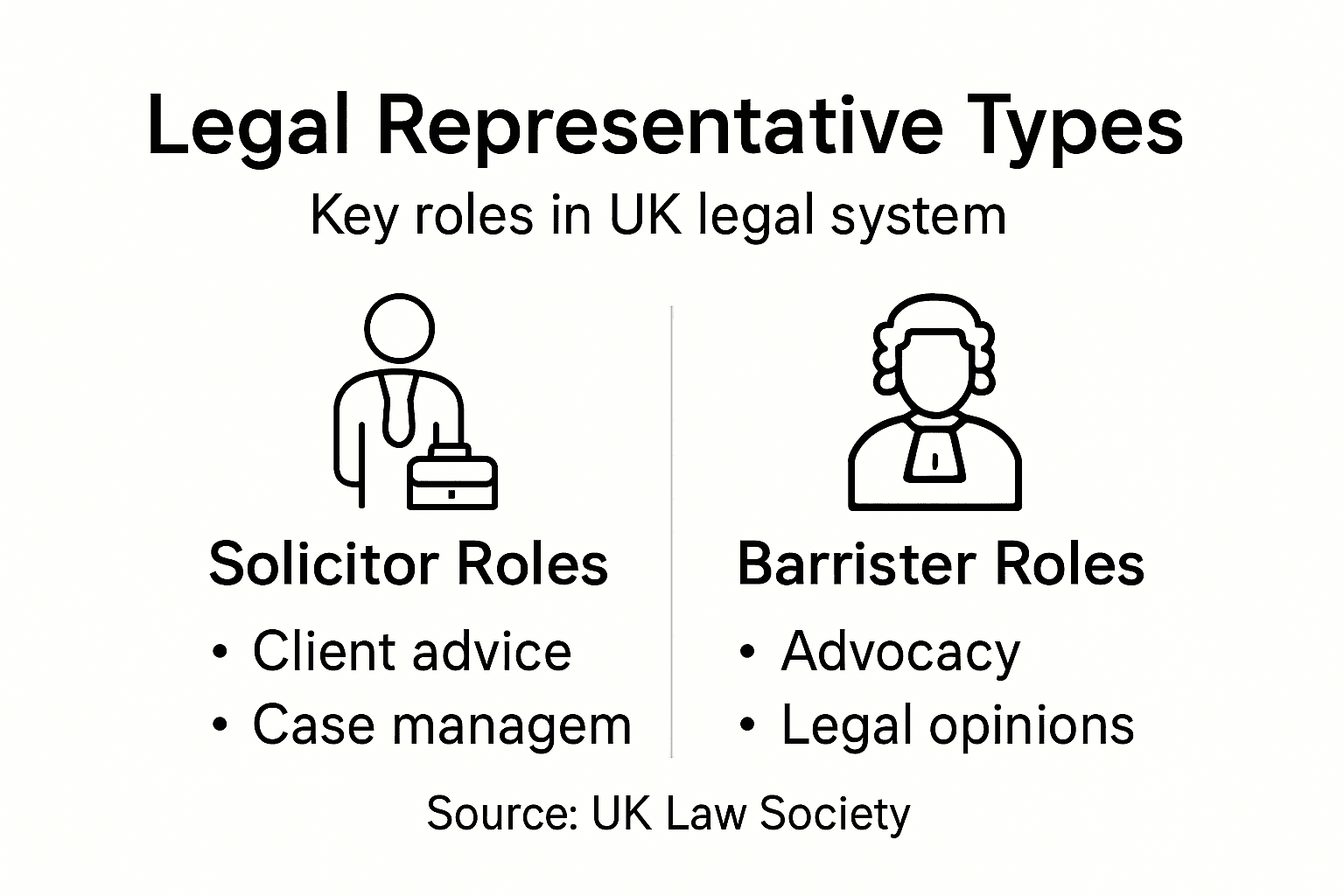
The United Kingdom’s legal profession comprises several distinct categories of legal representatives, each playing a crucial role in delivering comprehensive legal services. Solicitors remain the primary legal professionals who provide direct client advice, prepare legal documentation, and manage case preparations across numerous practice areas. These versatile legal practitioners serve as initial points of contact for individuals and organisations seeking professional legal guidance.
Barristers constitute another essential category of legal representatives, specialising in courtroom advocacy and complex litigation strategies. While solicitors typically handle initial case management, barristers offer specialist expertise in presenting arguments, interpreting legal precedents, and representing clients during court proceedings. Their advanced training enables them to provide sophisticated legal analysis and represent clients in higher courts with exceptional skill.
Chartered Legal Executives represent a specialist category within the legal profession. These professionals often focus on specific legal domains, offering deep expertise in areas such as property law, litigation, or family law. Working closely alongside solicitors, Chartered Legal Executives bring specialised knowledge and can undertake reserved legal activities under professional supervision, providing clients with targeted and cost-effective legal support.
Pro tip: When selecting a legal representative, carefully assess their specific qualifications, specialisation, and professional regulatory status to ensure they precisely match your legal requirements.
Here is a summary of the main types of legal representatives in the UK and their core areas of expertise:
| Legal Representative Type | Primary Functions | Typical Areas of Expertise |
|---|---|---|
| Solicitor | Client advice, documentation, case management | Conveyancing, family law, probate |
| Barrister | Court advocacy, litigation strategy | Criminal defence, civil litigation |
| Chartered Legal Executive | Specialist legal services, reserved activities under supervision | Property law, family law, litigation |
Legal rights in the United Kingdom represent a comprehensive framework designed to protect individuals’ interests and ensure fair treatment within the judicial system. These fundamental rights guarantee access to legal representation, enabling citizens to seek professional guidance and support across various legal domains. The Legal Services Act plays a critical role in regulating how legal representation is provided, ensuring transparency, fairness, and professional standards are consistently maintained.

The legal framework extends beyond courtroom representation to encompass broader decision-making protections. Statutory provisions for legal representation include mechanisms such as powers of attorney and guardianship, which allow appointed individuals to make decisions on behalf of those who lack legal capacity. These frameworks provide crucial safeguards, ensuring vulnerable individuals receive appropriate legal support and protection of their personal and financial interests.
Key legal rights in the United Kingdom are anchored in principles of individual autonomy and procedural justice. This includes the right to a fair hearing, the ability to challenge legal decisions, and access to independent legal advice. The intricate balance between individual rights and systemic protections ensures that legal representation serves not just as a procedural mechanism, but as a fundamental instrument of social justice and personal empowerment.
Pro tip: Always request detailed documentation outlining the specific legal rights and representation scope before engaging with any legal professional to ensure complete understanding of your legal protections.
Legal representatives in the United Kingdom operate under a comprehensive set of professional responsibilities that extend far beyond simple legal advice. Their core function involves providing strategic guidance, protecting client interests, and ensuring comprehensive representation across complex legal landscapes. These professionals are obligated to maintain the highest standards of professional conduct, which includes delivering clear, accurate advice and representing clients with unwavering commitment and ethical integrity.
The duty of care represents a fundamental responsibility for legal representatives. Professional legal conduct mandates strict adherence to confidentiality, ethical standards, and client-focused communication. This involves meticulously navigating legal processes, interpreting complex regulations, and providing transparent guidance that empowers clients to make informed decisions. Legal representatives must balance technical legal expertise with compassionate understanding of individual client needs.
Beyond individual case management, legal representatives play a crucial role in facilitating access to justice. Their responsibilities include interpreting legal frameworks, negotiating on behalf of clients, preparing comprehensive legal documentation, and representing clients in courts and tribunals. This multifaceted role requires exceptional communication skills, deep legal knowledge, and the ability to strategically advocate for client interests across various legal domains.
Pro tip: Request a clear engagement letter from your legal representative that explicitly outlines their specific responsibilities, communication protocols, and expected outcomes to ensure complete transparency.
Legal representation costs in the United Kingdom vary significantly depending on case complexity, legal domain, and the specific services required. While traditional hourly billing remains common, many legal practices now offer fixed fee arrangements to provide greater financial predictability for clients. These structured pricing models help individuals and businesses understand their potential financial commitments upfront, reducing uncertainty and potential financial stress.
Understanding the potential pitfalls is crucial for managing legal expenses effectively. Legal service funding options range from traditional payment methods to specialised schemes like legal aid, which can provide support for those with limited financial resources. Common challenges include unexpected additional charges, unclear fee structures, and misunderstandings about the scope of legal services. Clients must carefully review engagement letters, request detailed cost breakdowns, and seek clarification on potential extra expenses before committing to legal representation.
To mitigate financial risks, individuals should adopt a proactive approach to managing legal costs. This involves requesting comprehensive written estimates, understanding different fee arrangements (hourly rates, fixed fees, conditional fees), and discussing potential additional expenses. Some legal representatives offer initial consultation sessions that can help clients assess potential costs and develop a clear understanding of the financial implications of their legal matter.
Below is an overview of common legal fee structures and their potential advantages and drawbacks:
| Fee Structure | Description | Potential Benefits | Possible Drawbacks |
|---|---|---|---|
| Hourly Rate | Charged per hour of work | Flexible, pays as needed | Costs can escalate |
| Fixed Fee | Set total cost for services | Predictable budgeting | Limited scope |
| Conditional Fee | Pay only if successful | Reduces upfront costs | May include higher percent charges |
Pro tip: Always request a detailed, written breakdown of potential legal costs and ask for a written estimate with clear explanations of what services are included and what might incur additional charges.
Navigating legal matters in the United Kingdom requires knowledgeable guidance and trusted representation. This article highlights the complexity of legal representation, including the vital roles of solicitors, barristers, and Charter Legal Executives, alongside understanding your rights and costs involved. If you face challenges understanding these legal frameworks or require clear, strategic advice with transparent fees, you are not alone. At Ali Legal, we understand that clarity and trust in legal representation are essential to protect your rights and interests effectively.
Discover how our client-focused services in areas such as civil litigation, family law, and more can provide the expert advice and support you need. For tailored insights please explore our Uncategorized | Ali Legal resources.

Take control of your legal journey now by consulting with our dedicated team. Benefit from fixed fees, straightforward advice, and a commitment to building long-term relationships. Start by getting in touch today through our contact page and get expert legal representation that puts you first.
Legal representation in the UK involves acting on behalf of clients within judicial and administrative systems, providing various services such as strategic legal advice, negotiation, and court advocacy through qualified legal professionals like solicitors and barristers.
The primary types of legal representatives include solicitors, who manage client cases and provide advice; barristers, who specialise in courtroom advocacy and litigation; and Chartered Legal Executives, who focus on specific legal areas under professional supervision.
Legal rights associated with representation include access to legal guidance, the right to a fair hearing, and mechanisms to challenge legal decisions, all ensuring individuals receive appropriate support and protection in the justice system.
Cost management for legal representation can be done through understanding the various fee structures available, such as hourly rates or fixed fees, requesting detailed written estimates, and discussing potential additional costs upfront with the legal representative.


