
Menu
Get Expert Legal Support Today

Most advice about resolving cross-border business disputes overlooks the impact of international arbitration in shaping outcomes for British companies. As global commerce expands, understanding this private legal process can make the difference between a swift resolution and costly litigation. With over 170 countries enforcing arbitral awards, mastering the core principles of international arbitration gives British businesses and individuals vital advantages in protecting their interests worldwide.
International arbitration represents a sophisticated private dispute resolution mechanism enabling parties from different jurisdictions to resolve conflicts outside traditional court systems. At its core, this approach allows businesses and individuals to settle disputes through neutral arbitrators, creating a flexible alternative to national legal frameworks.
The fundamental principle of international arbitration centres on party autonomy. Participants have significant control over the dispute resolution process, including selecting arbitrators, determining procedural rules, and choosing applicable legal standards. This collaborative approach ensures that complex international disputes can be resolved with mutual agreement and respect for each party’s legal interests.
Key characteristics of international arbitration include its binding nature and widespread enforceability. Arbitration awards typically carry substantial legal weight, with limited grounds for challenge in national courts. The process prioritises confidentiality, efficiency, and specialised expertise, making it particularly attractive for cross-border commercial and investment disputes.
Pro Tip: Legal Preparation: Before entering international arbitration, meticulously document all contractual agreements and potential dispute scenarios to strengthen your procedural position and streamline potential resolution processes.
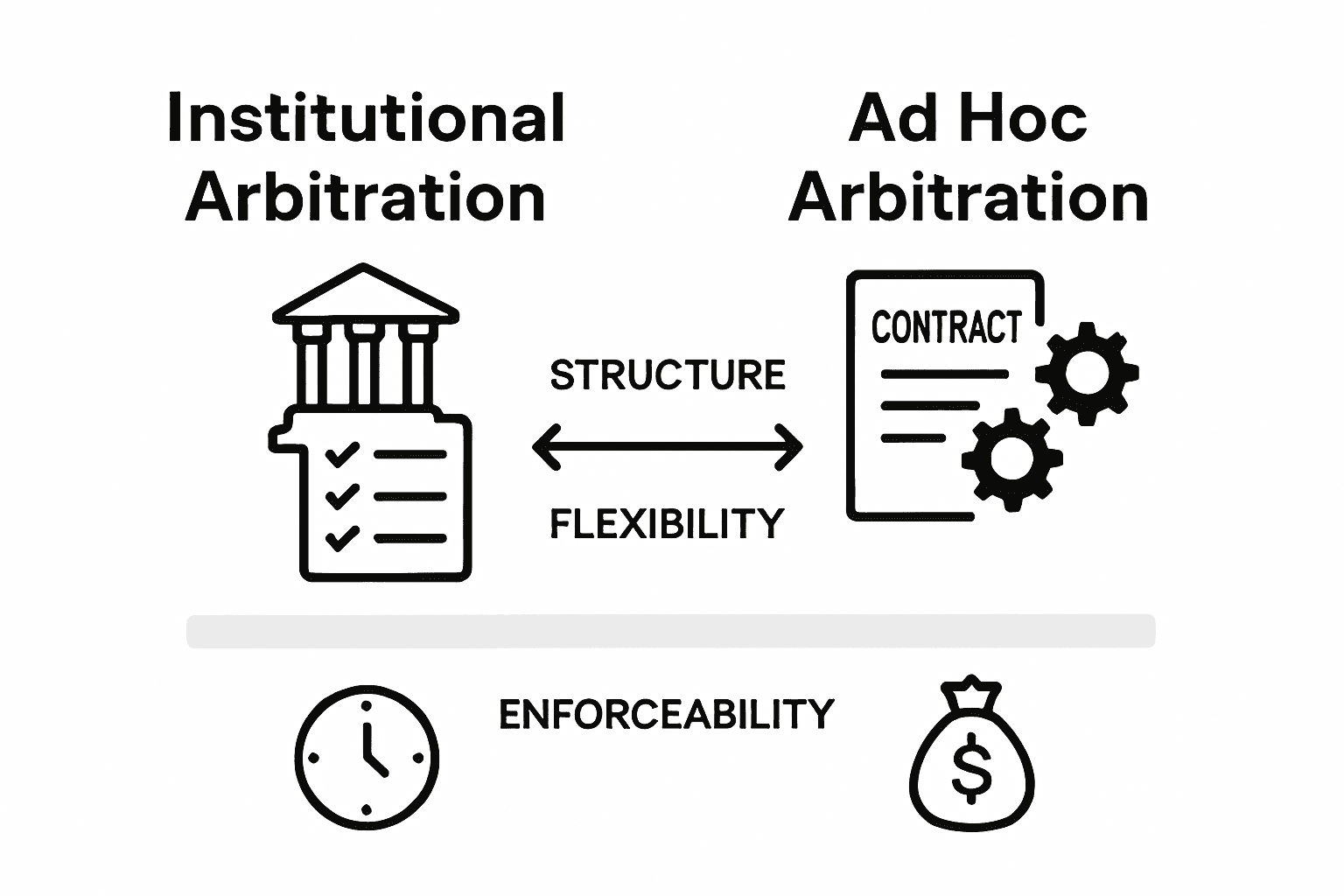
Arbitration encompasses several distinct approaches, with two primary categories emerging from institutional frameworks: institutional arbitration and ad hoc arbitration. Institutional arbitration involves established organizations managing the entire dispute resolution process, providing structured procedural rules, administrative support, and standardised protocols. These institutions, such as the International Chamber of Commerce, ensure professional oversight and consistent resolution mechanisms.
Alternatively, ad hoc arbitration offers parties greater flexibility in designing their dispute resolution process. Without institutional intervention, participants have more control over selecting arbitrators, determining procedural rules, and managing timelines. This approach requires significant mutual cooperation and sophisticated negotiation skills from all involved parties.
Furthermore, arbitration methods can be distinguished by their decision-making processes. Conventional arbitration differs markedly from final-offer arbitration in how awards are determined. In conventional arbitration, arbitrators comprehensively evaluate presented evidence and craft nuanced decisions. Conversely, final-offer arbitration compels arbitrators to select entirely between the final proposals submitted by disputing parties, creating a more binary resolution approach.
Pro Tip: Strategic Selection: When choosing an arbitration method, carefully assess the complexity of your dispute, desired level of procedural control, and potential long-term relationship implications between parties.
The following table summarises key differences between institutional and ad hoc arbitration to support method selection:
| Characteristic | Institutional Arbitration | Ad Hoc Arbitration |
|---|---|---|
| Administrative Support | Managed by established organisation | Managed solely by parties |
| Procedural Rules | Pre-set, comprehensive, standardised | Customisable by parties |
| Cost Predictability | More predictable, standard fee structures | Varies, potential for unexpected costs |
| Flexibility | Limited; relies on institution’s procedures | High; full party control |
| Speed of Proceedings | Typically more regulated and structured | Can be faster or slower, highly variable |
| Suitable for | Complex, high-value or multi-party disputes | Less complex, well-cooperating parties |
International arbitration operates within complex legal landscapes, with global frameworks designed to standardise dispute resolution processes. The UNCITRAL Model Law stands as a pivotal instrument, providing comprehensive guidelines that enable consistent interpretation and application of arbitration principles across diverse jurisdictional boundaries. This model law establishes critical standards for procedural fairness, ensuring that international commercial disputes can be resolved with transparency and predictability.
Key legal frameworks governing international arbitration include multiple international treaties and conventions. The New York Convention on the Recognition and Enforcement of Foreign Arbitral Awards remains particularly significant, offering a standardised mechanism for recognising and enforcing arbitration agreements and awards across signatory nations. These frameworks collectively aim to reduce legal uncertainties, promote party autonomy, and create a robust environment for cross-border dispute resolution.
Moreover, arbitration legal frameworks are increasingly adapting to contemporary challenges. Digital technologies, evolving commercial practices, and complex transnational business relationships necessitate dynamic legal interpretations. Contemporary frameworks now address emerging issues such as data protection, digital evidence admissibility, and cross-border enforcement mechanisms, reflecting the increasingly interconnected nature of global commerce.
Pro Tip: Legal Preparation: Thoroughly review the specific arbitration rules and legal frameworks applicable to your jurisdiction before initiating any international dispute resolution process, as nuanced differences can significantly impact procedural outcomes.
Here is a comparison of the main international legal frameworks relevant to arbitration:
| Framework | Primary Purpose | Geographic Scope | Unique Features |
|---|---|---|---|
| UNCITRAL Model Law | Harmonises arbitration laws and outlines standard procedures | Adopted globally | Emphasises party autonomy and procedural fairness |
| New York Convention | Facilitates recognition and enforcement of foreign arbitral awards | 170+ countries | Universal enforceability of awards |
| ICSID Convention | Resolves disputes between foreign investors and states | 150+ member states | Focused on investor–state disputes |
International arbitration follows a structured procedural framework designed to resolve disputes through a systematic and efficient approach. The process typically commences with the establishment of an arbitral tribunal, comprising neutral arbitrators selected by the involved parties or appointed through predetermined mechanisms. These arbitrators possess specialised expertise relevant to the specific dispute, ensuring a knowledgeable and impartial evaluation of complex commercial matters.
The arbitration procedure encompasses several critical stages. Initial proceedings involve comprehensive document exchange and discovery, where parties submit relevant evidence, written statements, and supporting documentation. Subsequent hearings allow both sides to present oral arguments, examine witnesses, and provide detailed testimonies before the arbitral tribunal. This structured approach enables a thorough exploration of the dispute, facilitating a nuanced understanding of the underlying issues and legal considerations.

Upon conclusion of the hearing process, the arbitral tribunal deliberates and prepares a binding decision known as an arbitral award. Unlike traditional court proceedings, arbitration offers greater flexibility in procedural rules, confidentiality, and potential for expedited resolution. The award is typically final and enforceable across multiple jurisdictions, providing a robust mechanism for international dispute settlement that transcends national legal boundaries.
Pro Tip: Strategic Preparation: Meticulously compile and organise all documentary evidence and potential witness testimonies well in advance of arbitration hearings to strengthen your procedural position and enhance the effectiveness of your legal presentation.
International arbitration presents a complex landscape of strategic advantages and potential challenges, requiring careful consideration of its multifaceted nature. The key benefits encompass several critical dimensions, including expedited dispute resolution, enhanced confidentiality, and the ability to select specialised arbitrators with expertise directly relevant to the specific commercial or legal context. This approach offers parties significantly more control over the resolution process compared to traditional litigation.
However, the financial implications of arbitration demand meticulous evaluation. Costs can escalate rapidly, with expenses including arbitrator fees, administrative charges, legal representation, and potential venue expenditures. The binding nature of arbitral awards introduces another crucial risk dimension, as parties have limited opportunities for appeal. This finality necessitates thorough preparation and strategic assessment before committing to the arbitration process, understanding that the decision will be largely conclusive.
Furthermore, international arbitration involves nuanced risks related to jurisdictional complexities and enforcement challenges. While arbitral awards are generally recognised across multiple jurisdictions, practical enforcement can vary significantly depending on national legal frameworks. Parties must carefully assess potential geopolitical, legal, and economic factors that might impact the ultimate resolution and implementation of the arbitration outcome.
Pro Tip: Risk Assessment: Conduct a comprehensive preliminary analysis of potential arbitration costs, jurisdictional challenges, and long-term strategic implications before initiating the arbitration process, ensuring a holistic understanding of potential outcomes.
Understanding the complexities of international arbitration requires more than just legal knowledge it demands strategic guidance and clear communication to protect your interests across borders. Whether you face challenges related to arbitrator selection, procedural intricacies, or enforcement of awards, Ali Legal offers expert support tailored to your unique dispute. We appreciate how important party autonomy, binding decisions, and navigating frameworks like the UNCITRAL Model Law are to your case.

Take control of your international dispute resolution now by consulting with specialists who value transparency, speed, and fixed fees. Discover how we simplify complex arbitration processes and help you manage costs and risks effectively. Act today for a strategic advantage and connect with Ali Legal via our contact page to start your journey towards a clear, binding resolution.
International arbitration is a private dispute resolution mechanism that allows parties from different jurisdictions to resolve conflicts outside traditional court systems through neutral arbitrators.
The core principles include party autonomy, which grants participants significant control over the dispute resolution process, including the selection of arbitrators and procedural rules, fostering mutual respect and agreement between parties.
Institutional arbitration is managed by established organisations that provide structured processes, while ad hoc arbitration allows parties greater flexibility in designing the dispute resolution process, relying on mutual cooperation without institutional oversight.
Key benefits of international arbitration include expedited dispute resolution, confidentiality, and the ability to select specialised arbitrators. However, it also carries risks such as potentially high costs, limited opportunities for appeal, and jurisdictional enforcement challenges.


