
Menu
Get Expert Legal Support Today

Over 90 percent of companies expanding internationally encounter at least one major cross-border legal challenge, highlighting the complexity faced by British businesses in the global market. Navigating these obstacles matters because even a minor legal error can lead to costly disputes or regulatory setbacks. This guide breaks down essential legal steps, helping British decision-makers minimize risk and maintain smooth transactions with confidence.
Addressing cross-border legal requirements demands a systematic approach that blends strategic analysis and comprehensive research. Understanding the intricate legal landscape requires careful examination of multiple jurisdictional frameworks to ensure smooth international business transactions.
To effectively assess cross-border legal requirements, start by conducting a thorough jurisdictional analysis. This involves examining specific legal systems, regulatory environments, and potential compliance challenges in each country involved in your transaction. International dispute legal frameworks provide critical insights into the complex interactions between different national legal systems. Focus on identifying potential legal risks, understanding local regulatory standards, and mapping out potential areas of legal complexity.
Your assessment should include detailed investigation of contractual requirements, export regulations, intellectual property protections, and potential taxation implications. Engage local legal experts who understand the nuanced legal environments of specific jurisdictions to provide targeted guidance. Pay special attention to differences in contract interpretation, dispute resolution mechanisms, and potential legal constraints that might impact your business operations.
Professional tip: Always allocate sufficient time and resources for comprehensive legal due diligence before finalising any international business transaction to minimise potential legal risks and unexpected complications.
Here is a comparison of key cross-border legal risks and their typical business impacts:
| Legal Risk Type | Description | Potential Business Impact |
|---|---|---|
| Contractual Ambiguities | Differing contract interpretations | Increased dispute likelihood |
| Regulatory Non-Compliance | Unmet local or international statutes | Fines, legal actions, reputational harm |
| Taxation Differences | Conflicting or unclear tax rules | Unexpected costs, double taxation |
| IP Protection Variances | Inconsistent intellectual property laws | Risk of IP theft or infringement |
| Export Restrictions | Country-specific export controls | Delivery delays, blocked transactions |
Identifying jurisdiction and regulatory obligations forms the critical foundation for navigating international business transactions. This crucial step requires meticulous research and strategic understanding of legal frameworks that govern cross border interactions.
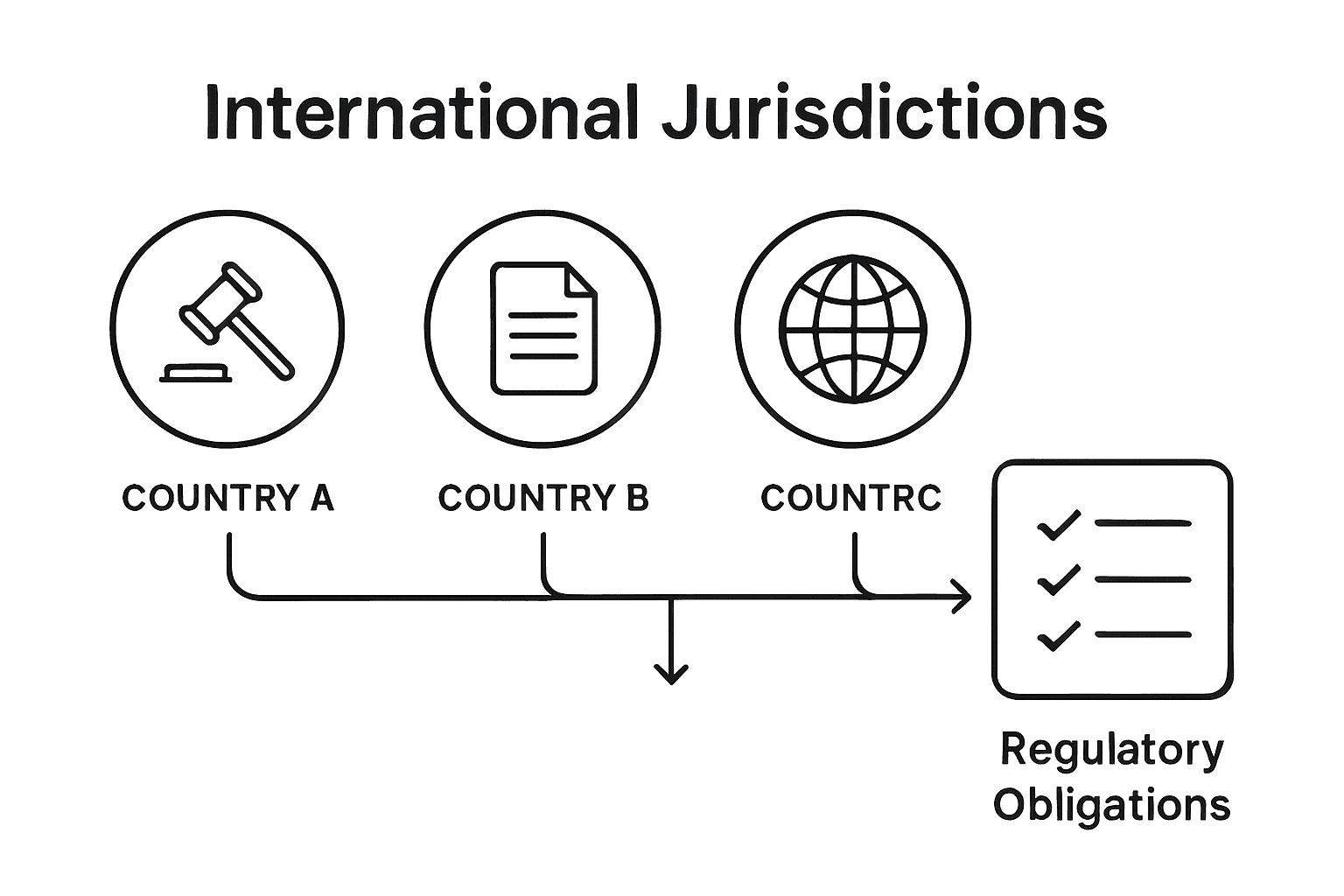
Begin by comprehensively mapping the legal landscapes of all jurisdictions involved in your transaction. Cross border dispute resolution strategies provide essential insights into understanding complex regulatory environments. Examine specific legal requirements, including local legislation, international treaties, compliance standards, and potential regulatory constraints that might impact your business operations. Focus on identifying key differences in legal interpretations, statutory requirements, and potential enforcement mechanisms across different jurisdictional boundaries.
Your jurisdiction assessment should include detailed analysis of specific regulatory frameworks governing your industry, potential licensing requirements, mandatory reporting obligations, and potential legal restrictions. Engage legal professionals with expertise in international regulations to help navigate these complex landscapes. Pay particular attention to nuanced legal interpretations, potential conflict resolution mechanisms, and regulatory compliance requirements that could significantly impact your international business strategy.
Professional tip: Develop a comprehensive regulatory compliance matrix that systematically tracks legal requirements across different jurisdictions to ensure comprehensive and proactive risk management.
Structuring and drafting international contracts requires precision and comprehensive understanding of complex legal frameworks across multiple jurisdictions. This critical process demands meticulous attention to detail and strategic legal planning.

Begin by developing a robust contract structure that accommodates diverse legal systems and international business practices. International business law principles emphasise the importance of creating flexible yet comprehensive contractual frameworks. Carefully draft each clause to address potential jurisdictional variations, ensuring clear language that minimises ambiguity and potential legal disputes. Focus on key elements such as precise definitions, comprehensive scope of work, payment terms, intellectual property protections, confidentiality provisions, and detailed dispute resolution mechanisms.
Your contract drafting process should incorporate thorough risk assessment and cultural considerations. Engage legal experts specialising in international commercial law to review and validate your contract structure. Pay particular attention to nuanced language interpretations, potential regulatory constraints, and specific legal requirements that might differ across various international jurisdictions. Consider incorporating multilingual provisions, clear governing law statements, and explicit clauses that address potential cross border complexities.
Professional tip: Always include comprehensive dispute resolution clauses that specify exact arbitration mechanisms and predetermined jurisdictional frameworks to minimise potential legal uncertainties in international business transactions.
The following table summarises essential elements of a robust international contract:
| Contract Element | Purpose | Why It Matters |
|---|---|---|
| Clear Definitions | Avoids misinterpretation | Minimises future disputes |
| Governing Law Clause | Selects applicable legal system | Ensures consistent enforcement |
| Dispute Resolution Terms | Details resolution process (e.g. arbitration) | Reduces legal uncertainty |
| Payment Terms | Specifies methods and deadlines | Prevents payment confusion |
| Confidentiality Provisions | Protects sensitive information | Safeguards business interests |
Negotiating and formalising international business agreements requires a strategic approach that balances legal precision with cultural sensitivity. This critical stage demands comprehensive preparation and nuanced communication skills to successfully bridge potential gaps between different business practices and legal frameworks.
International business negotiation strategies underscore the importance of thorough preparation and adaptive communication techniques. Begin by conducting comprehensive research on your counterparty’s business culture, legal environment, and specific organisational expectations. Develop a clear negotiation strategy that identifies your core objectives while maintaining flexibility for potential compromises. Prepare detailed documentation that articulates your position, including precise financial terms, performance expectations, risk allocation mechanisms, and comprehensive liability provisions. Ensure your negotiation approach demonstrates respect for cultural differences and promotes collaborative problem solving.
During the formalisation process, carefully document every agreed element with precision and clarity. Engage legal professionals with expertise in international commercial law to review and validate the agreement. Pay particular attention to language translations, ensuring that key terms retain their intended meaning across different linguistic contexts. Verify that the final agreement comprehensively addresses potential scenarios including performance standards, dispute resolution mechanisms, termination conditions, and potential contingencies. Confirm that all parties have a shared understanding of the agreement’s terms and implications.
Professional tip: Always allocate dedicated time for detailed review and seek independent legal counsel to validate the agreement’s comprehensiveness and protect your organisation’s strategic interests.
Implementing and monitoring compliance procedures represents a critical safeguard for international business operations, ensuring legal alignment and minimising potential regulatory risks. This comprehensive process demands meticulous attention and systematic approaches to maintaining organisational integrity across diverse legal environments.
International regulatory compliance strategies emphasise the importance of developing robust monitoring frameworks that adapt to changing legal landscapes. Begin by establishing a comprehensive compliance programme that includes detailed documentation of regulatory requirements specific to each jurisdiction where you operate. Create clear internal protocols that outline reporting mechanisms, accountability structures, and specific procedural steps for maintaining regulatory adherence. Develop a centralised compliance management system that tracks regulatory changes, monitors potential risks, and provides real time updates to relevant organisational stakeholders.
Ensure your compliance monitoring approach incorporates regular internal audits, comprehensive documentation processes, and proactive risk assessment techniques. Engage legal and compliance specialists who can provide expert guidance on navigating complex international regulatory requirements. Implement technology driven solutions that enable efficient tracking of compliance metrics, automated reporting, and rapid identification of potential regulatory discrepancies. Establish a culture of transparency and continuous learning that encourages employees to understand and actively participate in maintaining regulatory compliance.
Professional tip: Develop a dynamic compliance dashboard that provides real time insights into regulatory status and enables rapid response to emerging legal and regulatory challenges.
Expanding your business across borders comes with many complexities such as dealing with diverse jurisdictional obligations, cross border dispute resolution, and drafting watertight international contracts. This article highlights the critical need to assess legal requirements carefully, understand jurisdictional frameworks, and implement robust compliance procedures. Ali Legal is dedicated to helping you overcome these challenges by offering clear, strategic advice tailored to your unique global transactions.

If you want to protect your business and confidently navigate international legal landscapes visit our Uncategorized | Ali Legal section to explore insightful resources. Start the conversation with our expert solicitors today by contacting us through https://alilegal.co.uk/contact-us. Act now to ensure a smoother, risk-managed international expansion supported by transparent legal guidance. For a broad view of our services see All | Ali Legal.
To assess cross-border legal requirements, conduct a thorough jurisdictional analysis to understand specific legal systems and regulations. Begin by identifying potential legal risks and compliance challenges in each jurisdiction involved in your transaction.
When drafting an international contract, incorporate clear definitions, a governing law clause, and detailed dispute resolution terms. Ensure all key elements are well-defined, which helps avoid ambiguities and reduces the likelihood of future disputes.
Identify jurisdictional obligations by mapping the legal landscapes of all jurisdictions involved in the transaction. Research specific regulations, local legislation, and international treaties that apply to your industry to ensure compliance.
Effective negotiation of international agreements involves thorough preparation and understanding the counterparty’s business culture. Develop a clear strategy and articulate your position while demonstrating respect for cultural differences and potential compromises.
To monitor compliance procedures, establish a centralised compliance management system that tracks regulatory changes and potential risks. Regularly conduct internal audits and maintain comprehensive documentation to ensure adherence to the specific regulations in each jurisdiction.


