
Menu
Get Expert Legal Support Today

M&A law is the branch of corporate law that governs how companies are bought, sold, and merged, providing the legal structure for transferring ownership, allocating risk between buyer and seller, and securing any regulatory approvals a deal needs before it can complete. In the UK, the Companies Act 2006 and the City Code on Takeovers and Mergers are the two anchors most transactions sit against.
What this actually covers, in practice:
A merger combines two companies into one, usually through a share exchange or a scheme of arrangement. An acquisition is one company buying another, which happens either as an asset purchase (buying specific assets and contracts, leaving the seller’s company shell behind) or a share purchase (buying the company itself, warts and all).
Public and private deals follow different rulebooks. Private acquisitions are negotiated privately between parties. Public company takeovers must follow the Takeover Code, and bidders choose between a contractual offer, accepted individually by shareholders, or a scheme of arrangement, which needs 75% shareholder approval by value and court sanction.
Why do companies actually do this? Usually one of three reasons:
Every transaction, however different the industries involved, tends to move through the same recognisable stages. Knowing which document belongs where saves you from being blindsided by your own lawyer’s invoice.
Pro Tip: Ask your solicitor for a one-page timeline at the start of the deal, showing which document unlocks which stage. It stops “when will this actually finish?” from becoming a weekly argument.
The lawyer’s job changes depending on which side of the table you sit on, and understanding that split explains a lot about why deals take the shape they do.
Fee structures vary. Fixed fees suit well-scoped transactions with predictable stages; hourly rates suit deals where the scope keeps shifting. Ask which model applies before instructing anyone.
Due diligence exists because the biggest risks in a deal are rarely visible on the surface. Litigation exposure, unpaid tax liabilities, environmental contamination, and underfunded pension schemes are the usual culprits, and they can resurface long after completion if nobody caught them beforehand.
Lawyers deal with this through a specific toolkit:
Price adjustment mechanisms, particularly completion accounts, let the final price move up or down based on the target’s actual financial position at closing rather than a guess made months earlier. On the regulatory side, CMA referrals and NSI Act screening have become routine checks even on mid-sized deals in sensitive sectors, which is why early screening now happens as standard rather than as an afterthought.
Most transactions touch at least one of four regulatory frameworks, and knowing which applies early avoids expensive delays later.
Schemes of arrangement require court sanction and 75% shareholder approval by value, according to Slaughter and May’s takeover guide, while a straightforward contractual offer is accepted or rejected by shareholders individually. Which route a bidder chooses depends heavily on target size, board cooperation, and how quickly they need to squeeze out minority shareholders.
Preparation before your first meeting saves real money, since much of a solicitor’s early time gets spent chasing documents you could have gathered yourself.
Pro Tip: If a seller resists giving you access to their due diligence data room promptly, treat that reluctance itself as information. It usually tells you more than what’s eventually in the folder.
Completion is not the finish line. Filings at Companies House need updating, and corporate registers must reflect the new ownership.
Tax treatment often decides deal structure before anything else gets negotiated. An asset purchase generally lets a buyer choose which liabilities to take on and can offer more favourable capital allowances, but it can trigger higher transfer costs and requires reassigning contracts individually. A share purchase transfers the company wholesale, including its tax history and any latent liabilities, which is exactly why tax warranties and indemnities feature so heavily in share purchase agreements.
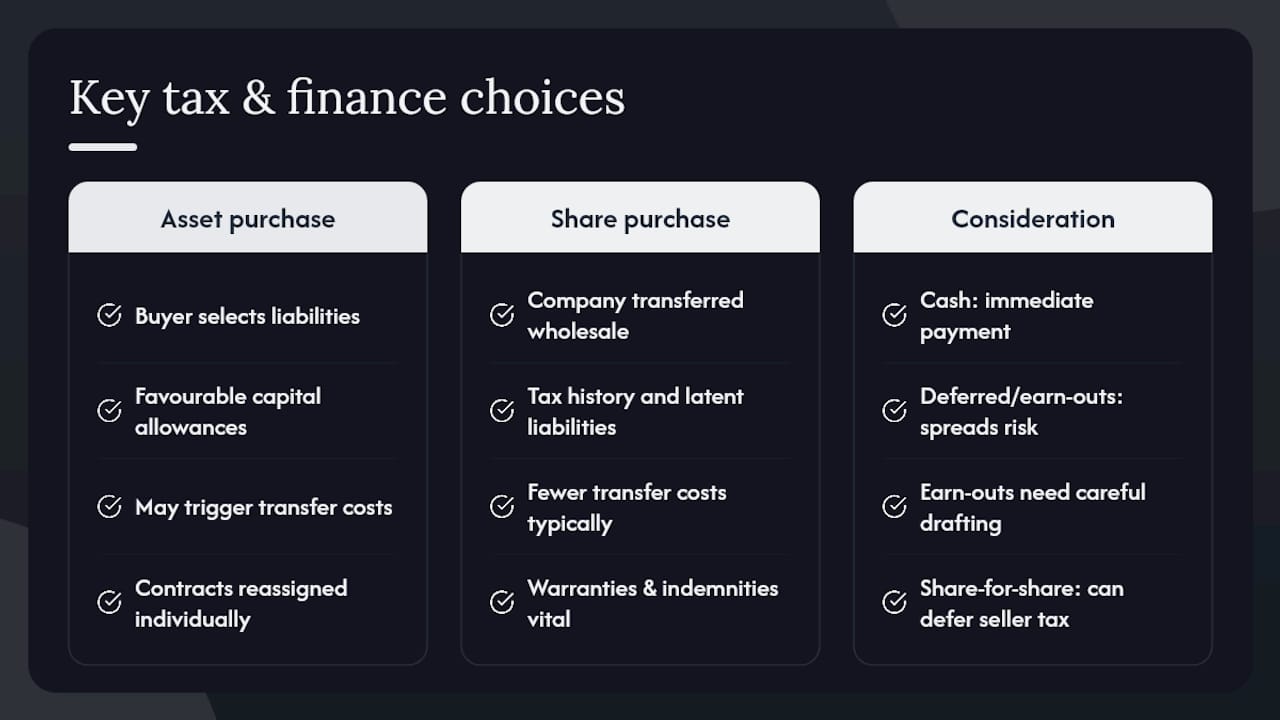
Consideration structure carries its own tax consequences. Cash consideration is straightforward but immediate; deferred consideration or earn-outs spread payment (and risk) over time and need careful drafting to avoid disputes over how the earn-out is calculated. Share-for-share exchanges can defer tax liability for sellers in some circumstances, which is part of why they remain popular in larger strategic mergers.
Working capital adjustments matter more than most first-time sellers expect. A completion accounts mechanism compares the target’s actual financial position at closing against an agreed benchmark, adjusting the final price accordingly. Get this wrong in drafting and you can end up disputing pounds owed months after everyone thought the deal was done.
Stamp duty, VAT treatment on asset transfers, and any relevant group relief provisions also need checking early, since they can materially change the economics of a deal that looked clean on a term sheet.
Valuation shapes every negotiation that follows, and lawyers need to understand roughly how a figure was reached even though the number itself comes from accountants and corporate finance advisers.
The most common approaches include:
No single method dominates; most serious valuations triangulate two or three approaches and negotiate from the overlap. Where valuation methods diverge sharply, that gap often becomes the starting point for price negotiation rather than a reason to abandon the deal. Lawyers translate the agreed figure into completion mechanics: how it’s paid, when, and what protects each side if post-completion figures don’t match what the valuation assumed.
Most SPAs specify a dispute mechanism well before anyone anticipates needing one, and the choice made at drafting stage matters enormously if a claim does arise.
Arbitration is common in cross-border and higher-value deals because it’s private, generally faster than litigation, and easier to enforce internationally under conventions most major jurisdictions have signed. Expert determination suits narrow, technical disagreements, particularly disputes over completion accounts or earn-out calculations, where a specialist accountant can resolve the figures faster than a court could. Court litigation remains the default for many UK domestic deals, particularly where the dispute concerns warranty breaches with substantial evidential complexity.
Escrow releases and warranty claims often carry their own contractual notice periods and procedural requirements, meaning a buyer who spots a problem must act within a defined window or risk losing the right to claim entirely. Getting the drafting right at signing, not scrambling for a remedy after the fact, is what actually protects a claim.
Cross-border transactions add layers that purely domestic deals never face. A UK buyer acquiring a target with overseas subsidiaries needs local counsel in each relevant jurisdiction, since UK warranties and indemnities don’t automatically translate into enforceable protection abroad.

Foreign direct investment screening is now a standing concern well beyond the UK’s own NSI Act. Many jurisdictions, including the EU and the US, run parallel national security or foreign investment reviews that can delay or block deals involving overseas parties, particularly in defence, technology, and critical infrastructure sectors. Currency risk also needs addressing contractually, especially where consideration or earn-outs are calculated in a currency different from the buyer’s reporting currency.
Choice of law and jurisdiction clauses deserve real attention rather than boilerplate treatment, since they determine which country’s courts (or which arbitral seat) would handle a dispute. Recent shareholder litigation across several major cross-border deals illustrates how quickly regulatory scrutiny and shareholder claims can complicate a transaction that looked settled at signing. Employment law also varies sharply by jurisdiction, so a TUPE-equivalent obligation in one country may look nothing like the UK version.
Speed and risk allocation are where specialist counsel earns its fee. A lawyer who has negotiated dozens of SPAs spots the warranty gap or the MAC clause loophole that a generalist would miss, and that difference often shows up months after completion, not at signing.
Ali Legal Ltd’s Corporate & M&A practice works on fixed fees where the deal scope allows it, precisely because clients deserve to know their legal cost before due diligence uncovers the first surprise.
— Panagiotis
This article is general information, not a substitute for advice from a qualified lawyer. Consult a qualified legal professional about your own circumstances before acting on anything here.


