
Menu
Get Expert Legal Support Today

A conveyancer handles the legal work that transfers property ownership, from contract checks and searches through to exchange of contracts and registration at HM Land Registry. Whether you are buying or selling, you will need one, and the law requires them to be regulated.
Your conveyancer’s core tasks cover:
Both solicitors and licensed conveyancers can carry out this work in England and Wales. Solicitors are regulated by the Solicitors Regulation Authority (SRA); licensed conveyancers are regulated by the Council for Licensed Conveyancers (CLC). Check either register before you instruct anyone.
A solicitor’s broader legal training is worth the premium when your transaction involves a dispute, an estate, a divorce, or any legal complexity that sits outside pure property law. For a straightforward purchase or sale, a licensed conveyancer is normally sufficient.
A conveyancer is the specialist who manages the legal transfer of property ownership. The term covers two distinct professionals: a solicitor who handles conveyancing as part of a wider legal practice, and a licensed conveyancer whose entire practice is built around property transactions, including residential sales, mortgages, and lease matters.
The practical difference is scope rather than authority. Both are fully qualified to handle residential conveyancing. The distinction shows up when something goes wrong or when a transaction touches another area of law. A solicitor can advise on the inheritance implications of a joint purchase, handle a boundary dispute that turns litigious, or deal with a divorce that affects the property. A licensed conveyancer cannot, and will refer you elsewhere if those issues arise.
Regulation at a glance:
Pro Tip: If your transaction involves a short lease, a shared ownership scheme, a probate sale, or any dispute about boundaries or rights of way, instruct a solicitor rather than a licensed conveyancer. The extra cost is modest compared with the risk of needing to switch mid-transaction.
The buyer’s conveyancer carries the heaviest workload in a transaction. Here is the sequence from instruction to registration.
Documents and confirmations to expect at each stage:
Pro Tip: Instruct your conveyancer as soon as your offer is accepted, not after the mortgage application. Collecting your identity documents, proof of funds, and source-of-funds evidence early removes one of the most common early-stage delays.
The seller’s conveyancer has a different but equally demanding set of tasks, most of which begin before the buyer’s solicitor has even seen the contract.
Preparing the contract pack:
Managing enquiries and identity checks:
Your conveyancer will verify your identity, check for outstanding charges or restrictions on the title, and reply formally to any enquiries the buyer’s solicitor raises. Inaccurate or incomplete property information forms can lead to post-completion disputes or cause the buyer to withdraw, so your conveyancer will press you to answer every question fully and honestly.

Co-ordinating completion:
On completion day the seller’s conveyancer receives the purchase funds, settles any outstanding mortgage on the property, handles financial apportionments (ground rent, service charges, council tax), and transfers the net proceeds to your account.
Seller’s documents checklist — have these ready before you instruct:
Getting these together early compresses the time between instruction and the contract pack reaching the buyer.
Searches are not optional extras. They reveal legal and physical risks that a visual inspection of the property cannot show, and most mortgage lenders require them as a condition of the loan.

| Search type | What it checks | Why it matters |
|---|---|---|
| Local authority search | Planning permissions, enforcement notices, road adoption, tree preservation orders | Reveals whether the property has unauthorised works or sits near a proposed development |
| Water and drainage search | Whether the property is connected to mains water and sewerage; location of public drains | A drain running under the garden can restrict building works |
| Environmental search | Contaminated land, flood risk, ground stability, radon | Affects insurability, mortgageability, and long-term value |
| Title investigation | Registered ownership, restrictive covenants, easements, rights of way | Confirms the seller can legally sell and flags restrictions on use |
| Chancel repair search | Liability to contribute to church repairs | Rare but can result in an unexpected financial liability |
| Bankruptcy search | Buyer’s and seller’s insolvency status | Required by most mortgage lenders before funds are released |
For title and ownership research, understanding how to verify property ownership is a useful background skill, particularly for unregistered land where the title deeds rather than a Land Registry entry establish ownership.
Pro Tip: Searches cover legal and administrative risk, not physical condition. Order a full structural survey separately. If the environmental search flags contaminated land, commission a specialist ground investigation report before exchanging contracts — remediation costs can run to tens of thousands of pounds.
Buying or selling a leasehold property adds a layer of complexity that freehold transactions simply do not have. Your conveyancer must review the lease itself and obtain a management pack from the freeholder or management company before the contract can proceed.
What the lease review covers:
Common leasehold risks your conveyancer will flag:
A lease with fewer than 70 years remaining at the point of completion will be refused by most high-street lenders. If the lease is short, your conveyancer should advise you on the lease extension process under the Leasehold Reform, Housing and Urban Development Act 1993 before you proceed. Factor in the cost and time of an extension when assessing the purchase price.
The management pack itself, which includes service charge accounts, building insurance details, and any notices served on the property, can take several weeks to arrive. Your conveyancer should request it as early as possible in the transaction.
The honest answer is that timescales vary considerably, and the biggest variable is rarely the conveyancer. Chain length, search turnaround times, and mortgage offer timing all affect the total duration.
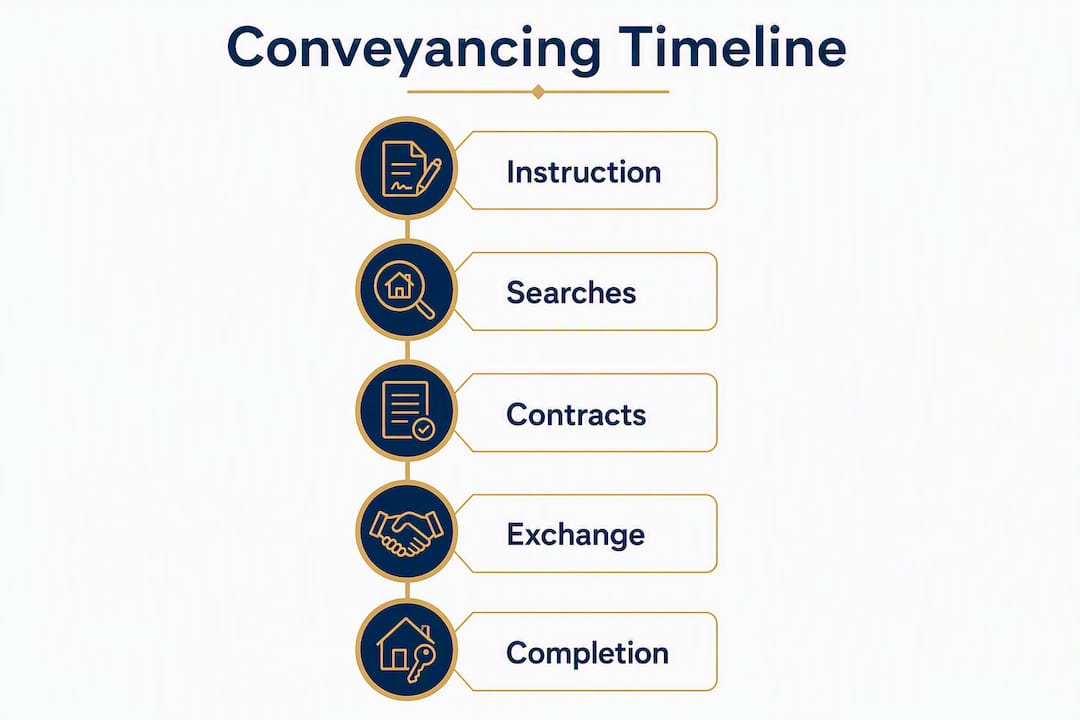
| Stage | Typical duration | What to check with your conveyancer |
|---|---|---|
| Instruction to searches returned | 3–6 weeks | Has the local authority search been submitted? |
| Enquiries raised and resolved | 2–6 weeks | Are all replies received and satisfactory? |
| Mortgage offer confirmed | 2–8 weeks from application | Has the lender received the title report? |
| Exchange of contracts | Once all above are complete | Is the deposit ready? Is the chain exchanged simultaneously? |
| Exchange to completion | 1–4 weeks (by agreement) | Are removal dates confirmed? |
| Post-completion registration | 2–6 weeks | Has the Land Registry application been submitted? |
A straightforward freehold transaction with no chain typically completes in 8–12 weeks from instruction. Add a chain, a leasehold property, or a complex title, and 16–20 weeks is realistic. Searches and unresolved enquiries account for the majority of delays between offer acceptance and exchange.
Pro Tip: If you are in a chain, ask your conveyancer to confirm the position of every party in the chain before you set a target completion date. A completion date that one party cannot meet unravels the whole chain. Weekly progress calls with your conveyancer during the enquiry stage cost nothing and save weeks.
Conveyancing fees have two components: the professional fee charged by the conveyancer, and disbursements, which are third-party costs the conveyancer pays on your behalf and recharges to you.
| Fee type | What it covers | Who typically pays |
|---|---|---|
| Professional fee | Legal work, contract review, correspondence, completion | Buyer and seller (separate firms) |
| Land Registry fee | Registering the transfer and any new mortgage | Buyer |
| Search fees | Local authority, water, environmental, and other searches | Buyer |
| Electronic ID check | Anti-money-laundering identity verification | Buyer and seller |
| Bank transfer (CHAPS) fee | Same-day transfer of completion funds | Buyer and seller |
| Stamp Duty Land Tax (SDLT) handling | Submitting the SDLT return to HMRC | Buyer |
| Leasehold supplement | Management pack, notice of transfer, deed of covenant | Buyer (and sometimes seller) |
Professional fees for a standard residential purchase typically range from £800 to £1,800 plus VAT, depending on property value, complexity, and whether the property is leasehold. Disbursements add a further £300–£600 for a freehold purchase; leasehold transactions carry additional costs for the management pack and notice fees.
Online conveyancing may quote lower professional fees, but practitioners warn that for complex transactions a solicitor’s broader expertise is worth the premium, and low-cost services can lack a single, dedicated contact.
Checklist for comparing quotes:
A quote that bundles everything into one headline figure without an itemised breakdown is a red flag. Ask for a full written estimate before you instruct.
The cheapest quote rarely delivers the fastest or most reliable service. The criteria below will help you make a decision you will not regret six weeks into a stalled transaction.
Selection criteria:
Questions to ask at first contact:
For a fuller framework on selecting a solicitor step by step, Ali Legal Ltd has published a practical guide covering the key questions and criteria.
Red flags to avoid:
Consumers have the right to choose any regulated conveyancer or solicitor. Estate agent recommendations are a reasonable starting point, but always ask whether the agent receives a referral fee and compare at least two or three quotes independently.
Use this checklist at the point of instruction and again before exchange to confirm nothing has been missed. It reflects the practical steps Ali Legal Ltd applies across residential transactions.
At instruction:
During the transaction:
Before exchange:
Before completion:
Every transaction is different. This checklist covers the standard steps, but a leasehold purchase, a probate sale, or a property with a complex title will require additional checks. Contact Ali Legal Ltd for a tailored review of your transaction before you commit.
For a downloadable version with additional compliance steps, see Ali Legal’s property due diligence checklist.
The question clients ask most often is not “what does a conveyancer do?” but “why is this taking so long?” The answer, almost every time, is that someone in the chain has not responded to an enquiry, a search is sitting in a local authority queue, or a mortgage lender is waiting for a document that nobody chased.
The single most effective habit I can recommend is this: respond to your conveyancer within 24 hours, every time. When a conveyancer raises an enquiry or requests a document, the clock stops until they hear back. A week’s delay in returning a signed form can push the entire chain’s completion date back by a fortnight if it misses a lender’s processing window.
The second habit is to read the report on title before you exchange, not after. It is a dense document, but it contains every material fact about what you are buying, including restrictions on use, rights of way, and any conditions the seller has disclosed. Questions raised after exchange are almost always too late to change the outcome.
For complex transactions, particularly those involving leasehold properties, shared ownership, or a title with historic defects, the value of a solicitor over a basic online service is not the price difference. It is the ability to advise on the legal risk, not just process the paperwork.
Ali Legal Ltd offers regulated conveyancing support for buyers and sellers across the UK, with fixed-fee transparency from the first quote and a named solicitor handling your file throughout.

Where many services route your matter through a team of case handlers, Ali Legal Ltd assigns a dedicated solicitor who knows your transaction from instruction to completion. Fixed fees mean the cost you are quoted is the cost you pay, with disbursements itemised separately so there are no surprises on completion day. The firm’s property team handles freehold and leasehold transactions, new builds, shared ownership, and complex titles, with the broader legal expertise to manage any non-conveyancing issues that arise during the process.
For a clear picture of what your transaction involves, start with Ali Legal’s property law compliance checklist, or visit the property and conveyancing service page to speak with a solicitor directly.
When choosing a conveyancer or checking your rights, go to primary sources rather than relying on third-party summaries.
Always verify a conveyancer’s registration number directly on the SRA or CLC register before you instruct. Keep your conveyancer’s name, firm address, and case reference number on file throughout the transaction and for at least six years after completion, in case a title query arises later.
This article provides general information about conveyancing in England and Wales and does not constitute legal advice. Rules, fees, and procedures can change. Confirm current requirements with HM Land Registry, the SRA, the CLC, or a qualified solicitor before making decisions about your transaction.


