
Menu
Get Expert Legal Support Today

TL;DR:
- Commercial arbitration is a private process where parties appoint an independent arbitrator to resolve disputes with a legally binding award. It offers confidentiality, expertise, flexibility, and enforceability in over 170 countries, making it a powerful cross-border dispute resolution tool. Proper drafting of arbitration clauses and careful preparation are essential to maximize its advantages and avoid procedural pitfalls.
Commercial arbitration is defined as a private, consensual dispute resolution process in which parties appoint an independent arbitrator or panel to deliver a legally binding decision, known as an arbitral award, outside of court. That award is enforceable in over 170 countries under the New York Convention, making it one of the most powerful tools available for resolving cross-border commercial disputes. Businesses choose arbitration because it combines the finality of a court judgment with the privacy, flexibility, and expertise that court litigation cannot offer. For anyone entering a commercial contract, understanding how arbitration works is not optional. It is a practical necessity.
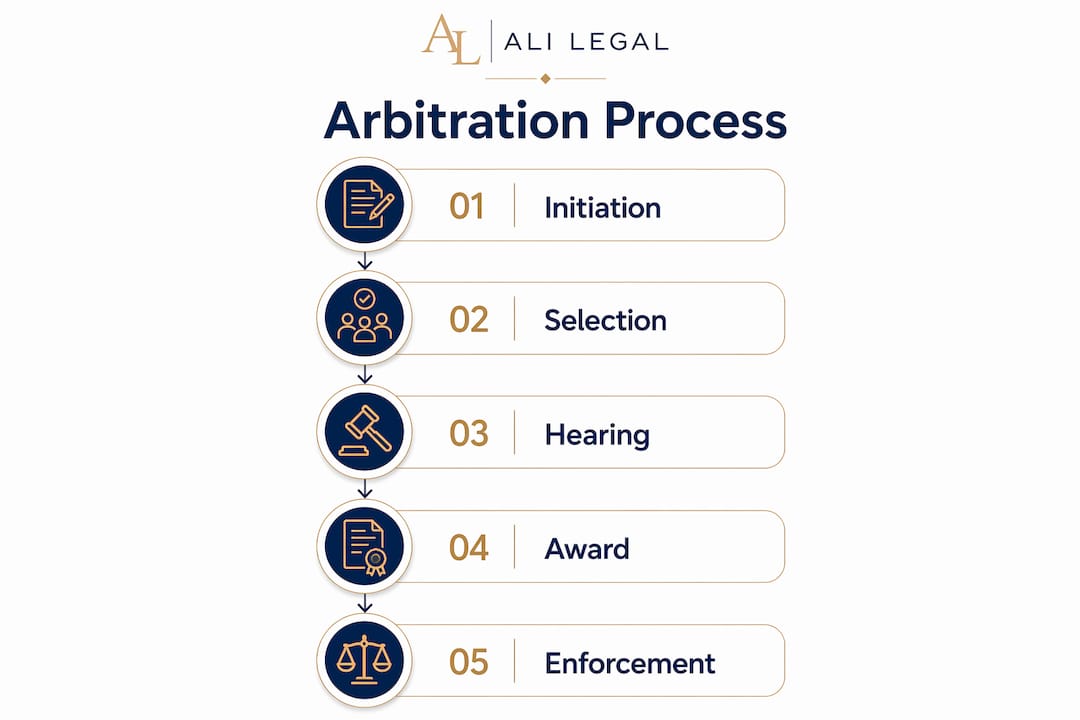
Commercial arbitration is a structured alternative to court litigation. Parties agree, usually through a clause in their contract, to submit any future disputes to one or more arbitrators rather than a judge. The arbitration process typically follows these stages:
Arbitration can be administered by an institution, such as the London Court of International Arbitration or the International Chamber of Commerce, or conducted on an ad hoc basis under rules the parties agree themselves. Institutional arbitration provides administrative support and established procedural frameworks. Ad hoc arbitration offers greater flexibility but demands more from the parties in managing the process.
The seat of arbitration is a critical concept that businesses frequently overlook. The seat determines procedural law and the extent to which national courts can intervene or support the proceedings. It is a legal designation, not simply the physical location of hearings. Choosing London as the seat, for example, brings the proceedings under the Arbitration Act 1996, which sets out the legal framework for arbitration in England and Wales.

Pro Tip: Specify the seat of arbitration explicitly in your contract clause. Leaving it undefined creates a procedural vacuum that opposing parties can exploit to delay or complicate proceedings.
Commercial arbitration offers several advantages that court litigation cannot match. The most significant are confidentiality, expertise, flexibility, finality, and international enforceability.
“Arbitration uniquely allows businesses to resolve disputes confidentially, protecting commercial interests better than court litigation. For businesses where reputation and commercial sensitivity matter, this is not a secondary benefit. It is often the primary reason arbitration is chosen over litigation.”
Arbitration is not without its difficulties. Businesses that enter arbitration without preparation often encounter problems that could have been avoided at the contract drafting stage.
Pro Tip: Treat the arbitration clause as seriously as the commercial terms of the contract. A well-drafted clause prevents procedural disputes and keeps the focus on the substantive issue when a disagreement arises.
You can compare arbitration against other resolution methods in Ali Legal Ltd’s guide to types of dispute resolution for UK businesses.
The arbitration agreement is the foundation of the entire process. A poorly constructed clause does not just create inconvenience. It can render the arbitration unenforceable or trigger years of procedural wrangling before the real dispute is resolved.
The table below summarises the key decisions in drafting an arbitration clause and their practical implications.
| Decision | Institutional arbitration | Ad hoc arbitration |
|---|---|---|
| Administrative support | Provided by the institution | Parties manage themselves |
| Procedural rules | Pre-established by institution | Agreed by parties |
| Cost | Higher institutional fees | Lower fees, higher management burden |
| Suitable for | Most commercial disputes | Experienced parties, simpler disputes |
| Flexibility | Moderate | High |
Early legal advice on clause drafting pays for itself many times over. Ali Legal Ltd’s analysis of arbitration clauses in UK contracts sets out the practical considerations in detail.
After working across a range of commercial disputes, the pattern I see most often is not a failure of arbitration itself. It is a failure of preparation. Businesses spend months negotiating the commercial terms of a contract and then accept a boilerplate arbitration clause without reading it carefully. That clause then becomes the most consequential paragraph in the entire document the moment a dispute arises.
The flexibility that makes arbitration attractive is also what makes it dangerous without proper drafting. I have seen disputes where the parties spent more time arguing about the arbitration procedure than about the underlying commercial disagreement. That outcome is entirely avoidable. Selecting arbitrators with genuine expertise in the relevant field, specifying the seat, and agreeing on procedural rules at the outset transforms arbitration from a theoretical advantage into a practical one.
Arbitration’s growing international significance is real. The New York Convention’s reach across 172 countries means that a well-obtained arbitral award travels further and faster than any court judgment. For businesses operating across borders, that enforceability is not a minor benefit. It is the difference between a recoverable debt and an unenforceable paper judgment. The businesses that use arbitration most effectively treat it as a system to be designed, not a default to be accepted.
— Panagiotis
Commercial arbitration works best when the legal groundwork is laid before a dispute arises. Ali Legal Ltd advises businesses on drafting arbitration agreements, selecting appropriate procedural rules, and navigating the arbitration process when disputes occur.

Ali Legal Ltd’s team has experience across international disputes and arbitration, including cross-border enforcement and multi-jurisdictional proceedings. Whether you are entering a new commercial contract or facing an existing dispute, Ali Legal Ltd provides clear, fixed-fee advice without unnecessary complexity. For businesses that need broader corporate and dispute resolution guidance, the corporate law guide covers the full legal framework. Contact Ali Legal Ltd to discuss your arbitration needs directly.
Commercial arbitration is a private, consensual process in which parties appoint an independent arbitrator or panel to resolve a dispute through a legally binding arbitral award, as an alternative to court litigation.
Arbitration is private, flexible, and produces awards enforceable in 172 countries under the New York Convention. Court litigation is public, procedurally rigid, and cross-border enforcement of judgments is significantly more complex.
The Arbitration Act 1996 governs commercial arbitration in England and Wales, setting out the legal framework for arbitration agreements, arbitrator appointments, and the supervisory role of the courts.
Grounds for appeal are narrow and vary by jurisdiction. Some jurisdictions allow parties to contract out of appeals entirely, which increases certainty but also the risk of accepting an erroneous decision.
A good arbitration agreement specifies the seat, governing law, number and expertise of arbitrators, procedural rules, and the scope of disputes covered. Incomplete clauses frequently lead to costly procedural disputes before the substantive issue is addressed.


