
Menu
Get Expert Legal Support Today
TL;DR:
- While not legally required, hiring a solicitor is practically essential to navigate complex contracts, liabilities, and licences when buying a business. They perform due diligence, review documents, negotiate terms, and protect buyers from costly hidden risks that can cause deal failure. Skipping legal advice often leads to significant financial exposure, faulty agreements, and post-completion problems that can outweigh the cost of professional support.
There is a widespread assumption that buying a business must involve a solicitor by law. It does not. In the UK, no legal requirement compels you to hire one. But the moment you look at what is actually at stake — contracts, liabilities, employee obligations, licences, leases, and warranties — the question shifts from “do I need a solicitor to buy a business?” to “can I really afford not to?” This article walks you through what solicitors do, when their involvement matters most, when it might be less critical, what fees look like, and how to make the right call for your situation.
Legally speaking, no. Practically speaking, the answer is almost always yes. The complexity that sits beneath even a modest acquisition is the kind of thing that trips up experienced buyers, not just first-timers.
When you hire a solicitor for a business purchase, you are not just paying for someone to read paperwork. You are paying for someone to know what to look for, what to push back on, and what could cost you far more than their fee if left unchecked.
A solicitor’s work in a typical acquisition covers a lot of ground:
Solicitors identify red flags in contracts, employee agreements, and licences that directly affect whether a business is worth buying at all. They also handle the post-completion transition, including asset transfers and regulatory updates that buyers often underestimate until they are standing in the middle of them.
One area buyers consistently overlook is legal due diligence on licences, leases, and liabilities. A lease that cannot be transferred, a licence that lapses on change of ownership, or a lien against business assets can each independently unravel a deal after you have already committed funds.
Pro Tip: Ask your solicitor to specifically confirm the transferability of every key licence and commercial lease before you proceed past heads of terms. This single check has saved buyers from committing to businesses they could not legally operate.
The importance of legal help in business acquisitions becomes clearest when you realise that warranties and indemnities in the sale agreement are your primary recourse if the seller has misrepresented the business. Without a solicitor drafting and scrutinising those clauses, you may have little legal protection after completion.
This is where the numbers start to tell a story. Approximately 30% of business deals fail due to hidden liabilities, financing issues, or poorly structured terms. That is not a small margin of error. That is almost one in three transactions going wrong, often after significant time and money have already been spent.
Buying a business without a solicitor leaves you exposed on several fronts:
Then there is the psychological dimension. Solicitors provide an emotional buffer in negotiations, preventing buyers from signing bad deals out of excitement or pressure. This phenomenon, sometimes called “deal fever,” is more common than buyers admit. When you have spent months finding the right business, negotiating terms, and imagining the future, your objectivity is compromised. A solicitor has no emotional stake in the deal closing. That detachment is worth a great deal.
The honest comparison is this: solicitor fees for buying a business will typically run into the thousands. Cleaning up a deal gone wrong can run into the hundreds of thousands. The cost-benefit calculation is not complicated.
There are circumstances where the complexity is genuinely low enough that some buyers choose to proceed without formal legal support. These are the exception, not the rule, and they require a clear-eyed assessment of what you are actually dealing with.
Even relatively simple acquisitions still carry risks, but a transaction might be lower risk when:
Even in these cases, risks remain. Verbal agreements, informal arrangements with suppliers, and undisclosed personal tax liabilities of the previous owner can all create problems. Business brokers can handle some of the process in simpler transactions, but their role is commercial rather than legal. They can facilitate a deal; they cannot protect you from its legal consequences.
The honest measure is this: if you are unsure whether your transaction is simple enough to proceed without legal advice, it probably is not. Complexity has a way of hiding until the wrong moment.
Not all solicitors are equally suited to business acquisitions. Choosing the right one matters as much as choosing to hire one at all. You want someone who specialises in business acquisitions, understands your sector, and communicates clearly without drowning you in legalese.
Look for these qualities when making your selection:
Pro Tip: Before instructing a solicitor, ask specifically what is and is not included in their quoted fee. Post-completion work, TUPE advice, and lease assignment negotiations are often billed separately, and those extras can add up quickly.
When comparing solicitors, a good due diligence template can help you understand the scope of what needs to be reviewed. It also gives you a useful basis for assessing whether the solicitor you are speaking to is covering the full picture or only part of it.
Here is a direct comparison to help you weigh the decision:
| Factor | With a solicitor | Without a solicitor |
|---|---|---|
| Hidden liabilities | Identified and addressed in contract | Risk transferred to buyer |
| Contract terms | Negotiated and legally sound | Potentially one-sided or unenforceable |
| Licence and lease checks | Confirmed transferable before completion | May only be discovered post-completion |
| Emotional detachment | Professional buffer during negotiations | Buyer’s judgement can be compromised |
| Post-completion compliance | Managed and documented | Buyer’s sole responsibility |
| Upfront cost | Solicitor fees (typically £1,500 to £5,000+) | Lower upfront spend |
| Risk-adjusted cost | Generally lower over time | Potentially very high if problems arise |
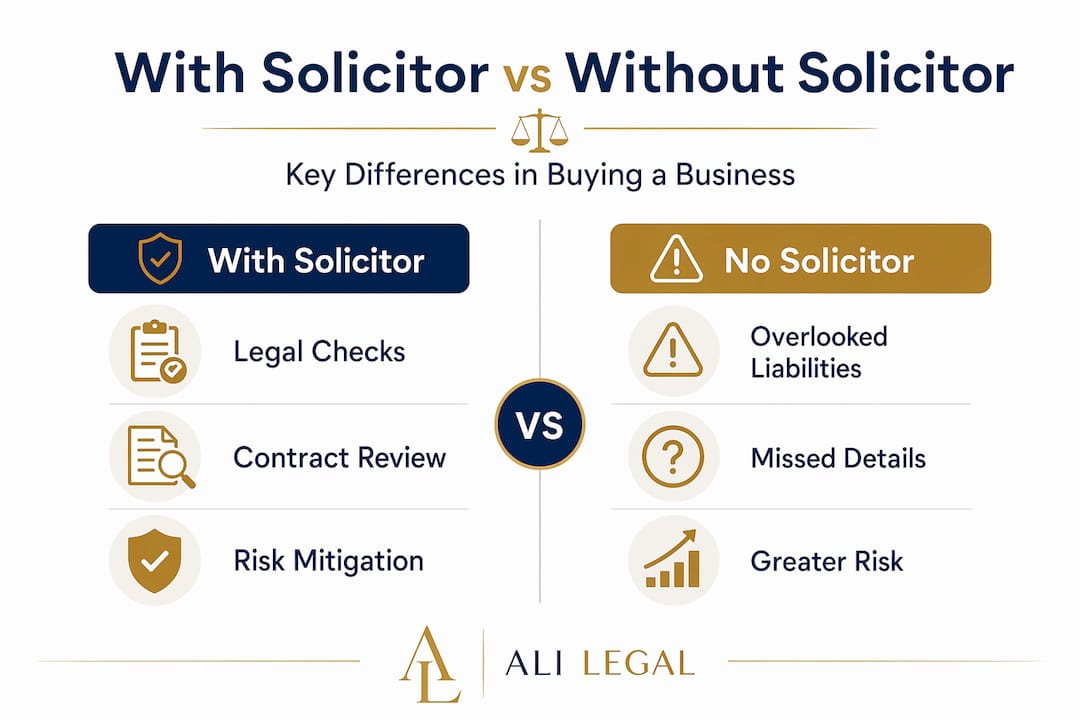
The intangible benefits of having a solicitor are harder to put in a table but no less real. Professional detachment, negotiation leverage, and the confidence of knowing someone is protecting your position are not abstract concepts. They affect the quality of the deal you end up with.
I’ve seen entrepreneurs make this mistake more than once, and it almost always follows the same pattern. The business looks straightforward, the seller seems trustworthy, and the buyer convinces themselves that paying solicitor fees is an unnecessary expense on a deal they have already mentally closed. Then something surfaces post-completion. A tax liability. A lease that cannot be transferred. An employee dispute that predates the sale but lands squarely on the new owner.
What I’ve learned is that “buying a business without a solicitor” is rarely a rational financial decision. It is usually an emotional one dressed up as pragmatism. The excitement of acquisition clouds the judgement, and the cost of legal advice feels like friction rather than protection.
In my experience, the buyers who regret involving a solicitor are almost none. The buyers who regret not involving one are far too many. That asymmetry should tell you something. If you are weighing up whether to seek legal advice for a business purchase, the complexity of the transaction is almost certainly higher than it appears from the outside.
Engage a solicitor early. Not after heads of terms are signed and you have already committed emotionally and financially. Before you even approach that stage, so that they can shape the process from the start rather than fix problems after the fact.
— Panagiotis
Whether you are buying your first business or your fifth, having the right legal team changes the outcome. Alilegal works with entrepreneurs at every stage of the acquisition process, from initial due diligence through to post-completion compliance. If a dispute arises after purchase, the commercial litigation team at Alilegal is built for exactly that kind of complex, high-stakes challenge.

For buyers who want expert support from solicitors who specialise in business acquisitions, transparent fixed-fee arrangements, and clear communication throughout, Alilegal offers the legal services you need without the jargon. Get in touch directly for a personalised consultation and a clear fee estimate before you commit to anything.
No. There is no statutory obligation in the UK to hire a solicitor when buying a business. However, the legal complexity of most acquisitions means that proceeding without one carries significant financial and contractual risk.
A solicitor handles due diligence, contract drafting and review, licence and lease checks, negotiation support, and post-completion regulatory transfers. Their role is to protect the buyer from hidden liabilities and ensure the deal is legally sound.
Solicitor fees vary based on the complexity of the transaction, the solicitor’s experience, and the billing structure. Fixed-fee arrangements typically range from £1,500 to £5,000 or more for straightforward acquisitions, with complex deals costing considerably higher.
No. A business broker facilitates the commercial transaction but cannot provide legal advice, draft enforceable contracts, or protect you from legal liabilities. Their role and a solicitor’s role are complementary, not interchangeable.
The primary risks include inheriting hidden liabilities, signing unfavourable or unenforceable contracts, failing to confirm licence and lease transferability, and having no legal recourse if the seller has misrepresented the business. An objective legal perspective often separates a profitable acquisition from a costly failure.


