
Menu
Get Expert Legal Support Today

Many tenants believe they can withhold rent without consequence when a landlord fails to meet obligations. This misunderstanding can lead to eviction threats and legal trouble. Understanding your tenant rights across UK jurisdictions is essential to protect yourself from unlawful treatment and navigate rental relationships confidently. This guide explains your legal protections, clarifies landlord duties, and shows you how to assert your rights effectively in 2026.
| Point | Details |
|---|---|
| Rights vary by location | Tenant protections differ across England, Scotland, and Northern Ireland based on tenancy type. |
| Landlords have legal duties | Property safety, repairs, and deposit protection are mandatory landlord obligations. |
| Eviction requires process | Landlords must provide proper notice and obtain a court order to evict legally. |
| Documentation protects you | Recording communications and repair requests strengthens your position in disputes. |
Tenant rights are legal protections and responsibilities that govern your relationship with a landlord during a tenancy. These rights ensure you receive fair treatment, safe housing, and proper procedures if disputes arise. The framework varies across England, Scotland, and Northern Ireland, with each jurisdiction applying different rules to tenancy agreements.
Knowing your rights prevents exploitation and unfair practices. Awareness reduces disputes with landlords and ensures fair treatment under varying legal frameworks. When you understand the protections available, you can recognise when a landlord oversteps legal boundaries and take appropriate action.
Basic tenant protections include:
These protections exist within a legal context shaped by housing acts, tenancy legislation, and consumer protection laws. The relationship between tenant and landlord is contractual but heavily regulated to prevent power imbalances. Understanding what is conveyancing UK buyers experience can also help you grasp property law basics that affect rental agreements.
Your tenancy agreement type directly determines which rights apply to your situation. In England, most private rentals operate under an Assured Shorthold Tenancy (AST), whilst Scotland uses Private Residential Tenancies, and Northern Ireland has its own tenancy framework. Each structure provides different levels of security and varying eviction procedures.

Assured Shorthold Tenancy covers over 90% of rentals in England with minimum eviction notices and deposit protections. ASTs typically run for 6 or 12 months initially, then continue as periodic tenancies. Landlords can use Section 21 for no-fault evictions after the fixed term, though this requires two months’ notice.
Scottish Private Residential Tenancies offer greater security of tenure. Landlords cannot evict without grounds, and tenants benefit from stronger protections against unfair rent increases. Northern Ireland tenancies fall somewhere between, with specific notice periods and grounds for eviction that differ from both England and Scotland.
Key differences include:
| Tenancy Type | Location | Eviction Notice | Deposit Protection |
|---|---|---|---|
| Assured Shorthold | England | 2 months minimum | Required within 30 days |
| Private Residential | Scotland | Grounds only | Required within 30 days |
| Standard Tenancy | Northern Ireland | 2-12 months | Required within 14 days |
Understanding property law UK owners navigate helps you recognise the legal framework governing your tenancy. Your agreement type affects everything from how quickly you can be evicted to what remedies you have when landlords breach their duties.
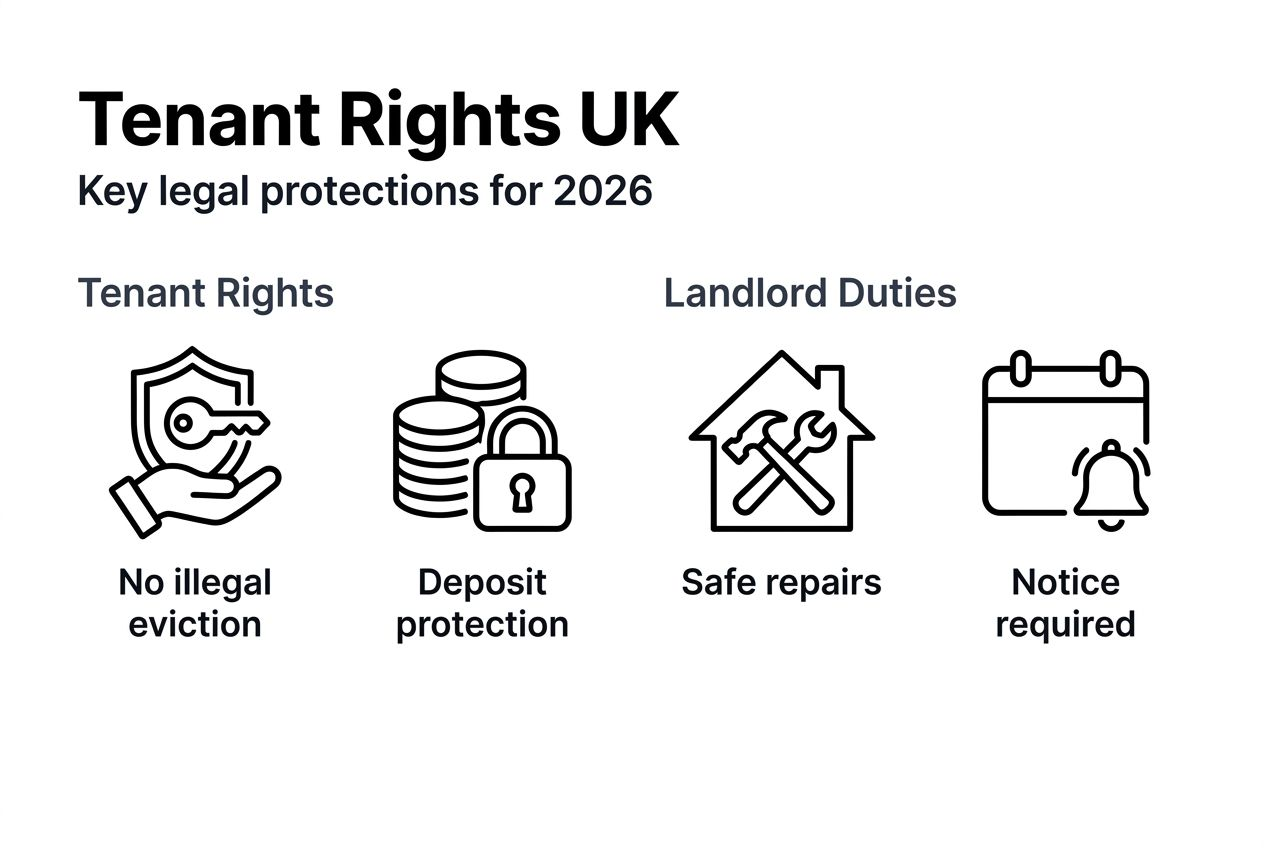
Landlords must maintain properties to safety standards and habitability requirements throughout your tenancy. This legal duty covers structural repairs, heating systems, water supply, and electrical safety. When landlords fail these obligations, you gain legal remedies without risking your tenancy security.
Landlords must ensure property safety, carry out repairs, and protect tenant deposits in government-approved schemes within 30 days. Repair responsibilities include fixing structural problems, ensuring heating and hot water function properly, and addressing safety hazards promptly. Tenants remain responsible only for damage beyond normal wear and tear.
Deposit protection schemes provide tenants with dispute resolution options when disagreements arise over deductions. Your landlord must place your deposit in an approved scheme within 30 days of receiving it and provide you with prescribed information about the protection. Failure to comply gives you grounds to challenge eviction proceedings.
These duties create concrete protections:
Pro tip: Photograph property conditions at move-in and document all repair requests in writing via email or letter. This evidence proves invaluable if disputes arise over deposit deductions or landlord negligence. Keep copies of all communications and note dates when you reported issues.
Understanding contract law UK explained principles helps you recognise that tenancy agreements create binding obligations on both parties. Your landlord cannot ignore legal duties simply because they own the property.
Eviction requires landlords to follow strict legal procedures regardless of the reason. They cannot force you out, change locks, or remove your belongings without a court order. Even when rent arrears exist or tenancy breaches occur, proper notice and court involvement remain mandatory.
Eviction requires landlords to give proper legal notice and obtain a court order based on recognised grounds under the Housing Act 1988. Notice periods vary by eviction ground, with Section 21 requiring two months and Section 8 grounds having different timescales. Your landlord must use the correct notice form and serve it properly.
Withholding rent rarely provides a legal defence and usually strengthens your landlord’s eviction case. Courts view non-payment seriously even when genuine repair issues exist. Better strategies include paying rent into a separate account whilst pursuing formal complaints, or applying for rent reductions through proper channels.
You can challenge unfair eviction attempts by:
Courts will not grant possession orders if landlords fail procedural requirements. Documentation showing you paid rent on time, reported repairs promptly, and fulfilled tenancy obligations strengthens your position. Civil litigation expertise helps navigate complex eviction defences when disputes escalate.
Several myths prevent tenants from correctly asserting their rights and lead to poor decisions during disputes. Understanding the legal reality behind these misconceptions empowers you to act confidently when problems arise.
Myth one suggests tenants can withhold rent anytime landlords fail to make repairs. Reality shows non-payment risks eviction unless you follow proper legal procedures for rent abatement or obtain court permission. Judges rarely accept withheld rent as a valid defence without formal applications.
Myth two claims landlords can evict at will whenever they want the property back. Reality requires legal grounds, proper notice periods, and court orders. Even no-fault Section 21 evictions demand strict procedural compliance and cannot happen during fixed terms without break clauses.
Myth three assumes all tenancy agreements offer identical protections regardless of type or location. Reality shows rights vary significantly between ASTs in England, Private Residential Tenancies in Scotland, and Northern Ireland agreements. Understanding your specific tenancy type matters enormously.
| Myth | Reality | Impact |
|---|---|---|
| Can withhold rent for repairs | Must pay whilst pursuing legal remedies | Risks eviction and court costs |
| Landlord can evict immediately | Requires notice and court order | Illegal eviction is criminal offence |
| All tenancies have same rights | Rights vary by type and location | Wrong assumptions lead to losses |
Pro tip: Always verify legal information from official sources like Shelter or Citizens Advice rather than relying on informal advice from friends or internet forums. Incorrect information costs you money and tenancy security. Professional legal guidance prevents expensive mistakes during critical disputes.
Taking proactive steps to understand and document your tenancy protects you when problems develop. Following these actions systematically ensures you maintain strong legal positions throughout your rental period.
Identify your tenancy type by reading your agreement carefully and checking which legal framework applies to your situation. Look for specific clauses about notice periods, rent increases, and termination procedures. Confirm whether you have an AST, Private Residential Tenancy, or other agreement type.
Document all communications with your landlord using email or recorded delivery letters rather than phone calls or text messages. Keep copies of every repair request, complaint, and response. Photograph property conditions regularly, especially when issues develop.
Understand your landlord’s legal obligations regarding repairs, safety, and deposit protection before disputes arise. Know which repairs they must handle and the timeframes they must meet. Research your rights under the specific laws governing your tenancy.
Seek legal advice promptly when you receive eviction notices or face serious disputes. Early intervention prevents procedural mistakes that weaken your position. Professional guidance from organisations like civil litigation specialists helps you navigate complex situations effectively.
Maintaining evidence strengthens your position enormously. Save all tenancy documents, rent payment receipts, and correspondence in organised files. Note dates, times, and details of verbal conversations immediately after they occur. This documentation proves essential if disputes reach court.
Staying informed about legal changes affecting tenant rights helps you adapt your approach. Housing legislation evolves regularly, with new protections and procedures introduced periodically. Following reliable sources ensures you understand current requirements.
Pro tip: Join a tenancy deposit protection scheme’s free dispute resolution service rather than accepting unfair deductions without challenge. Independent adjudicators frequently rule in favour of tenants when landlords cannot prove damage claims with proper evidence. This process costs nothing and recovers money that rightfully belongs to you.
Navigating tenant rights and eviction procedures often requires professional legal expertise, especially when stakes are high. Ali Legal offers experienced support for tenancy disputes, helping you understand your options and build strong cases against unlawful treatment.

Our civil litigation services specialise in protecting tenants facing eviction threats or deposit disputes. Early legal advice prevents costly procedural mistakes that weaken your position. We provide clear, fixed-fee guidance tailored to your specific situation, whether you need help challenging an eviction notice or recovering your deposit.
For business tenancies and commercial lease disputes, our commercial litigation services deliver strategic solutions when negotiations break down. Contact Ali Legal today for a confidential consultation about your tenancy concerns.
Report the issue in writing via email or recorded delivery letter, clearly describing the problem and requesting action within a reasonable timeframe. If your landlord still refuses, contact your local council’s environmental health department for properties with health and safety hazards. You can also pursue legal action for breach of repair obligations, though you must continue paying rent whilst following proper procedures.
In England, landlords can use Section 21 no-fault evictions after fixed terms end, requiring two months’ notice. However, they must comply with all legal requirements including deposit protection and proper notice procedures. Scotland abolished no-fault evictions, requiring landlords to prove specific grounds. Courts will not grant possession without following correct legal processes.
Your landlord must protect your deposit in an approved scheme within 30 days in England and Scotland, or 14 days in Northern Ireland. At tenancy end, they have a reasonable period to assess damages and return your deposit, typically 10 days. If disputes arise, use the scheme’s free adjudication service rather than accepting unfair deductions.
Rent increases require proper notice and cannot occur during fixed-term tenancies unless your agreement includes a rent review clause. For periodic tenancies, landlords must give at least one month’s notice and use the correct legal form. You can challenge excessive increases through rent tribunals if the proposed amount exceeds fair market rates.
You can challenge eviction by checking whether your landlord followed correct procedures and used valid grounds with proper evidence. Attend all court hearings to present your defence and bring documentation supporting your case. Legal advice helps identify procedural errors that invalidate notices, such as deposit protection failures or incorrect notice periods.


