
Menu
Get Expert Legal Support Today

Many believe all UK court decisions bind every judge, but this is inaccurate. About 60% of precedents are persuasive rather than binding, creating flexibility within our legal system. Legal precedent balances consistency with adaptability, ensuring fairness while allowing law to evolve. This guide will explain what legal precedent is, how courts apply it, and how it impacts your personal legal matters. You’ll gain clarity on the UK court hierarchy, learn to identify relevant precedents, and understand how this knowledge strengthens your case strategy.
| Point | Details |
|---|---|
| Legal precedent ensures fairness | Courts follow higher court decisions to maintain consistency across similar cases. |
| Binding versus persuasive matters | Binding precedents must be followed; persuasive ones influence but don’t bind lower courts. |
| Court hierarchy determines application | UK court structure dictates which precedents apply in your case. |
| Higher courts can overturn precedent | Supreme Court can change precedent to keep law relevant and just. |
| Precedent guides legal strategies | Understanding precedent helps predict outcomes and shape your approach. |
Legal precedent means courts follow decisions from higher courts when facing cases with similar facts. This principle forms the backbone of UK common law, ensuring the legal system treats like cases alike. When a court makes a ruling, that decision becomes a reference point for future judges handling comparable disputes.
The doctrine of precedent creates predictability. Lower courts are generally bound to apply decisions of superior courts, preventing arbitrary outcomes. This consistency protects you from facing wildly different rulings simply because you appeared before a different judge. The system respects established legal principles while allowing careful evolution.
Courts can distinguish cases with different material facts, providing necessary flexibility. The doctrine of precedent allows courts to develop the law incrementally by distinguishing cases or using persuasive precedent. If the facts of your situation differ meaningfully from previous cases, judges can reach different conclusions. This mechanism prevents rigid application when justice demands a fresh approach.
How precedent works practically:
Barristers play a crucial role in presenting precedent effectively to support your position. Understanding the foundations of legal precedent helps you grasp why certain arguments carry more weight. This system balances respect for established law with the flexibility needed for individual justice.
The UK court system operates in a clear hierarchy, determining which precedents bind which courts. The Supreme Court sits at the apex, followed by the Court of Appeal, High Court, Crown Court, and lower tribunals. This structure directly affects how precedent influences your case outcome.

Decisions from the Supreme Court bind all lower courts in England and Wales. Court of Appeal rulings bind all courts below it. High Court decisions generally bind lower courts but carry less weight than appellate decisions. Understanding court hierarchy in conflict of laws clarifies which precedents matter most.
Pro Tip: Always ask your solicitor which court level created the precedent they’re citing. A Supreme Court decision carries far more authority than a County Court ruling, dramatically affecting your case strategy.
Here’s how different court levels create binding versus persuasive precedent:
| Court Level | Binding Authority | Persuasive Authority |
|---|---|---|
| Supreme Court | All UK courts | None needed |
| Court of Appeal | High Court and below | Supreme Court |
| High Court | Lower courts and tribunals | Appeal courts |
| Crown/County Courts | None | All higher courts |
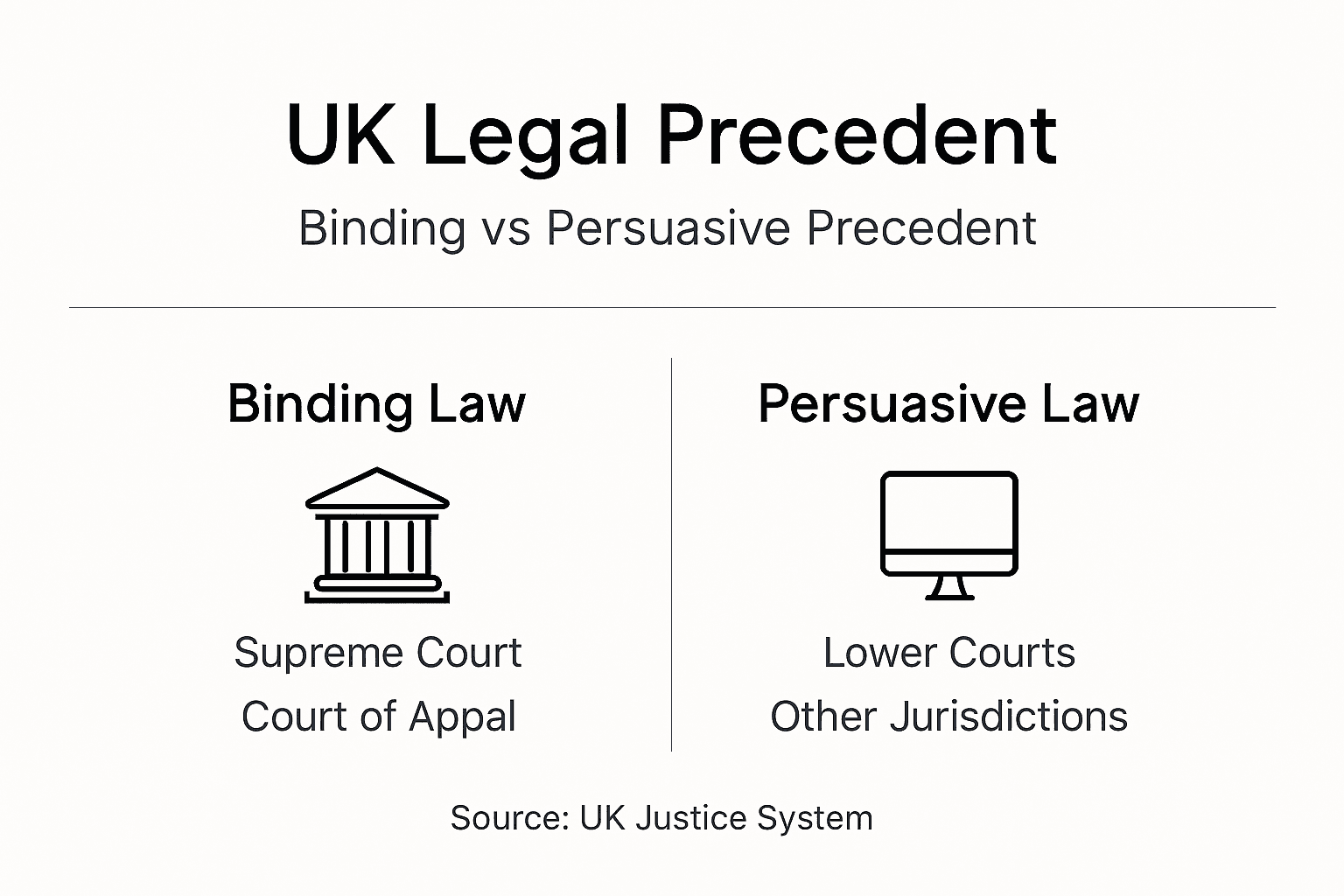
Lower courts’ decisions or courts in other jurisdictions provide persuasive precedent. Approximately 60% of court decisions are persuasive, not binding, which impacts how precedent develops flexibly. A well-reasoned Scottish case might influence an English judge, but it won’t compel them to follow it. This distinction matters when building your legal strategy.
The hierarchy creates several practical effects:
This system balances legal certainty with adaptability. While you can predict outcomes based on binding precedent, persuasive authority allows courts to consider fresh perspectives. The structure ensures stability while preventing stagnation, keeping UK law responsive to society’s evolving needs.
Courts must follow binding precedent when material facts closely match. Judges examine the essential elements of previous cases, comparing them to the dispute before them. If the facts align sufficiently, the court applies the established legal principle. This process protects consistency and prevents arbitrary decisions.
Courts can distinguish cases on facts to avoid strict application when justice demands it. If your situation differs materially from the precedent case, the judge can reach a different conclusion. For example, a negligence case involving a manufacturer might not bind a case involving a professional service provider. The factual differences justify departing from precedent.
Persuasive precedent influences but doesn’t compel decisions. Judges consider well-reasoned lower court decisions, foreign judgments, or academic commentary. While not bound to follow these sources, they may adopt the reasoning if it’s convincing. This flexibility helps law adapt to new situations without waiting for higher court rulings.
How courts work through precedent:
Judges balance respect for precedent with justice and legal development. They recognize that rigid application can produce unfair results in unique situations. Applying and distinguishing precedent requires legal expertise to identify which differences matter.
Pro Tip: When discussing your case with a solicitor, ask them to explain how the facts of relevant precedents compare to yours. Understanding these distinctions helps you set realistic expectations and identify weaknesses in opposing arguments.
The distinguishing process protects you from inappropriate precedent application. If previous cases involved different circumstances, you shouldn’t face the same outcome simply because some facts overlap. This mechanism ensures the legal system considers your unique situation rather than mechanically applying past decisions.
The UK Supreme Court can overrule its previous decisions when necessary. This power ensures law evolves to meet modern realities rather than remaining frozen in outdated reasoning. The Court exercises this authority carefully, balancing legal certainty against the need for progress. Overturning precedent signals significant legal development.
Several factors justify overturning established precedent:
The Court of Appeal can also depart from its own previous decisions in limited circumstances. Generally, it will follow established Court of Appeal precedent unless convinced it was clearly wrong. This restraint maintains stability while allowing correction of obvious errors. Lower courts cannot overrule higher court decisions, only distinguish them.
Historic examples show how law evolves through precedent revision. The Supreme Court has overturned precedents in areas like human rights, contract law, and negligence. These changes reflect society’s changing values and improved understanding of justice. When courts overturn precedent, they often provide detailed reasoning explaining why change is necessary.
Overturning precedent balances legal certainty with necessary change. You need to predict how courts will decide cases, which requires stable precedent. However, rigid adherence to outdated principles would produce injustice. The Supreme Court’s power to overrule itself provides a safety valve, ensuring law remains just and relevant.
This power affects your case in several ways. If you’re challenging an established precedent, you face a high burden of proof. Courts won’t overturn precedent lightly. However, if societal understanding has genuinely shifted or the precedent creates clear injustice, higher courts may be willing to reconsider. Your solicitor can assess whether your case presents grounds for challenging existing precedent.
The ability to change precedent ensures the legal system stays relevant over time. Laws that made sense decades ago might not reflect current realities. This flexibility protects you from being bound by outdated reasoning while maintaining the predictability necessary for fair legal processes.
Many people misunderstand how precedent works, creating unrealistic expectations about their cases. Clearing up these misconceptions helps you navigate the legal system more effectively. Understanding what precedent actually does and doesn’t do prevents frustration and improves your decision-making.
Here are the most common misconceptions:
All past court decisions are binding on every court. Only higher court decisions bind lower courts. Lower court rulings may be persuasive but don’t compel other judges to follow them.
Legal precedent is completely rigid. Courts can distinguish cases on material facts or apply persuasive precedent, providing flexibility within the system.
Once set, precedent never changes. Higher courts can overturn precedent when necessary, ensuring law evolves with society.
Lower court decisions have no value. While not binding, well-reasoned lower court decisions often influence judges facing similar questions.
Precedent solely determines case outcomes. Judges consider precedent alongside statutory law, factual evidence, and legal arguments specific to your situation.
Foreign precedents have no relevance. Courts sometimes consider persuasive precedent from other common law jurisdictions when UK authority is unclear.
Every aspect of a precedent case binds future courts. Only the ratio decidendi binds future courts; obiter dicta comments are persuasive but not mandatory.
These misunderstandings can lead to poor strategic decisions. If you assume a lower court decision binds your judge, you might overestimate your chances. If you believe precedent is completely rigid, you might miss opportunities to distinguish your case. Understanding how precedent actually functions helps you work more effectively with your solicitor.
Legal precedent guides but does not solely determine case outcomes. Your specific facts, the quality of evidence, and your legal representation all matter significantly. Precedent provides a framework, but your case still requires careful preparation and skilled advocacy. Don’t assume precedent alone will win or lose your case.
Real cases demonstrate how precedent shapes UK law and influences decisions. Donoghue v Stevenson (1932) established modern negligence law, cited in over 500 UK court decisions. This landmark case created the neighbour principle, holding that you owe a duty of care to people who might reasonably be affected by your actions. Courts still apply this principle nearly a century later.
The Donoghue case involved a woman who found a decomposed snail in her ginger beer. She couldn’t sue for breach of contract because she didn’t purchase the drink herself. The House of Lords created a new duty of care in negligence, fundamentally changing UK law. This precedent now affects personal injury claims, product liability cases, and professional negligence disputes.
Family law relies heavily on precedent to fill legislative gaps. Precedent plays a key role resolving family law and personal injury disputes in UK courts. When statutes don’t provide clear answers, courts look to previous decisions. For example, precedents guide how judges divide assets in divorce, determine child custody arrangements, and calculate spousal maintenance.
Personal injury claims depend extensively on established precedent:
These precedents create predictability. When you suffer an injury, solicitors can estimate your claim’s value based on similar precedent cases. Insurance companies use the same precedents to assess settlement offers. This consistency helps resolve disputes without lengthy trials. Understanding how expert witnesses use precedent strengthens your case presentation.
Contract law also evolves through precedent. Cases establishing rules about contract formation, breach remedies, and frustration guide commercial disputes. When you enter a contract, established precedent determines your rights and obligations even if the contract doesn’t address every scenario. Courts apply precedent to fill gaps and resolve ambiguities.
You can see examples of precedent influence in specialized areas like property disputes. Precedents guide how courts handle boundary disputes, easements, and restrictive covenants. This body of case law provides clarity where statutes offer limited guidance.
Understanding precedent helps predict likely case outcomes. When your solicitor reviews similar cases, they can estimate your chances of success. This prediction isn’t guaranteed, but precedent provides reliable guidance. If binding precedent strongly supports your position, you can approach negotiations confidently. If precedent favors the opposition, you might consider settlement.
Precedent knowledge helps set realistic expectations:
You can use precedent knowledge to communicate effectively with your solicitor. Ask them to explain how precedent cases compare to yours. Discuss whether distinguishing features might lead to different outcomes. This dialogue ensures you understand your case’s strengths and weaknesses. Informed clients make better strategic decisions.
Precedent influences legal approaches in civil, family, and personal injury cases. In civil litigation, precedent determines liability standards and damage calculations. In family matters, precedent guides asset division and child arrangements. In personal injury claims, precedent establishes compensation ranges for specific injuries. Using precedent in legal strategies requires matching your facts to favorable cases.
Your solicitor will search for precedent supporting your position and anticipate precedent the opposition will cite. They’ll prepare arguments distinguishing unfavorable cases or emphasizing favorable ones. This precedent analysis forms the foundation of legal strategy. The better you understand this process, the more effectively you can participate in strategic decisions.
Precedent also affects timing decisions. If recent precedent strengthens your position, immediate action might be wise. If unfavorable precedent exists but higher court review is pending, waiting might improve your chances. These tactical considerations require balancing precedent analysis with practical factors like limitation periods and evidence availability.
Be aware that precedent doesn’t guarantee outcomes. Judges retain discretion in applying precedent to specific facts. Evidence quality, witness credibility, and legal representation all matter. Precedent provides a framework, but your case’s unique elements still require skilled presentation. Strong precedent improves your odds but doesn’t eliminate the need for thorough preparation.
You can research precedent using online legal databases and official court websites. BAILII provides free access to UK court decisions, making precedent research accessible. You can search by keyword, court level, or date to find relevant cases. Reading these decisions helps you understand how courts have handled similar disputes.
Follow these steps to find and assess precedent:
Compare the facts carefully to ensure precedents are relevant to your situation. A case might involve the same area of law but differ in material ways. For example, a negligence case involving a manufacturer differs from one involving a professional advisor. These distinctions matter when predicting how precedent applies to you. Assessing precedent relevance requires legal training and experience.
Discuss identified precedents with your solicitor to understand their impact. While you can research precedent yourself, interpretation requires legal expertise. Your solicitor can explain whether a case truly supports your position or whether distinguishing features limit its application. They’ll also know about recent developments that might affect precedent’s continued validity. Talking to your solicitor about precedent strengthens your collaborative approach.
Stay aware that legal advice is crucial when applying precedent to your case. Reading cases yourself provides valuable context, but don’t rely solely on your interpretation. Courts spend considerable time analyzing precedent’s nuances. Without legal training, you might miss important distinctions or misunderstand the binding principle. Professional guidance ensures you apply precedent correctly.
You can find legal resources for precedent research in specialized areas. Some databases focus on specific practice areas like family law or personal injury. These resources often include commentary explaining how precedent has developed. Using these tools alongside your solicitor’s expertise maximizes your understanding.
Keep notes on precedent cases you find relevant. Record the case name, court level, key facts, and legal principle. This documentation helps discussions with your solicitor and ensures you remember important details. Organized precedent research supports strategic decision-making throughout your case.
Understanding legal precedent is just the first step. Applying this knowledge effectively requires professional legal support. Ali Legal offers expert guidance to help you understand how precedent affects your specific situation and strengthen your case strategy.

Our specialized civil litigation services provide comprehensive support for disputes where precedent plays a crucial role. We analyze relevant case law, identify favorable precedent, and build arguments that leverage established legal principles. Our team distinguishes unfavorable precedent and presents your case in the strongest possible light.
For family matters, our family and divorce lawyers apply precedent to protect your interests in divorce, child arrangements, and financial settlements. We understand how courts have decided similar cases and use this knowledge to achieve fair outcomes. Professional legal advice improves your confidence and case outcomes by ensuring precedent works in your favor. Contact Ali Legal today to discuss how we can help you navigate your legal matter with clarity and strength.
Binding precedent comes from higher courts and must be followed by lower courts when facts align. For example, a Supreme Court decision binds all UK courts below it. Persuasive precedent comes from lower courts, foreign jurisdictions, or other sources that influence but don’t compel judges. Courts may adopt persuasive reasoning if they find it convincing, but they’re not required to do so.
Precedent helps predict your case outcome by showing how courts decided similar disputes. Your solicitor uses precedent to assess your claim’s strength, estimate potential damages, and develop legal strategy. If binding precedent supports your position, you have stronger grounds for success. If precedent favors the opposition, you might need to distinguish your facts or consider settlement. Understanding precedent helps you make informed decisions throughout your case.
Higher court rulings bind lower courts in the UK system. Supreme Court decisions bind all courts, Court of Appeal rulings bind High Court and below, and High Court decisions bind lower courts and tribunals. Lower court decisions are persuasive but not mandatory, meaning judges may consider them but aren’t required to follow them. This hierarchy ensures consistency while allowing flexibility through persuasive authority.
Yes, higher courts can modify or overturn precedent as law evolves. The Supreme Court can overrule its own previous decisions when necessary to correct errors or adapt to changing societal values. This power ensures the legal system adapts to new social needs rather than remaining locked in outdated reasoning. However, courts exercise this authority carefully to maintain legal certainty.
Search legal databases like BAILII and official court records online for cases involving similar facts and legal issues. Compare facts between cases carefully to ensure the precedent truly relates to your situation. Consult a solicitor for interpretation and application because professional guidance ensures you understand precedent’s nuances. You can also explore legal precedent resources for additional research support.


