
Menu
Get Expert Legal Support Today

Only a fraction of British firms succeed in global trade without major legal setbacks. The tangled world of International Business Law affects every cross-border contract, leaving even seasoned British entrepreneurs and executives searching for clear answers. This guide breaks down complex regulations, explains compliance risks, and reveals the essential frameworks driving successful international transactions for British companies.
International Business Law represents a complex legal framework governing cross-border commercial interactions, regulations, and transactions between businesses operating across different national jurisdictions. This specialised area of legal practice addresses the intricate challenges arising from global economic exchanges.
The field encompasses several critical domains, including international trade regulations and legal frameworks. Key components typically involve international sales contracts, cross-border regulatory compliance, corporate governance standards, dispute resolution mechanisms, and the nuanced interactions between different national legal systems. Businesses must navigate complex rules surrounding taxation, intellectual property protection, labour regulations, and investment protocols when engaging in international commerce.
Furthermore, International Business Law addresses emerging challenges in global trade, such as digital economy regulations, technological compliance, and ethical business practices. The discipline integrates legal principles with economic realities, helping organisations understand and mitigate risks associated with international transactions. Topics like cross-border litigation, international arbitration, and transnational contract enforcement form the core of this sophisticated legal domain.
Professional Insight: Always consult specialised legal counsel familiar with international business regulations before initiating complex cross-border commercial agreements to minimise potential legal risks and ensure comprehensive compliance.
International Legal Frameworks constitute the foundational structure governing cross-border commercial interactions, providing essential guidelines for businesses operating across different jurisdictional boundaries. These frameworks establish the rules and principles that enable smooth, predictable international trade and commerce.
The primary sources of international business law are comprehensively defined by established legal principles. Treaties, international customs, and general legal principles form the core legal instruments that regulate global business interactions. In the United Kingdom, these sources are supplemented by domestic legislation, residual European Union regulations, and participation in multilateral and bilateral trade agreements. The intricate web of legal sources ensures comprehensive coverage of potential commercial scenarios, providing businesses with clear guidelines for international transactions.
Moreover, international business law draws from multiple authoritative sources beyond primary legal instruments. Judicial decisions, scholarly writings, and academic commentaries serve as subsidiary means of interpreting and developing legal frameworks. These sources help clarify complex legal provisions, resolve ambiguities, and adapt international business law to evolving global economic landscapes. The dynamic nature of these legal frameworks allows for continuous refinement and interpretation, ensuring that businesses can navigate increasingly complex international commercial environments.
Professional Insight: Always maintain comprehensive documentation of international legal sources and consult specialised legal experts to ensure precise understanding and compliance with the multifaceted legal frameworks governing cross-border business transactions.
International Business Law encompasses three critical domains that form the backbone of cross-border commercial interactions: trade regulations, contractual frameworks, and comprehensive compliance mechanisms. These interconnected areas ensure that businesses can operate effectively and legally across different national jurisdictions.
Trade represents a fundamental pillar of international business law, with complex regulations governing imports, exports, and cross-border transactions. UK businesses must navigate intricate rules involving tariff classifications, customs requirements, and international trade agreements. These regulations determine how goods and services move across borders, specifying everything from documentation standards to potential restrictions on specific products or services.

Contracts and compliance form equally crucial components of international business law. Companies must develop robust contractual frameworks that account for different legal systems, cultural nuances, and regulatory environments. Effective trade compliance involves managing export controls, understanding sanctions, and adhering to complex international regulations. This requires meticulous attention to detail, including correct tariff classifications, origin determinations, and comprehensive risk management strategies to prevent potential legal challenges or financial penalties.
Professional Insight: Develop a comprehensive compliance checklist that incorporates legal requirements from multiple jurisdictions, and regularly update your understanding of international trade regulations to maintain seamless business operations.
International Business Disputes represent complex legal challenges that require sophisticated strategies for resolution and enforcement. Businesses engaged in cross-border transactions must develop comprehensive approaches to manage potential conflicts and protect their commercial interests effectively.
Recent UK legal reforms have significantly enhanced arbitration mechanisms, creating more robust frameworks for resolving international commercial disputes. These reforms empower businesses with streamlined processes for addressing legal challenges, including early dismissal of weak cases, increased transparency requirements, and improved court support for arbitration proceedings. The changes demonstrate the United Kingdom’s commitment to providing efficient dispute resolution pathways for international commercial entities.
Dispute Resolution Mechanisms play a critical role in international business law. The International Chamber of Commerce offers comprehensive services including arbitration, mediation, and expert determination, which provide neutral, predictable frameworks for resolving cross-border conflicts. These mechanisms allow businesses to address disputes outside traditional court systems, offering more flexible, cost-effective solutions that can be enforced across multiple jurisdictions. Companies must carefully select appropriate dispute resolution strategies, considering factors such as contractual obligations, potential enforcement challenges, and the specific legal environments of involved parties.
The following table summarises the principal differences between international commercial arbitration and litigation, two key dispute resolution methods discussed:
| Aspect | Arbitration | Litigation |
|---|---|---|
| Forum | Private tribunal | National court system |
| Speed | Typically faster resolution | Often prolonged procedures |
| Confidentiality | Proceedings kept private | Generally a public process |
| Enforceability | Awards enforceable internationally | Enforcement may be limited by jurisdiction |
Professional Insight: Develop a comprehensive dispute resolution strategy before entering international contracts, including clear clauses specifying arbitration procedures, applicable laws, and potential enforcement mechanisms.
International Business Compliance represents a multifaceted challenge for UK companies operating in global markets. Organisations must navigate an increasingly complex regulatory landscape that demands sophisticated, proactive approaches to risk management and legal adherence.
Regulatory complexity poses significant challenges for businesses, particularly in understanding and implementing evolving legal requirements. Small and medium enterprises frequently struggle with the administrative burden of compliance, facing risks such as misinterpreting regulations, encountering unexpected sanctions, and managing the financial implications of legal requirements. These challenges are compounded by rapidly changing international trade rules, which demand continuous learning and adaptability from corporate legal teams.
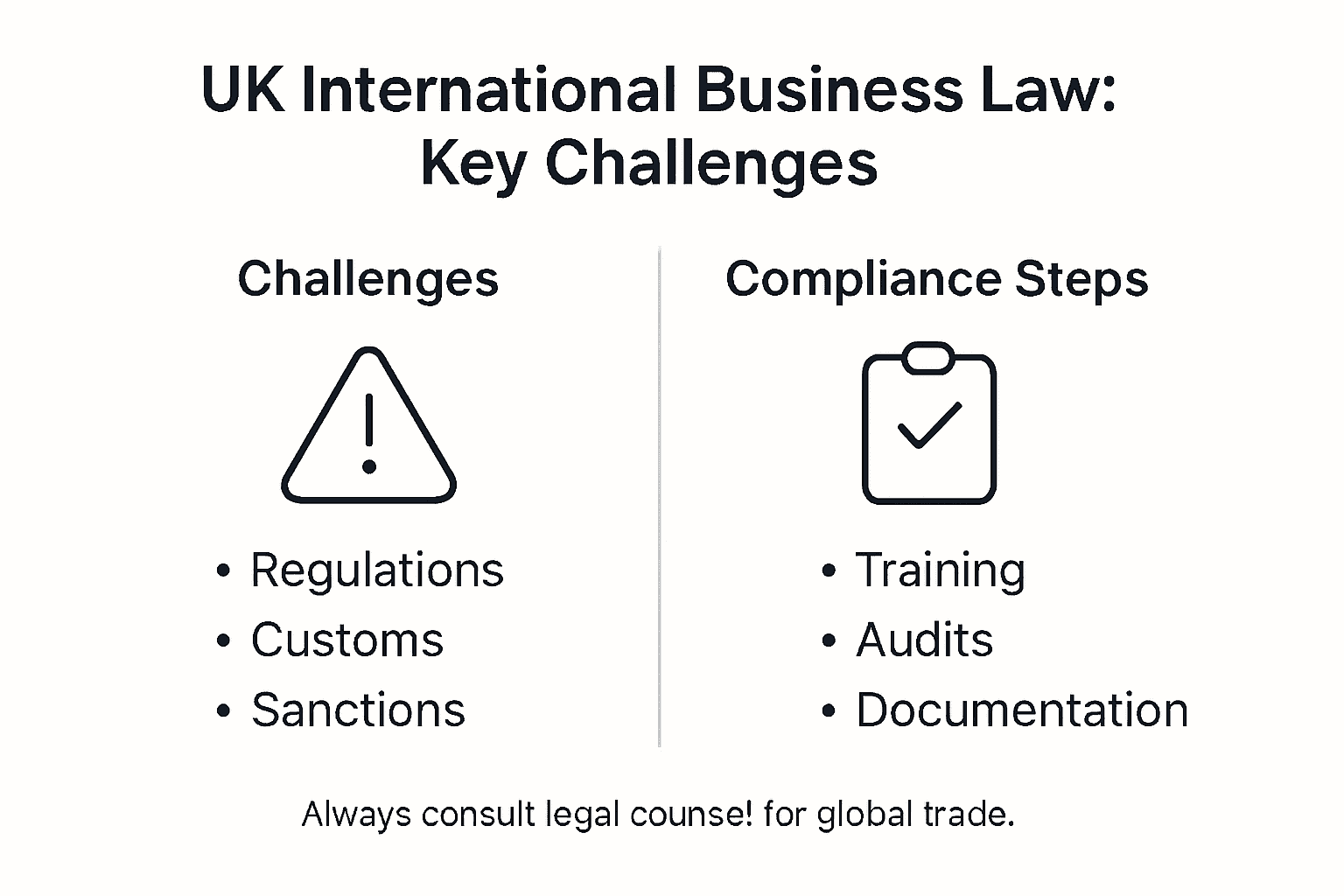
The UK’s regulatory framework emphasises that effective compliance extends beyond mere documentation to encompass organisational culture and behaviour. Businesses must implement robust risk assessment processes, develop clear procedural guidelines, and commit to ongoing staff training. This holistic approach requires regular evaluation of compliance programmes, ensuring they remain responsive to emerging legal challenges and aligned with the specific operational context of each organisation.
For clarity, the table below highlights common risks in international business and corresponding compliance steps for UK organisations:
| Risk Area | Common Challenge | Mitigation Approach |
|---|---|---|
| Regulatory Changes | Sudden new legal requirements | Proactive legal monitoring |
| Cross-Border Taxation | Inconsistent tax laws | Engage tax specialists |
| Data Protection | Varying privacy standards | Customise compliance programmes |
| Trade Sanctions | Unexpected trade bans | Pre-transaction due diligence |
Professional Insight: Create a dynamic compliance strategy that includes regular legal audits, continuous staff training, and flexible mechanisms for adapting to changing international regulatory landscapes.
Understanding the complex rules of international business law is crucial for UK companies involved in cross-border trade. This field covers key challenges such as compliance with trade regulations, managing contracts across jurisdictions, and resolving disputes efficiently. At Ali Legal, we recognise that navigating tariffs, customs requirements, and arbitration procedures can feel overwhelming. Our expert team offers clear and strategic guidance tailored to your business needs, helping you minimise risks and stay compliant throughout every stage of your international transactions.
Explore practical insights and legal support with our Uncategorized | Ali Legal resources and reach out directly through our contact page for personalised advice.

Take control of your global business ventures now by partnering with Ali Legal for transparent, fast, and reliable legal solutions. Protect your investments and streamline cross-border operations with expert counsel just a click away at Ali Legal Contact.
International business law refers to the legal framework that governs commercial transactions and regulations between businesses across different national jurisdictions.
The primary sources include treaties, international customs, and general legal principles. These are supplemented by domestic legislation and trade agreements.
Businesses can ensure compliance by developing robust risk assessment processes, understanding evolving regulatory requirements, and implementing a comprehensive compliance strategy that includes ongoing staff training.
Key dispute resolution mechanisms include arbitration and mediation, which provide structured, neutral processes for resolving conflicts outside of traditional court systems.


