
Menu
Get Expert Legal Support Today

Five legal forms cover almost every UK business: sole trader, partnership (including limited liability partnership), private limited company, public limited company, and social-purpose structures like the community interest company or co-operative. The right choice comes down to three things: how much personal liability you can accept, how you want profits taxed, and how much administrative work you’re prepared to take on. Everything else follows from those three decisions.
Before you weigh up the detail, here’s the shortlist.
The most common transition is sole trader to limited company once profits grow or personal risk becomes uncomfortable. It’s rarely the first choice, but it’s frequently the second.
A sole trader isn’t a separate legal entity. You and the business are the same thing in the eyes of the law, which is exactly why liability is unlimited. If the business owes money it can’t pay, creditors can pursue your personal assets, house included. Tax works through Income Tax and National Insurance on profits, filed via Self Assessment. There’s a persistent myth that opening a separate business bank account creates some kind of legal firewall. It does not. Separate accounts help with bookkeeping, not liability. This structure suits low-risk trades, early-stage freelancers, and anyone testing an idea before committing further.
A general partnership splits profits and management between two or more people, and each partner is taxed personally on their share. The catch is joint and several liability: if your partner signs a bad contract, you can be on the hook for it too. A limited partnership adds a category of partners whose liability is capped at their investment, though at least one general partner must still carry unlimited liability. This structure works best when partners have complementary skills and genuine trust, less well when the relationship is untested.
An LLP gives you limited liability protection while keeping partnership-style profit sharing and tax treatment, which is why it’s the structure of choice for law firms, architecture practices, and accountancy partnerships. Members pay tax personally on their share of profits rather than the business paying Corporation Tax. LLPs must register at Companies House and file annual accounts, so the administrative burden sits above a simple partnership but below a full company. The flexibility to divide profits however partners agree, rather than by fixed shareholding, is what draws professional firms to this structure specifically.
A limited company exists as its own legal entity, separate from the people who run it. That separation is the whole point: shareholders’ liability is limited to what they’ve invested, and the company itself pays Corporation Tax on profits, while directors and shareholders pay personal tax on salaries and dividends. Directors carry legal duties, including acting in the company’s best interests and filing accurate accounts. Companies House obligations include annual confirmation statements, filed accounts, and a public register of directors and shareholders. Read more on the duties that come with running a company. This form suits businesses with growth ambitions, external risk, or anyone planning to bring in investors or employees at scale.
A PLC is a limited company that can offer shares to the public, which brings a minimum share capital requirement and considerably stricter reporting and governance rules. Few small businesses need this structure. It’s relevant once you’re genuinely raising capital on public markets rather than through private investment rounds.
A Community Interest Company is a limited company variant built for social enterprises, complete with an asset lock and a community interest test enforced by the CIC Regulator. Co-operatives distribute control and profit among members rather than shareholders. Both trade some commercial flexibility for a structure that guarantees social purpose can’t be quietly abandoned later.
Five questions cut through most of the indecision.
Take these questions to an accountant or solicitor rather than guessing: ask specifically about your expected profit in year one and two, whether you’ll need investment, and what your personal asset exposure looks like right now.
Pro Tip: If you’re about to sign a contract with a supplier, take on your first investor, or hire your first employee, get advice on structure before you sign anything, not after. Unpicking the wrong structure later costs far more than choosing carefully now.
Certain situations are flashing red flags for immediate legal input: investor term sheets, contracts with unusual liability clauses, or any transfer of significant assets into a new company.
Most founders start as sole traders and incorporate once profits or risk grow past a comfortable point. The process is fairly mechanical once you know the sequence.
Registration at Companies House is usually quick, often same-day online, though the full transition including tax registration typically takes one to two weeks once contracts and accounts are properly moved across.
Sole traders register directly with HMRC for Self Assessment; anyone incorporating registers with Companies House first, then HMRC for Corporation Tax. From day one, open a dedicated business bank account, keep every invoice and receipt, and set up basic payroll records if you’re taking on staff. For anything beyond straightforward trading, a solicitor or accountant earns their fee quickly, and GOV.UK’s own guidance pages are the right starting point for the mechanics.
Investor term sheets, multi-party contracts, and asset transfers between entities are exactly where DIY structuring goes wrong. A solicitor drafts partnership agreements that survive disagreement, checks incorporation paperwork before Companies House rejects it, and structures ownership so it doesn’t cause problems at your next funding round. Ali Legal Ltd works across corporate law with fixed-fee options for exactly this kind of structuring work.
Raising money changes the calculation entirely, and this is where structure choice stops being theoretical.
A sole trader can’t sell equity, full stop. There’s no share structure to offer, which means funding options are limited to personal savings, loans, or grants. Investors have no mechanism to take a stake even if they wanted to.
Partnerships and LLPs can bring in new partners or members, but that route usually means renegotiating profit-sharing arrangements from scratch rather than issuing straightforward equity. It works for bringing in a working partner. It works far less well for a passive investor who just wants a financial stake.
A private limited company solves this cleanly. Shares can be issued, transferred, and valued, which is exactly the mechanism venture investors, angel networks, and even friends-and-family rounds expect to see. Standard investment structures, from convertible loan notes to SEIS and EIS tax relief schemes, are all built around companies limited by shares. Trying to attract serious investment as a sole trader or general partnership is, in practice, close to impossible.
A PLC opens the door to public markets and much larger capital raises, but that access comes with a genuinely heavier compliance load, and it’s not a realistic step for most early-stage businesses.
CICs face a structural constraint here too: the asset lock that protects their social mission also limits how attractive they are to profit-seeking investors, since returns and asset distribution are deliberately restricted.
Control follows ownership, and each structure distributes both very differently.
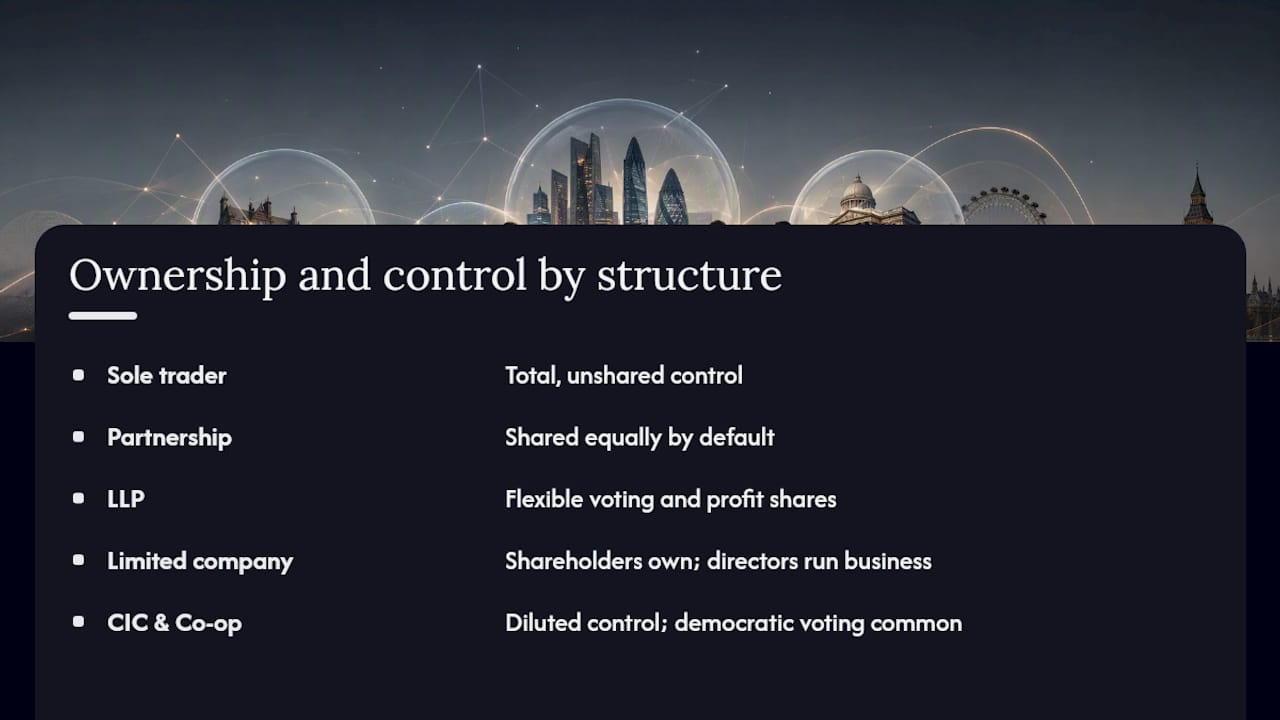
A sole trader has total, unshared control. Every decision is yours, which is either liberating or a liability depending on how much oversight the business actually needs. Partnerships split control between partners equally by default, unless the partnership agreement states otherwise, which means disagreements can genuinely deadlock the business if there’s no tie-breaking mechanism written in.
LLPs work similarly but with more flexibility. Members can agree bespoke voting rights and profit shares in the LLP agreement rather than defaulting to equal splits.
Limited companies introduce a formal split between ownership and management: shareholders own the business, but directors run it day to day. Shareholders hold voting rights proportional to their shareholding and can, in principle, remove directors who aren’t performing. That separation is precisely why companies are easier to invest in, since a shareholder doesn’t need to run the business to hold a stake in it. PLCs extend this further with statutory protections for minority shareholders and stricter disclosure rules, because public money demands public accountability.
CICs and co-operatives dilute individual control further still. Co-operatives typically follow one-member-one-vote regardless of investment size, prioritising democratic control over capital weight.
Employment obligations largely don’t change with legal structure. Once you take on staff, whether you’re a sole trader or a PLC, you must register as an employer with HMRC, operate PAYE, provide a written contract, and meet minimum wage and pension auto-enrolment duties.
Where structure does matter is liability and administrative capacity. A sole trader employing staff carries personal liability for employment claims, on top of the personal liability they already carry for the business generally, which stacks risk in a way that limited structures avoid. A limited company’s separate legal status means employment claims are generally brought against the company rather than the director personally, though directors can still face personal liability in cases of discrimination or health and safety breaches they’re directly responsible for.
Administrative capacity also tends to track structure. Companies usually have more established payroll and HR processes by the time they’re hiring, simply because incorporation itself demanded more formal recordkeeping from day one. A sole trader taking on their first employee is often building payroll infrastructure from nothing, at exactly the moment they can least afford the distraction.
Winding up looks different depending on where you started.
A sole trader simply stops trading, informs HMRC, and files a final Self Assessment return. There’s no formal deregistration process beyond that, because there was never a separate legal entity to dissolve.
Partnerships dissolve according to the terms of the partnership agreement, or under default rules if no agreement covers it, with remaining assets and debts settled between partners according to their shares.
An LLP or limited company requires formal dissolution through Companies House, typically by striking off the register once debts are settled and assets distributed, or through a formal liquidation process if the business is insolvent. Directors have a legal duty to act properly during this process, particularly around creditor treatment, and cutting corners here can expose directors to personal liability even though the company structure was supposed to prevent exactly that.
A CIC’s asset lock adds an extra layer: on dissolution, remaining assets can’t simply be distributed to members. They must go to another asset-locked body or a charity, which is the price paid for the social-purpose protection the structure offers throughout its life.
Most guidance on legal forms treats the decision as a one-time tax optimisation exercise: calculate the break-even profit point, pick whichever structure saves more money, done. That framing undersells the real question. The businesses that get into trouble aren’t usually the ones that picked the “wrong” structure on day one. They’re the ones that picked the right structure for year one and never revisited it as the business changed.
A sole trader taking on their first serious contract, or a partnership bringing in an outside investor, needs a fresh look at structure at that exact moment, not twelve months later when a dispute forces the question. The tax saving from incorporating too early can also be smaller than founders expect, once accountancy and filing costs are honestly totted up against genuinely modest early profits.
If there’s one thing worth prioritising above the spreadsheet, it’s this: treat structure as a decision you’ll revisit at every genuine inflection point in the business, not a box ticked once at the start. GOV.UK’s guidance is a solid, free starting point for the mechanics. Where it runs out is judgement, and that’s exactly where proper advice earns its cost.
— Panagiotis
Ali Legal Ltd offers something most founders working through this decision alone don’t have: a solicitor checking the structure before you sign anything, rather than untangling a problem after it’s already cost you money. Whether you’re incorporating for the first time, drafting a partnership agreement, or reviewing a contract that will follow your business for years, getting it right at formation stage is considerably cheaper than fixing it later.

Ali Legal Ltd’s services include support with company formation, corporate law guidance, and contract review, all offered with fixed-fee options so you know the cost before you commit. If you’re weighing up incorporation or need a partnership agreement drafted properly the first time, get in touch through Ali Legal’s contact page to discuss what your business actually needs.
This article is general information, not a substitute for advice from a qualified lawyer. Consult a qualified legal professional about your own circumstances before acting on anything here.


