
Menu
Get Expert Legal Support Today

TL;DR:
- Commercial litigation in England and Wales involves resolving disputes related to business relationships, mainly through specialized courts and procedural rules. Parties are advised to prepare thoroughly, use alternative dispute resolution methods like mediation, and act promptly to preserve their legal rights. Effective management of litigation requires early legal advice, strategic court selection, and disciplined case organization.
Commercial litigation law is the body of law governing legal disputes that arise from business relationships, commercial transactions, and contractual obligations between parties. It covers everything from a supplier suing for unpaid invoices to a shareholder challenging a boardroom decision. In England and Wales, commercial litigation operates within a specialist procedural framework built around the Civil Procedure Rules (CPR) and dedicated courts such as the Commercial Court and the Business and Property Courts. Understanding this area of law helps businesses and individuals protect their rights, manage risk, and make informed decisions when disputes arise.
Commercial litigation law is defined as the legal process by which parties resolve disputes connected to commercial activity through the courts. The term “commercial litigation” is widely used, but the recognised industry term is “commercial dispute resolution,” which encompasses both court proceedings and alternative methods. The disputes themselves, known as commercial disputes, typically involve businesses, sole traders, partnerships, or individuals acting in a commercial capacity.
Common commercial litigation examples include breach of contract claims, debt recovery actions, shareholder disputes, professional negligence claims, and disputes over intellectual property rights. A technology company pursuing a former partner for misuse of confidential information is a commercial dispute. So is a construction firm seeking damages after a client refuses to pay for completed works. The range is broad, but the common thread is that the dispute stems from a commercial relationship or transaction.
Commercial litigators, also called commercial litigation solicitors or commercial litigation attorneys in some jurisdictions, manage these cases from initial investigation through to trial or settlement. What a commercial litigator does includes assessing the legal merits of a claim, advising on procedural strategy, drafting court documents, managing disclosure, and representing clients at hearings. Their role demands both legal precision and commercial awareness, because the cost of litigation must always be weighed against the value of the outcome.

The Business and Property Courts, launched in july 2017, form a network of specialist jurisdictions within the High Court designed to handle complex commercial disputes. They include the Commercial Court, the Technology and Construction Court (TCC), the Intellectual Property Enterprise Court (IPEC), and the Financial List, among others. Each court has specific expertise suited to the nature of the dispute.
The choice of court matters considerably. Selecting the appropriate forum is a strategic decision affecting procedure, enforcement options, and the overall cost of resolving a dispute. A case heard in the Commercial Court benefits from judges with deep expertise in banking, shipping, and international trade. A construction dispute is better suited to the TCC, where judges understand technical evidence and complex project contracts.
Key courts and their focus areas include:
Regional courts provide genuine access to specialist justice without requiring parties to litigate in London. This matters for smaller businesses where travel and accommodation costs can distort the economics of a claim.
The Civil Procedure Rules govern all civil litigation in England and Wales, including commercial disputes. The CPR’s overriding objective requires courts to deal with cases justly and at proportionate cost. That single principle reshapes how litigation is conducted from the moment a dispute arises.
Before the CPR, litigation was largely party-driven. Solicitors set their own pace, and cases could drift for years. The CPR replaced that approach with court-controlled litigation conduct, requiring parties to act reasonably and comply with strict timetables. Courts now actively manage cases, set deadlines, and penalise parties who behave unreasonably through adverse costs orders. This is a fundamental shift in litigation culture, not just a procedural update.
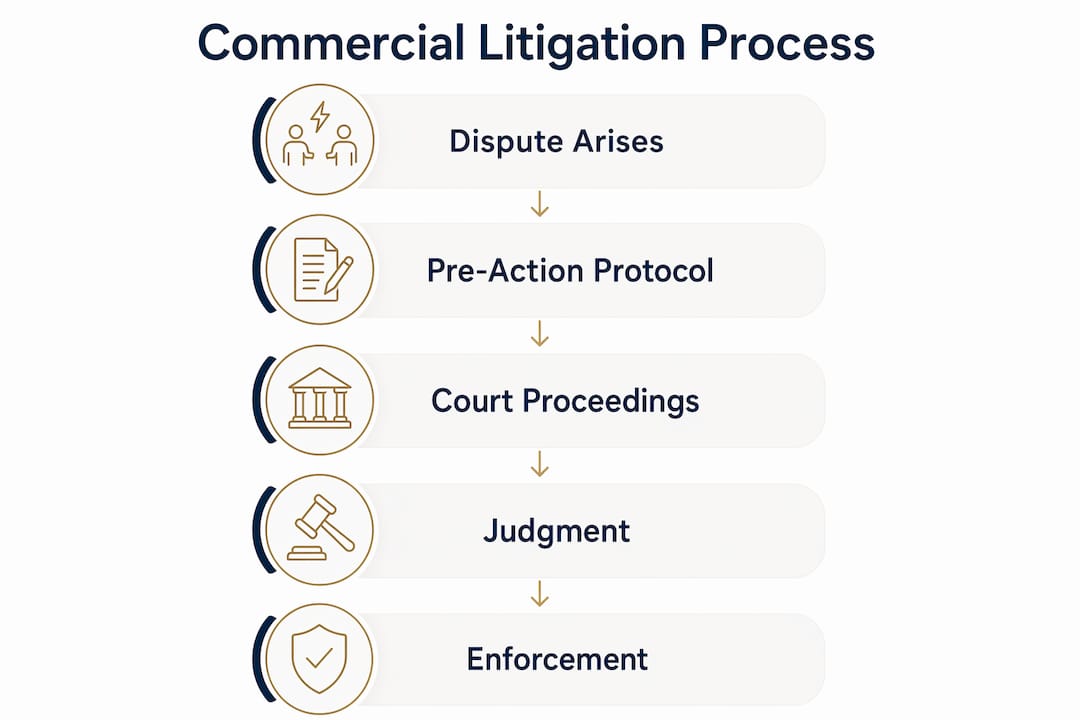
What commercial litigation involves under the CPR includes pre-action protocols, which require parties to exchange information and attempt resolution before issuing proceedings. Case management conferences allow judges to set the litigation timetable, limit disclosure, and identify the real issues in dispute. Witness statements and expert reports are exchanged in advance of trial, reducing surprises and focusing the hearing on genuinely contested matters.
Pro Tip: Begin your case preparation before you instruct solicitors. Gather contracts, correspondence, invoices, and any relevant communications as soon as a dispute becomes apparent. Courts expect parties to be ready to engage quickly, and early organisation reduces costs significantly.
Limitation periods are the legal deadlines within which a claim must be brought. Miss the deadline and the claim is almost certainly lost, regardless of its merits. The Limitation Act 1980 sets a six-year limitation period for most contract and tort claims in England and Wales. That period runs from the date the cause of action accrued, which is usually when the breach occurred or the loss was suffered.
Jurisdiction and limitation issues are gateway questions that determine whether a claim can proceed at all. Courts consider them before examining the merits. A technically strong claim becomes worthless if it is time-barred.
Practical steps for managing limitation risk:
Alternative dispute resolution (ADR) covers methods of resolving disputes outside formal court proceedings. The two most common forms in commercial contexts are mediation and arbitration. They are frequently confused, but they operate very differently.
Arbitration involves adjudication with a binding outcome decided by an arbitrator or panel. It closely resembles court litigation in structure but takes place privately. Mediation, by contrast, involves a neutral facilitator helping parties reach a negotiated settlement. The mediator has no power to impose a decision. The parties retain control of the outcome.
| Feature | Court litigation | Mediation | Arbitration |
|---|---|---|---|
| Decision maker | Judge | Parties themselves | Arbitrator |
| Outcome binding | Yes | Only if settled | Yes |
| Confidential | No | Yes | Yes |
| Costs | High | Lower | Variable |
| Speed | Slower | Faster | Variable |
| Suitable for | Complex, high-value disputes | Relationship-sensitive disputes | International or specialist disputes |
ADR is increasingly compulsory as a step within commercial dispute resolution. Courts regularly encourage or require parties to attempt ADR before proceeding to trial. Refusing ADR without good reason can result in cost penalties even for a winning party. This reflects a broader policy shift: courts want ADR to filter disputes before they consume judicial resources.
Pro Tip: Mediation works best when both parties have something to lose from continued litigation. If the relationship between the parties has commercial value, or if the costs of trial outweigh the sum in dispute, mediation is almost always worth attempting before issuing proceedings.
For businesses weighing their options, Alilegal’s guide to dispute resolution methods sets out the practical differences between each approach in plain terms.
Commercial litigation rewards preparation and penalises delay. The CPR’s emphasis on proactive case management means that parties who engage early and organise their evidence thoroughly are better placed than those who react slowly. The following steps apply whether you are a claimant or a defendant.
Preserve all relevant documents immediately. Once a dispute is foreseeable, stop deleting emails, messages, or files. Courts take document destruction seriously, and adverse inferences can be drawn against a party that fails to preserve evidence.
Seek specialist legal advice early. A commercial litigation solicitor can assess the strength of your position, identify limitation risks, and advise on the most cost-effective route to resolution. Early advice prevents costly procedural errors later.
Review the relevant contracts. Most commercial disputes turn on the precise wording of a contract. Identify the governing law clause, jurisdiction clause, and any dispute resolution provisions before taking any steps.
Consider ADR before issuing proceedings. Courts expect parties to have explored settlement options. A letter before action, followed by a genuine attempt at negotiation or mediation, demonstrates good faith and can reduce costs exposure.
Assess proportionality honestly. The CPR requires litigation to be proportionate to the value and complexity of the dispute. A £15,000 debt claim does not justify the same litigation budget as a £5 million contract dispute. Discuss costs budgets with your solicitor at the outset.
Choose the right forum. The forum selection decision affects procedure, cost, and enforcement. Specialist courts offer expertise but come with higher procedural demands. Discuss the options with your legal team before issuing.
After years of working with businesses and individuals through commercial disputes, one pattern stands out above all others. The parties who fare best are not always those with the strongest legal case. They are the ones who treat litigation as a managed process rather than a reactive event.
The CPR changed litigation culture permanently. Courts no longer tolerate the old approach of issuing proceedings and then waiting to see what happens. Judges expect parties to know their case, comply with timetables, and engage constructively with the other side. Businesses that understand this from day one spend less, resolve disputes faster, and avoid the procedural penalties that erode even winning positions.
The specialist courts, particularly the Commercial Court and the TCC, are genuinely efficient when used correctly. The judges are expert, the procedures are tailored to complex disputes, and the outcomes are predictable. The mistake many businesses make is treating these courts as a last resort rather than a first-choice forum for serious disputes.
My honest view on ADR is this: mediation is underused and misunderstood. Businesses often see it as a sign of weakness. It is the opposite. A well-timed mediation, conducted after disclosure but before trial, resolves the majority of commercial disputes that reach it. The cost saving compared to a full trial is substantial, and the outcome is within the parties’ control. That combination is rare in litigation.
— Panagiotis
Commercial disputes carry real financial and reputational risk. Getting the strategy right from the start makes a measurable difference to the outcome.

Alilegal’s commercial litigation solicitors bring specialist expertise to high-stakes business disputes, from contract claims and shareholder conflicts to professional negligence and international commercial matters. The team works across the Business and Property Courts and advises on ADR strategy, forum selection, and procedural compliance under the CPR. Alilegal offers fixed-fee arrangements and clear, direct advice at every stage. If you are facing a commercial dispute or want to understand your legal position before one arises, contact Alilegal to speak with a specialist solicitor.
Commercial litigation is the legal process of resolving disputes arising from business relationships or commercial transactions through the courts. It covers contract claims, debt recovery, shareholder disputes, and professional negligence, among other matters.
A commercial litigator assesses the legal merits of a dispute, advises on procedural strategy, drafts court documents, manages disclosure, and represents clients at hearings. Their role combines legal expertise with commercial judgement about costs and outcomes.
The main types include breach of contract claims, debt recovery actions, shareholder and partnership disputes, professional negligence claims, and intellectual property disputes. Each type may be heard in a different specialist court depending on its subject matter and value.
The Limitation Act 1980 sets a six-year deadline for most contract and tort claims. Missing this deadline bars the claim from being heard, regardless of its underlying merits.
ADR, particularly mediation, is preferable when the cost of litigation outweighs the sum in dispute, when the parties have an ongoing commercial relationship worth preserving, or when confidentiality is a priority. Courts also increasingly require parties to attempt ADR before proceeding to trial.


