
Menu
Get Expert Legal Support Today

TL;DR:
- Business law governs how businesses are created, operated, and protected, affecting companies of all sizes.
- Understanding legal frameworks helps prevent risks like unpaid contracts, wrongful dismissals, and exposure to debts.
- Entrepreneurs should prioritize understanding contract law and business structure early to build long-term, durable businesses.
Most business owners encounter legal trouble not because they ignored the law, but because they never understood what business law actually covers. It is easy to assume that legal matters only affect large corporations with in-house legal teams. The reality is quite different. Business law governs how every commercial enterprise is formed, operated, and protected, regardless of size. From the contracts you sign with suppliers to the way you classify your employees, the rules governing business touch almost every decision you make. This guide breaks down the core areas, explains what does business law entail in practical terms, and gives you the knowledge to act with confidence.
Business law is the body of rules that governs how companies are created, how they operate, and how they are held accountable. It sits at the intersection of private agreements and public regulation, which is why it affects everything from a simple service contract to how you structure your shareholding. Legal frameworks are critical engines for economic development, not bureaucratic obstacles.
Understanding the importance of business law becomes clearer when you look at what it prevents. Without enforceable contracts, a client can walk away without paying. Without proper employment law compliance, a wrongful dismissal claim can cost you tens of thousands of pounds. Without the correct corporate structure, your personal assets sit exposed to business debts. Business law is the framework that keeps those risks manageable.
Here is an overview of the five core areas every business owner should know:
Pro Tip: If you are starting out, do not try to learn all five areas simultaneously. Prioritise contract law and your business structure first. These two areas form the foundation everything else builds upon.
Your choice of legal structure is one of the most consequential decisions you will make as an entrepreneur. It determines your personal liability, how you are taxed, and whether investors will take you seriously. Many business owners pick a structure based on what is easiest to set up, rather than what serves their long-term interests. That is a costly mistake.
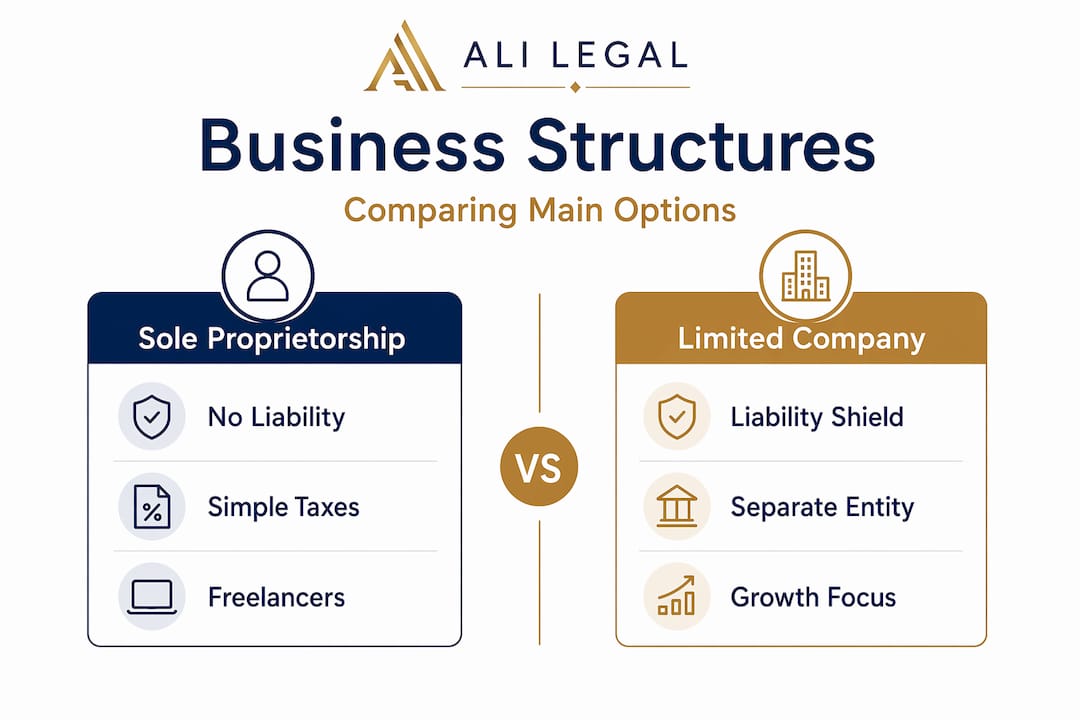
Here is how the three main structures compare:
| Structure | Liability protection | Tax treatment | Best suited for |
|---|---|---|---|
| Sole proprietorship | None. Personal assets at risk | Income taxed as personal earnings | Freelancers, single-person trades |
| Limited liability company (LLC) or Ltd | Separates personal and business assets | Profits taxed at corporation rate | Small to medium businesses seeking growth |
| Corporation (PLC or Ltd with shareholders) | Full separation of assets | Corporation tax applies; dividends taxed separately | High-growth businesses seeking investment |
Sole proprietorships offer no liability protection and are generally suited for freelancers, while corporations suit businesses that need investor backing. The middle ground, a private limited company, is where most UK entrepreneurs land. It gives you liability protection without the administrative weight of a public company.

One detail many business owners overlook: lenders almost universally require a written business plan before approving financing. Your legal structure directly affects how that plan is received. A sole trader applying for a significant business loan faces far more scrutiny than a limited company with proper governance in place.
Pro Tip: Register as a limited company earlier than you think you need to. The liability protection alone is worth the administrative effort, even if you are still in early trading. You can always find guidance on the essential legal documents you will need from the outset.
Compliance is where many businesses stumble. Not because the rules are impossible to follow, but because owners underestimate how many regulations apply to them. Every business operating in the UK needs, at minimum, the correct licences for its sector, a registered address, a tax identification number with HMRC, and an understanding of its reporting obligations.
The regulatory picture has grown more complex in recent years. A notable development is the treatment of environmental claims. Greenwashing is now a competition law liability in several jurisdictions, with significant financial penalties for misleading environmental marketing. If your business makes sustainability claims, those claims now carry legal weight and must be substantiable.
Beyond day-to-day compliance, there is the question of limitation periods. Many business owners do not realise that their right to pursue a legal claim has an expiry date. Commercial disputes are often barred after five years, while certain civil claims can extend to fifteen years. Acting early on a dispute is not just tactically smart. It protects your legal rights.
Here are the core compliance areas to keep in mind:
One often-overlooked compliance factor is the role of local commercial customs. Local commercial codes can override general legal principles, affecting how disputes are evaluated and what outcomes are possible. If you trade internationally or operate in a specialised sector, those customs may shape your legal position in ways that standard contract templates simply do not address.
Disputes are a normal part of running a business. The question is not whether you will ever face one, but whether you are prepared when it happens. Understanding how business law works in the context of conflict is just as important as understanding how it works in normal operations.
The most common disputes business owners face tend to follow a predictable pattern:
When a dispute does arise, your contract clauses matter enormously. A well-drafted dispute resolution clause can require the parties to attempt mediation before going to court, saving both time and money. Arbitration is another route, offering a private, binding resolution without the exposure of public proceedings. Business law stabilises operations precisely because it provides a defined framework for resolving these conflicts rather than leaving them to ad hoc negotiation.
If a dispute does escalate to litigation, understanding the difference between civil and commercial proceedings is useful. Commercial courts deal with business-to-business matters and tend to move faster and with greater procedural sophistication than general civil courts.
I have worked with enough business owners to know that the most damaging legal problems are rarely dramatic. They are quiet failures, a contract signed without reading it properly, a staff member dismissed without following the correct procedure, a limitation period missed because the dispute felt like it could wait.
What I find consistently true is that entrepreneurs who treat legal compliance as a foundation rather than an afterthought tend to build more durable businesses. Not because they are risk-averse, but because they understand that integrity and long-term thinking build more commercial value than clever shortcuts.
The most common misunderstanding I encounter is the belief that a verbal agreement or a handshake is sufficient between people who trust each other. Trust is not a legal concept. Circumstances change, memories differ, and relationships break down. A written agreement is not a sign of distrust. It is what makes trust scalable across time and pressure.
My practical advice is this: do not wait until a dispute arises to understand your legal position. Know your structure, know your contracts, and know the compliance obligations that apply to your sector. Legal knowledge is not a burden you carry. It is a tool you use.
— Panagiotis
Understanding business law basics is the right starting point. Acting on that understanding with proper legal support is what keeps your business protected when it counts.

Alilegal works with businesses at every stage, from structuring a new company to resolving complex commercial disputes. Whether you are facing a contract breach, an employment claim, or a regulatory challenge, the team brings the same approach: clear advice, defined strategy, and no unnecessary delay. For businesses already in conflict, Alilegal’s commercial litigation service provides strategy-led dispute resolution when the stakes are high. For those who need support in court, the civil litigation practice brings real strength to the table. The earlier you engage legal support, the more options you have. Contact Alilegal today to discuss your situation.
Business law covers the rules governing how businesses are formed, operated, and dissolved, including contract law, corporate governance, employment obligations, intellectual property, and tax compliance.
Business law protects small businesses by providing enforceable rights in contracts, limiting personal liability through the correct legal structure, and establishing clear obligations to employees and regulators. Without it, small businesses are uniquely exposed.
Civil litigation covers disputes between individuals or organisations under general law, while commercial litigation specifically addresses business-to-business disputes and tends to involve more complex contractual and regulatory considerations.
Limitation periods vary by claim type. Commercial claims are often barred after five years, while some civil claims may remain actionable for up to fifteen years. Acting promptly protects your legal options.
Yes. Verbal agreements are difficult to enforce and prone to interpretation disputes. A written contract that clearly states the terms, obligations, and dispute resolution process is the single most reliable protection any business has.


